Combined biochemical profiling and DNA sequencing in the expanded newborn screening for inherited metabolic diseases: the experience in an Italian reference center.
Simona Fecarotta, Lorenzo Vaccaro, Alessandra Verde, Marianna Alagia, Alessandro Rossi, Chiara Colantuono, Maria Teresa Cacciapuoti, Patrizia Annunziata, Sara Riccardo, Antonio Grimaldi, Tonya Fusco, Rosa De Santis, Fernando Barretta, Lucia Albano, Daniela Crisci, Fabiana Vallone, Antonietta Tarallo, Marcella Cesana, Nicola Brunetti-Pierri, Giulia Frisso, Margherita Ruoppolo, Davide Cacchiarelli, Giancarlo Parenti
{"title":"Combined biochemical profiling and DNA sequencing in the expanded newborn screening for inherited metabolic diseases: the experience in an Italian reference center.","authors":"Simona Fecarotta, Lorenzo Vaccaro, Alessandra Verde, Marianna Alagia, Alessandro Rossi, Chiara Colantuono, Maria Teresa Cacciapuoti, Patrizia Annunziata, Sara Riccardo, Antonio Grimaldi, Tonya Fusco, Rosa De Santis, Fernando Barretta, Lucia Albano, Daniela Crisci, Fabiana Vallone, Antonietta Tarallo, Marcella Cesana, Nicola Brunetti-Pierri, Giulia Frisso, Margherita Ruoppolo, Davide Cacchiarelli, Giancarlo Parenti","doi":"10.1186/s13023-025-03546-1","DOIUrl":null,"url":null,"abstract":"<p><strong>Background: </strong>Newborn screening (NBS) programs have significantly improved the health and outcomes of patients with inherited metabolic disorders (IMDs). Methods based on liquid chromatography/mass spectrometry (LC-MS/MS) analysis are viewed worldwide as the gold standard procedure for the expanded NBS programs for these disorders. Advanced molecular technologies point to genomic sequencing as an alternative and feasible strategy for the screening of genetic diseases, including IMDs. However, each of the two approaches has potential limitations when used as a first-tier analysis. In this study, we tested a workflow-based parallel biochemical and sequencing analyses to determine whether this approach could improve the diagnostic outcome.</p><p><strong>Results: </strong>For each patient identified by LC-MS/MS as positive, we performed both the biochemical confirmatory tests and next-generation sequencing (NGS) procedures from the same Dried Blood Spot (DBS). NGS analysis was based on applying Exome Sequencing libraries, limiting the analysis to 105 actionable genes involved in IMDs. This allows overtaking the actual limitations of NBS on DBS, enhancing our capacity to identify variants that can drive a genetic disease. Through this approach, we could reach 100% of cases solved, with 37.9% of cases (41/108) for which the combination of the biochemical and NGS analysis was indispensable for a correct diagnosis. In total, we could identify 17 affected, 34 false positives, 12 individuals referred to us for maternal conditions. In 45 newborns the molecular analysis showed heterozygosity for mutations in one or more of the genes analyzed, with results compatible with the biochemical profile indicative of NBS positivity.</p><p><strong>Conclusions: </strong>In this study, we validated the performance of the proposed workflow. The advantage of this approach is limiting molecular analysis only to positive newborns and using a restricted panel of 105 genes relevant for the expanded NBS, with a 100% rate of diagnosis and potential reduction of the costs related to NBS procedures and reduced impact on patients and families.</p>","PeriodicalId":19651,"journal":{"name":"Orphanet Journal of Rare Diseases","volume":"20 1","pages":"38"},"PeriodicalIF":3.5000,"publicationDate":"2025-01-24","publicationTypes":"Journal Article","fieldsOfStudy":null,"isOpenAccess":false,"openAccessPdf":"https://www.ncbi.nlm.nih.gov/pmc/articles/PMC11762513/pdf/","citationCount":"0","resultStr":null,"platform":"Semanticscholar","paperid":null,"PeriodicalName":"Orphanet Journal of Rare Diseases","FirstCategoryId":"3","ListUrlMain":"https://doi.org/10.1186/s13023-025-03546-1","RegionNum":2,"RegionCategory":"医学","ArticlePicture":[],"TitleCN":null,"AbstractTextCN":null,"PMCID":null,"EPubDate":"","PubModel":"","JCR":"Q2","JCRName":"GENETICS & HEREDITY","Score":null,"Total":0}
引用次数: 0
Abstract
Background: Newborn screening (NBS) programs have significantly improved the health and outcomes of patients with inherited metabolic disorders (IMDs). Methods based on liquid chromatography/mass spectrometry (LC-MS/MS) analysis are viewed worldwide as the gold standard procedure for the expanded NBS programs for these disorders. Advanced molecular technologies point to genomic sequencing as an alternative and feasible strategy for the screening of genetic diseases, including IMDs. However, each of the two approaches has potential limitations when used as a first-tier analysis. In this study, we tested a workflow-based parallel biochemical and sequencing analyses to determine whether this approach could improve the diagnostic outcome.
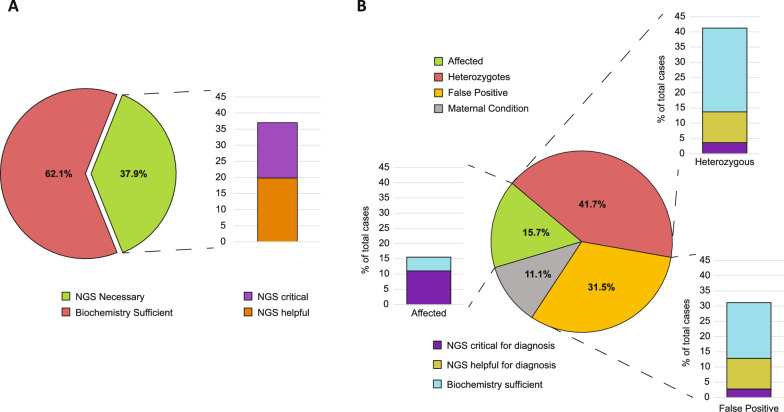
Results: For each patient identified by LC-MS/MS as positive, we performed both the biochemical confirmatory tests and next-generation sequencing (NGS) procedures from the same Dried Blood Spot (DBS). NGS analysis was based on applying Exome Sequencing libraries, limiting the analysis to 105 actionable genes involved in IMDs. This allows overtaking the actual limitations of NBS on DBS, enhancing our capacity to identify variants that can drive a genetic disease. Through this approach, we could reach 100% of cases solved, with 37.9% of cases (41/108) for which the combination of the biochemical and NGS analysis was indispensable for a correct diagnosis. In total, we could identify 17 affected, 34 false positives, 12 individuals referred to us for maternal conditions. In 45 newborns the molecular analysis showed heterozygosity for mutations in one or more of the genes analyzed, with results compatible with the biochemical profile indicative of NBS positivity.
Conclusions: In this study, we validated the performance of the proposed workflow. The advantage of this approach is limiting molecular analysis only to positive newborns and using a restricted panel of 105 genes relevant for the expanded NBS, with a 100% rate of diagnosis and potential reduction of the costs related to NBS procedures and reduced impact on patients and families.
期刊介绍:
Orphanet Journal of Rare Diseases is an open access, peer-reviewed journal that encompasses all aspects of rare diseases and orphan drugs. The journal publishes high-quality reviews on specific rare diseases. In addition, the journal may consider articles on clinical trial outcome reports, either positive or negative, and articles on public health issues in the field of rare diseases and orphan drugs. The journal does not accept case reports.




 京公网安备 11010802042870号
京ICP备2023020795号-1
京公网安备 11010802042870号
京ICP备2023020795号-1

 分享
分享
 求助内容:
求助内容: 应助结果提醒方式:
 扫码关注我们
