{"title":"Monitoring Sleep and Nightly Recovery with Wrist-Worn Wearables: Links to Training Load and Performance Adaptations.","authors":"Olli-Pekka Nuuttila, Daniela Schäfer Olstad, Kaisu Martinmäki, Arja Uusitalo, Heikki Kyröläinen","doi":"10.3390/s25020533","DOIUrl":null,"url":null,"abstract":"<p><p>Previous studies on the effects of intensified training on sleep quality/quantity have been somewhat contradictory. Moreover, recreational athletes often track various sleep metrics, and those metrics' actual connections to training adaptations are unknown. This study explored the effects of intensified training on sleep and nightly recovery along with their associations with training adaptations. A total of 24 participants (10 females) performed a 3-week baseline training period (BL), a 2-week overload period (OL), and a 1-week recovery period (REC), which were followed by test days (T1-T3). The endurance performance was assessed with a 3000 m running test. Throughout all of the periods, the nightly recovery information was monitored with a wrist-worn wearable, including sleep quantity and quality, heart rate (HR) and HR variability (HRV), and proprietary parameters combining several parameters and scaling the results individually. In addition, the perceived strain and muscle soreness were evaluated daily. The 3000 m running performance improved from T1 to T2 (-1.2 ± 1.7%, <i>p</i> = 0.006) and from T1 to T3 (-1.7 ± 1.2%, <i>p</i> = 0.002). The perceived strain and muscle soreness increased (<i>p</i> < 0.001) from the final week of the BL to the final week of the OL, but the subjective sleep quality and nightly recovery metrics remained unchanged. The OL average of the proprietary parameter, autonomic nervous system charge (\"ANS charge\", combining the HR, HRV, and breathing rate), as well as the change in the sleep HR and HRV from the BL to the OL, were associated (<i>p</i> < 0.05) with a change in the 3000 m running time. In conclusion, the subjective recovery metrics were impaired by intensified training, while the sleep and nightly recovery metrics showed no consistent changes. However, there were substantial interindividual differences in nightly recovery, which were also associated with the training adaptations. Therefore, monitoring nightly recovery can help in recognizing individual responses to training and assist in optimizing training prescriptions.</p>","PeriodicalId":21698,"journal":{"name":"Sensors","volume":"25 2","pages":""},"PeriodicalIF":3.5000,"publicationDate":"2025-01-17","publicationTypes":"Journal Article","fieldsOfStudy":null,"isOpenAccess":false,"openAccessPdf":"https://www.ncbi.nlm.nih.gov/pmc/articles/PMC11768492/pdf/","citationCount":"0","resultStr":null,"platform":"Semanticscholar","paperid":null,"PeriodicalName":"Sensors","FirstCategoryId":"103","ListUrlMain":"https://doi.org/10.3390/s25020533","RegionNum":3,"RegionCategory":"综合性期刊","ArticlePicture":[],"TitleCN":null,"AbstractTextCN":null,"PMCID":null,"EPubDate":"","PubModel":"","JCR":"Q2","JCRName":"CHEMISTRY, ANALYTICAL","Score":null,"Total":0}
引用次数: 0
Abstract
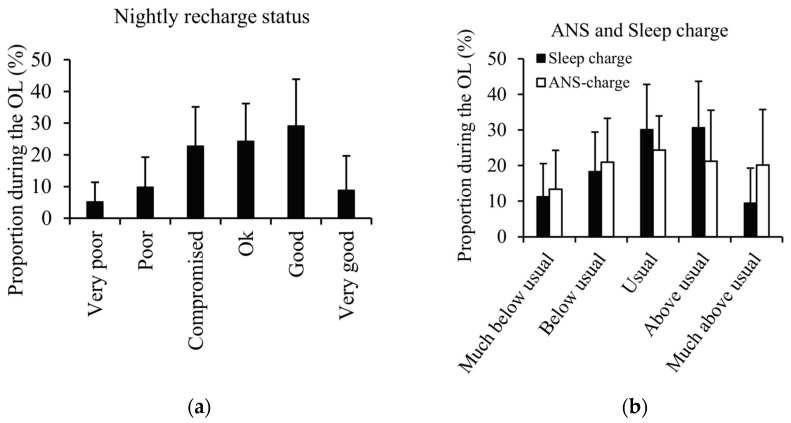
Previous studies on the effects of intensified training on sleep quality/quantity have been somewhat contradictory. Moreover, recreational athletes often track various sleep metrics, and those metrics' actual connections to training adaptations are unknown. This study explored the effects of intensified training on sleep and nightly recovery along with their associations with training adaptations. A total of 24 participants (10 females) performed a 3-week baseline training period (BL), a 2-week overload period (OL), and a 1-week recovery period (REC), which were followed by test days (T1-T3). The endurance performance was assessed with a 3000 m running test. Throughout all of the periods, the nightly recovery information was monitored with a wrist-worn wearable, including sleep quantity and quality, heart rate (HR) and HR variability (HRV), and proprietary parameters combining several parameters and scaling the results individually. In addition, the perceived strain and muscle soreness were evaluated daily. The 3000 m running performance improved from T1 to T2 (-1.2 ± 1.7%, p = 0.006) and from T1 to T3 (-1.7 ± 1.2%, p = 0.002). The perceived strain and muscle soreness increased (p < 0.001) from the final week of the BL to the final week of the OL, but the subjective sleep quality and nightly recovery metrics remained unchanged. The OL average of the proprietary parameter, autonomic nervous system charge ("ANS charge", combining the HR, HRV, and breathing rate), as well as the change in the sleep HR and HRV from the BL to the OL, were associated (p < 0.05) with a change in the 3000 m running time. In conclusion, the subjective recovery metrics were impaired by intensified training, while the sleep and nightly recovery metrics showed no consistent changes. However, there were substantial interindividual differences in nightly recovery, which were also associated with the training adaptations. Therefore, monitoring nightly recovery can help in recognizing individual responses to training and assist in optimizing training prescriptions.
期刊介绍:
Sensors (ISSN 1424-8220) provides an advanced forum for the science and technology of sensors and biosensors. It publishes reviews (including comprehensive reviews on the complete sensors products), regular research papers and short notes. Our aim is to encourage scientists to publish their experimental and theoretical results in as much detail as possible. There is no restriction on the length of the papers. The full experimental details must be provided so that the results can be reproduced.





 京公网安备 11010802042870号
京ICP备2023020795号-1
京公网安备 11010802042870号
京ICP备2023020795号-1

 分享
分享
 求助内容:
求助内容: 应助结果提醒方式:
 扫码关注我们
