Yuanming Leng, Huitong Ding, Ting Fang Alvin Ang, Rhoda Au, P Murali Doraiswamy, Chunyu Liu
{"title":"Identifying proteomic prognostic markers for Alzheimer's disease with survival machine learning: The Framingham Heart Study.","authors":"Yuanming Leng, Huitong Ding, Ting Fang Alvin Ang, Rhoda Au, P Murali Doraiswamy, Chunyu Liu","doi":"10.1016/j.tjpad.2024.100021","DOIUrl":null,"url":null,"abstract":"<p><strong>Background: </strong>Protein abundance levels, sensitive to both physiological changes and external interventions, are useful for assessing the Alzheimer's disease (AD) risk and treatment efficacy. However, identifying proteomic prognostic markers for AD is challenging by their high dimensionality and inherent correlations.</p><p><strong>Methods: </strong>Our study analyzed 1128 plasma proteins, measured by the SOMAscan platform, from 858 participants 55 years and older (mean age 63 years, 52.9 % women) of the Framingham Heart Study (FHS) Offspring cohort. We conducted regression analysis and machine learning models, including LASSO-based Cox proportional hazard regression model (LASSO) and generalized boosted regression model (GBM), to identify protein prognostic markers. These markers were used to construct a weighted proteomic composite score, the AD prediction performance of which was assessed using time-dependent area under the curve (AUC). The association between the composite score and memory domain was examined in 339 (of the 858) participants with available memory scores, and in a separate group of 430 participants younger than 55 years (mean age 46, 56.7 % women).</p><p><strong>Results: </strong>Over a mean follow-up of 20 years, 132 (15.4 %) participants developed AD. After adjusting for baseline age, sex, education, and APOE ε4 + status, regression models identified 309 proteins (P ≤ 0.2). After applying machine learning methods, nine of these proteins were selected to develop a composite score. This score improved AD prediction beyond the factors of age, sex, education, and APOE ε4 + status across 15-25 years of follow-up, achieving its peak AUC of 0.84 in the LASSO model at the 22-year follow-up. It also showed a consistent negative association with memory scores in the 339 participants (beta = -0.061, P = 0.046), 430 participants (beta = -0.060, P = 0.018), and the pooled 769 samples (beta = -0.058, P = 0.003).</p><p><strong>Conclusion: </strong>These findings highlight the utility of machine learning method in identifying proteomic markers in improving AD prediction and emphasize the complex pathology of AD. The composite score may aid early AD detection and efficacy monitoring, warranting further validation in diverse populations.</p>","PeriodicalId":22711,"journal":{"name":"The Journal of Prevention of Alzheimer's Disease","volume":"12 2","pages":"100021"},"PeriodicalIF":7.8000,"publicationDate":"2025-02-01","publicationTypes":"Journal Article","fieldsOfStudy":null,"isOpenAccess":false,"openAccessPdf":"https://www.ncbi.nlm.nih.gov/pmc/articles/PMC12184055/pdf/","citationCount":"0","resultStr":null,"platform":"Semanticscholar","paperid":null,"PeriodicalName":"The Journal of Prevention of Alzheimer's Disease","FirstCategoryId":"1085","ListUrlMain":"https://doi.org/10.1016/j.tjpad.2024.100021","RegionNum":0,"RegionCategory":null,"ArticlePicture":[],"TitleCN":null,"AbstractTextCN":null,"PMCID":null,"EPubDate":"2025/1/1 0:00:00","PubModel":"Epub","JCR":"Q2","JCRName":"BUSINESS","Score":null,"Total":0}
引用次数: 0
Abstract
Background: Protein abundance levels, sensitive to both physiological changes and external interventions, are useful for assessing the Alzheimer's disease (AD) risk and treatment efficacy. However, identifying proteomic prognostic markers for AD is challenging by their high dimensionality and inherent correlations.
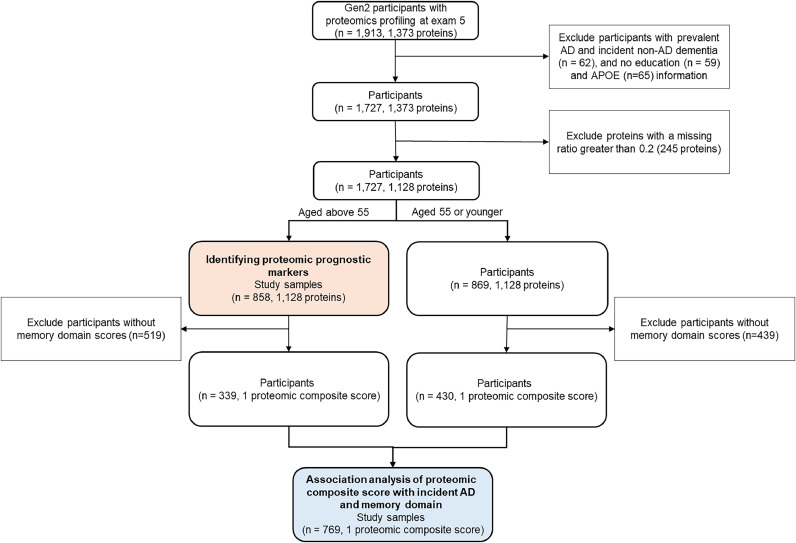
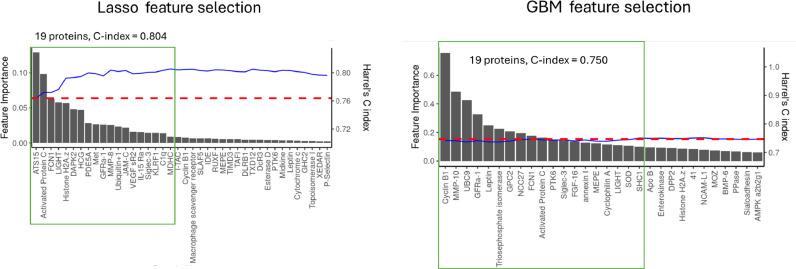
Methods: Our study analyzed 1128 plasma proteins, measured by the SOMAscan platform, from 858 participants 55 years and older (mean age 63 years, 52.9 % women) of the Framingham Heart Study (FHS) Offspring cohort. We conducted regression analysis and machine learning models, including LASSO-based Cox proportional hazard regression model (LASSO) and generalized boosted regression model (GBM), to identify protein prognostic markers. These markers were used to construct a weighted proteomic composite score, the AD prediction performance of which was assessed using time-dependent area under the curve (AUC). The association between the composite score and memory domain was examined in 339 (of the 858) participants with available memory scores, and in a separate group of 430 participants younger than 55 years (mean age 46, 56.7 % women).
Results: Over a mean follow-up of 20 years, 132 (15.4 %) participants developed AD. After adjusting for baseline age, sex, education, and APOE ε4 + status, regression models identified 309 proteins (P ≤ 0.2). After applying machine learning methods, nine of these proteins were selected to develop a composite score. This score improved AD prediction beyond the factors of age, sex, education, and APOE ε4 + status across 15-25 years of follow-up, achieving its peak AUC of 0.84 in the LASSO model at the 22-year follow-up. It also showed a consistent negative association with memory scores in the 339 participants (beta = -0.061, P = 0.046), 430 participants (beta = -0.060, P = 0.018), and the pooled 769 samples (beta = -0.058, P = 0.003).
Conclusion: These findings highlight the utility of machine learning method in identifying proteomic markers in improving AD prediction and emphasize the complex pathology of AD. The composite score may aid early AD detection and efficacy monitoring, warranting further validation in diverse populations.
期刊介绍:
The JPAD Journal of Prevention of Alzheimer’Disease will publish reviews, original research articles and short reports to improve our knowledge in the field of Alzheimer prevention including: neurosciences, biomarkers, imaging, epidemiology, public health, physical cognitive exercise, nutrition, risk and protective factors, drug development, trials design, and heath economic outcomes.JPAD will publish also the meeting abstracts from Clinical Trial on Alzheimer Disease (CTAD) and will be distributed both in paper and online version worldwide.We hope that JPAD with your contribution will play a role in the development of Alzheimer prevention.



 京公网安备 11010802042870号
京ICP备2023020795号-1
京公网安备 11010802042870号
京ICP备2023020795号-1

 分享
分享
 求助内容:
求助内容: 应助结果提醒方式:
 扫码关注我们
