Zixuan Xue, Ye Yan, Huiying Chen, Hai Mao, Tianwu Ma, Guoliang Wang, Hongxian Zhang, Lulin Ma, Jianfei Ye, Kai Hong, Fan Zhang, Shudong Zhang
{"title":"Risk factors for lymphatic leakage following radical cystectomy and pelvic lymph node dissection in patients with muscle-invasive bladder cancer.","authors":"Zixuan Xue, Ye Yan, Huiying Chen, Hai Mao, Tianwu Ma, Guoliang Wang, Hongxian Zhang, Lulin Ma, Jianfei Ye, Kai Hong, Fan Zhang, Shudong Zhang","doi":"10.1186/s12957-025-03683-8","DOIUrl":null,"url":null,"abstract":"<p><strong>Background: </strong>Lymphatic leakage is a common complication after radical cystectomy and pelvic lymph node dissection (PLND) for muscle-invasive bladder cancer (MIBC).This study aimed to investigate the risk factors contributing to postoperative lymphatic leakage in patients with MIBC.</p><p><strong>Materials and methods: </strong>A total of 534 patients undergoing radical cystectomy and PLND were enrolled in the retrospective study at Peking University Third Hospital from January 2010 to July 2023. Patients were categorized into lymphatic leakage(n = 254)and non-leakage groups (n = 280) and compared demographic, perioperativ and pathologic factors. Multivariate logistic regression was applied to identify risk factors for lymphatic leakage. Spearman correlation was used to analyze the relationship between lymph leakage ratio and risk factors.</p><p><strong>Results: </strong>Patients with lymphatic leakage had significantly higher rates of receiving extended PLND (19.7% vs. 11.4%, p = 0.008), higher total number of dissected lymph nodes (median 11 vs. 8, p < 0.001), longer hospital stays (median 13 vs. 11 days, p < 0.001), higher postoperative hypoalbuminemia rate (56.7% vs. 36.4%, p < 0.001) and higher fever rate (14.2% vs. 8.6%, p = 0.04) compared to the non-leakage group. On multivariate analysis, higher number of dissected lymph nodes (OR 3.278, 95% CI 1.135-9.471, p = 0.028) was found to be a independent risk factor for lymphatic leakage. Additionally, a positive correlation was observed between the numbers of dissected lymph nodes and lymphatic leakage rate (R = 0.456, p = 0.013).</p><p><strong>Conclusions: </strong>The increased number of dissected lymph nodes is associated with a heightened risk of lymphatic leakage following radical cystectomy for MIBC.</p>","PeriodicalId":23856,"journal":{"name":"World Journal of Surgical Oncology","volume":"23 1","pages":"23"},"PeriodicalIF":2.5000,"publicationDate":"2025-01-25","publicationTypes":"Journal Article","fieldsOfStudy":null,"isOpenAccess":false,"openAccessPdf":"https://www.ncbi.nlm.nih.gov/pmc/articles/PMC11763139/pdf/","citationCount":"0","resultStr":null,"platform":"Semanticscholar","paperid":null,"PeriodicalName":"World Journal of Surgical Oncology","FirstCategoryId":"3","ListUrlMain":"https://doi.org/10.1186/s12957-025-03683-8","RegionNum":3,"RegionCategory":"医学","ArticlePicture":[],"TitleCN":null,"AbstractTextCN":null,"PMCID":null,"EPubDate":"","PubModel":"","JCR":"Q3","JCRName":"ONCOLOGY","Score":null,"Total":0}
引用次数: 0
Abstract
Background: Lymphatic leakage is a common complication after radical cystectomy and pelvic lymph node dissection (PLND) for muscle-invasive bladder cancer (MIBC).This study aimed to investigate the risk factors contributing to postoperative lymphatic leakage in patients with MIBC.
Materials and methods: A total of 534 patients undergoing radical cystectomy and PLND were enrolled in the retrospective study at Peking University Third Hospital from January 2010 to July 2023. Patients were categorized into lymphatic leakage(n = 254)and non-leakage groups (n = 280) and compared demographic, perioperativ and pathologic factors. Multivariate logistic regression was applied to identify risk factors for lymphatic leakage. Spearman correlation was used to analyze the relationship between lymph leakage ratio and risk factors.
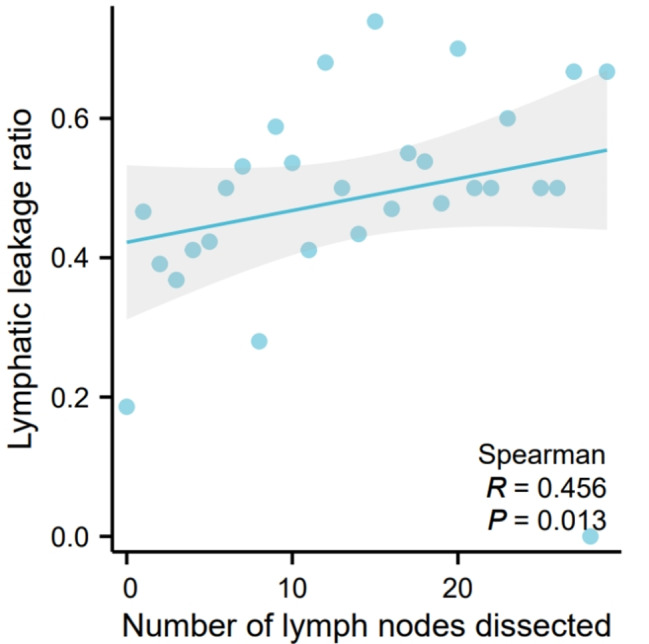
Results: Patients with lymphatic leakage had significantly higher rates of receiving extended PLND (19.7% vs. 11.4%, p = 0.008), higher total number of dissected lymph nodes (median 11 vs. 8, p < 0.001), longer hospital stays (median 13 vs. 11 days, p < 0.001), higher postoperative hypoalbuminemia rate (56.7% vs. 36.4%, p < 0.001) and higher fever rate (14.2% vs. 8.6%, p = 0.04) compared to the non-leakage group. On multivariate analysis, higher number of dissected lymph nodes (OR 3.278, 95% CI 1.135-9.471, p = 0.028) was found to be a independent risk factor for lymphatic leakage. Additionally, a positive correlation was observed between the numbers of dissected lymph nodes and lymphatic leakage rate (R = 0.456, p = 0.013).
Conclusions: The increased number of dissected lymph nodes is associated with a heightened risk of lymphatic leakage following radical cystectomy for MIBC.
背景:淋巴渗漏是肌肉浸润性膀胱癌根治性膀胱切除术和盆腔淋巴结清扫术(PLND)后常见的并发症。本研究旨在探讨导致MIBC患者术后淋巴渗漏的危险因素。材料与方法:回顾性研究2010年1月至2023年7月北京大学第三医院534例行根治性膀胱切除术和PLND的患者。将患者分为淋巴渗漏组(254例)和非淋巴渗漏组(280例),比较人口统计学、围手术期和病理因素。采用多因素logistic回归分析确定淋巴渗漏的危险因素。采用Spearman相关分析淋巴漏率与危险因素的关系。结果:淋巴渗漏患者接受延长PLND的比例明显更高(19.7% vs. 11.4%, p = 0.008),清扫淋巴结总数更高(中位数11 vs. 8, p)。结论:清扫淋巴结数量的增加与MIBC根治性膀胱切除术后淋巴渗漏的风险增加有关。
期刊介绍:
World Journal of Surgical Oncology publishes articles related to surgical oncology and its allied subjects, such as epidemiology, cancer research, biomarkers, prevention, pathology, radiology, cancer treatment, clinical trials, multimodality treatment and molecular biology. Emphasis is placed on original research articles. The journal also publishes significant clinical case reports, as well as balanced and timely reviews on selected topics.
Oncology is a multidisciplinary super-speciality of which surgical oncology forms an integral component, especially with solid tumors. Surgical oncologists around the world are involved in research extending from detecting the mechanisms underlying the causation of cancer, to its treatment and prevention. The role of a surgical oncologist extends across the whole continuum of care. With continued developments in diagnosis and treatment, the role of a surgical oncologist is ever-changing. Hence, World Journal of Surgical Oncology aims to keep readers abreast with latest developments that will ultimately influence the work of surgical oncologists.







 京公网安备 11010802042870号
京ICP备2023020795号-1
京公网安备 11010802042870号
京ICP备2023020795号-1

 分享
分享
 求助内容:
求助内容: 应助结果提醒方式:
 扫码关注我们
