Zhipeng Zheng , Wenhui Ji , Xiao Wang , Xueting Wang , Simin Dai , Zhaowen Zhang , Yinghua Zhang , Xiaoyan Wang , Shen Cao , Min Chen , Bing Xie , Jun Feng , Dong Wu
{"title":"Household waste-specific ambient air shows greater inhalable antimicrobial resistance risks in densely populated communities","authors":"Zhipeng Zheng , Wenhui Ji , Xiao Wang , Xueting Wang , Simin Dai , Zhaowen Zhang , Yinghua Zhang , Xiaoyan Wang , Shen Cao , Min Chen , Bing Xie , Jun Feng , Dong Wu","doi":"10.1016/j.wasman.2025.01.030","DOIUrl":null,"url":null,"abstract":"<div><div>Household waste is a hotspot of antibiotic resistance, which can be readily emitted to the ambient airborne inhalable particulate matters (PM<sub>10</sub>) during the day-long storage in communities. Nevertheless, whether these waste-specific inhalable antibiotic resistance genes (ARGs) are associated with pathogenic bacteria or pose hazards to local residents have yet to be explored. By high-throughput metagenomic sequencing and culture-based antibiotic resistance validation, we analyzed 108 airborne PM<sub>10</sub> and nearby environmental samples collected across different types of residential communities in Shanghai, the most populous city in China. Compared to the cold-dry period, the warm-humid season had significantly larger PM<sub>10</sub>-associated antibiotic resistomes in all types of residential communities (<em>T</em>-test, <em>P</em> < 0.001), most of airborne ARGs in which were estimatedly originated from disposed household waste (∼ 30 %). In addition, the airborne bacteria were assembled in a deterministic approach (iCAMP, <em>P</em> < 0.01), where the waste-specific bacteria taxa including <em>Acinetobacter</em>, <em>Pseudomonas</em>, <em>Rhodococcus</em>, and <em>Kocuria</em> had the predominant niches in the airborne microbial assemblages. Notably, these waste-sourced bacteria were also identified as the primary airborne hosts of ARGs encoding the aminoglycoside resistances. Among them, some antibiotic resistant human pathogens, such as <em>Pseudomonas aeruginosa</em> and <em>Acinetobacter baumannii</em>, not only exhibited higher ARG horizontal gene transfer (HGT) potential across the microbial assemblages, but also imposed direct infection risks on the local residents by 2 min inhalation exposure per day. When the daily exposure duration increased to 11 min, the infection-induced illness burden became unignorably high, especially in densely populated urban communities, being twofold greater than rural areas.</div></div>","PeriodicalId":23969,"journal":{"name":"Waste management","volume":"194 ","pages":"Pages 309-317"},"PeriodicalIF":7.1000,"publicationDate":"2025-02-15","publicationTypes":"Journal Article","fieldsOfStudy":null,"isOpenAccess":false,"openAccessPdf":"","citationCount":"0","resultStr":null,"platform":"Semanticscholar","paperid":null,"PeriodicalName":"Waste management","FirstCategoryId":"93","ListUrlMain":"https://www.sciencedirect.com/science/article/pii/S0956053X25000303","RegionNum":2,"RegionCategory":"环境科学与生态学","ArticlePicture":[],"TitleCN":null,"AbstractTextCN":null,"PMCID":null,"EPubDate":"2025/1/24 0:00:00","PubModel":"Epub","JCR":"Q1","JCRName":"ENGINEERING, ENVIRONMENTAL","Score":null,"Total":0}
引用次数: 0
Abstract
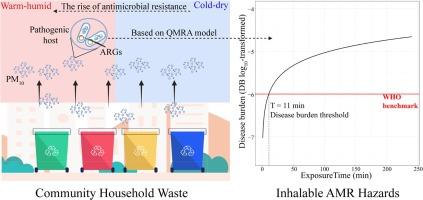
Household waste is a hotspot of antibiotic resistance, which can be readily emitted to the ambient airborne inhalable particulate matters (PM10) during the day-long storage in communities. Nevertheless, whether these waste-specific inhalable antibiotic resistance genes (ARGs) are associated with pathogenic bacteria or pose hazards to local residents have yet to be explored. By high-throughput metagenomic sequencing and culture-based antibiotic resistance validation, we analyzed 108 airborne PM10 and nearby environmental samples collected across different types of residential communities in Shanghai, the most populous city in China. Compared to the cold-dry period, the warm-humid season had significantly larger PM10-associated antibiotic resistomes in all types of residential communities (T-test, P < 0.001), most of airborne ARGs in which were estimatedly originated from disposed household waste (∼ 30 %). In addition, the airborne bacteria were assembled in a deterministic approach (iCAMP, P < 0.01), where the waste-specific bacteria taxa including Acinetobacter, Pseudomonas, Rhodococcus, and Kocuria had the predominant niches in the airborne microbial assemblages. Notably, these waste-sourced bacteria were also identified as the primary airborne hosts of ARGs encoding the aminoglycoside resistances. Among them, some antibiotic resistant human pathogens, such as Pseudomonas aeruginosa and Acinetobacter baumannii, not only exhibited higher ARG horizontal gene transfer (HGT) potential across the microbial assemblages, but also imposed direct infection risks on the local residents by 2 min inhalation exposure per day. When the daily exposure duration increased to 11 min, the infection-induced illness burden became unignorably high, especially in densely populated urban communities, being twofold greater than rural areas.
生活垃圾是抗生素耐药性的热点,在社区储存一天后,容易向环境中排放可吸入颗粒物(PM10)。然而,这些废物特异性可吸入抗生素耐药基因(ARGs)是否与致病菌有关或对当地居民构成危害还有待探讨。通过高通量宏基因组测序和基于培养的抗生素耐药性验证,我们分析了在中国人口最多的城市上海不同类型住宅社区收集的108个空气中PM10和附近环境样本。与冷干季节相比,暖湿季节在所有类型的居住社区中都有更大的pm10相关抗生素抗性组(t检验,P < 0.001),其中大多数空气传播的ARGs估计来自处置的生活垃圾(约30%)。此外,空气中的细菌以确定性的方式组装(iCAMP, P
期刊介绍:
Waste Management is devoted to the presentation and discussion of information on solid wastes,it covers the entire lifecycle of solid. wastes.
Scope:
Addresses solid wastes in both industrialized and economically developing countries
Covers various types of solid wastes, including:
Municipal (e.g., residential, institutional, commercial, light industrial)
Agricultural
Special (e.g., C and D, healthcare, household hazardous wastes, sewage sludge)




 京公网安备 11010802042870号
京ICP备2023020795号-1
京公网安备 11010802042870号
京ICP备2023020795号-1

 分享
分享
 求助内容:
求助内容: 应助结果提醒方式:
 扫码关注我们
