Cai-Xia Li , Wen-Wu Liu , Shi-Ji Da , Ling-Bin Kong
{"title":"Improved free iodine capture by light-driven carbon-halogen bond cleavage in perovskite solar cells with dynamic self-healing ability","authors":"Cai-Xia Li , Wen-Wu Liu , Shi-Ji Da , Ling-Bin Kong","doi":"10.1016/j.cej.2025.159767","DOIUrl":null,"url":null,"abstract":"<div><div>Carbon-based hole layer-free perovskite solar cells (PSCs) have excellent performance in work function matching, hydrophobicity, electrical conductivity, and relatively low cost, which is a competitive alternative. However, internal defects dramatically affect the stability of PSCs. Especially the iodine vacancy defect of Pb-I terminal has a lower formation energy, which is easier to form and exist stably. In this work, a few additives of p-Bromoaniline (BrC<sub>6</sub>H<sub>4</sub>NH<sub>2</sub>) were introduced to dynamically self-healing defects while capturing the migrating I<sup>−</sup> ions in perovskite. Under outdoor illumination, most of the <em>C-Br</em> bonds in p-Bromoaniline are activated and broken, resulting in <em>Br<sup>−</sup></em> ions and aniline cations (C<sub>6</sub>H<sub>4</sub>NH<sub>2</sub><sup>+</sup>). As <em>Br<sup>−</sup></em> ions with a smaller radius preferentially adsorb and passivate the iodine vacancy at the Pb-I end. Additionally, the C<sub>6</sub>H<sub>4</sub>NH<sub>2</sub><sup>+</sup> cation captured I<sup>−</sup> ions migrating from the perovskite, preventing further chemical reactions of the halogen ions when exposed to light, thus improving the stability of the PSCs through a dual protection mechanism. Under light/dark conditions, by orchestrating the precise cleavage and subsequent reformation of <em>C-X (X = Br, I)</em> bonds, <em>X<sup>−</sup></em> ions can undergo repeated cycles to facilitate a dynamic, cyclic self-repair mechanism of iodine vacancy defects. The result revealed that photoelectric conversion efficiency (PCE) of p-Bromoaniline-modified PSCs increased from 13.46 % to 17.18 %. The unencapsulated PSCs maintained a steady-state output power of 83.7 % under AM 1.5 illumination for 40 days at room temperature and RH 60 %.</div></div>","PeriodicalId":270,"journal":{"name":"Chemical Engineering Journal","volume":"506 ","pages":"Article 159767"},"PeriodicalIF":13.2000,"publicationDate":"2025-01-15","publicationTypes":"Journal Article","fieldsOfStudy":null,"isOpenAccess":false,"openAccessPdf":"","citationCount":"0","resultStr":null,"platform":"Semanticscholar","paperid":null,"PeriodicalName":"Chemical Engineering Journal","FirstCategoryId":"5","ListUrlMain":"https://www.sciencedirect.com/science/article/pii/S1385894725005662","RegionNum":1,"RegionCategory":"工程技术","ArticlePicture":[],"TitleCN":null,"AbstractTextCN":null,"PMCID":null,"EPubDate":"2025/1/27 0:00:00","PubModel":"Epub","JCR":"Q1","JCRName":"ENGINEERING, CHEMICAL","Score":null,"Total":0}
引用次数: 0
Abstract
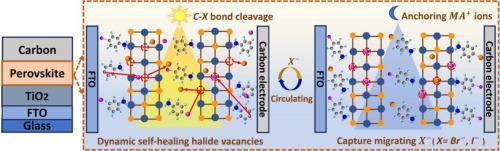
Carbon-based hole layer-free perovskite solar cells (PSCs) have excellent performance in work function matching, hydrophobicity, electrical conductivity, and relatively low cost, which is a competitive alternative. However, internal defects dramatically affect the stability of PSCs. Especially the iodine vacancy defect of Pb-I terminal has a lower formation energy, which is easier to form and exist stably. In this work, a few additives of p-Bromoaniline (BrC6H4NH2) were introduced to dynamically self-healing defects while capturing the migrating I− ions in perovskite. Under outdoor illumination, most of the C-Br bonds in p-Bromoaniline are activated and broken, resulting in Br− ions and aniline cations (C6H4NH2+). As Br− ions with a smaller radius preferentially adsorb and passivate the iodine vacancy at the Pb-I end. Additionally, the C6H4NH2+ cation captured I− ions migrating from the perovskite, preventing further chemical reactions of the halogen ions when exposed to light, thus improving the stability of the PSCs through a dual protection mechanism. Under light/dark conditions, by orchestrating the precise cleavage and subsequent reformation of C-X (X = Br, I) bonds, X− ions can undergo repeated cycles to facilitate a dynamic, cyclic self-repair mechanism of iodine vacancy defects. The result revealed that photoelectric conversion efficiency (PCE) of p-Bromoaniline-modified PSCs increased from 13.46 % to 17.18 %. The unencapsulated PSCs maintained a steady-state output power of 83.7 % under AM 1.5 illumination for 40 days at room temperature and RH 60 %.
期刊介绍:
The Chemical Engineering Journal is an international research journal that invites contributions of original and novel fundamental research. It aims to provide an international platform for presenting original fundamental research, interpretative reviews, and discussions on new developments in chemical engineering. The journal welcomes papers that describe novel theory and its practical application, as well as those that demonstrate the transfer of techniques from other disciplines. It also welcomes reports on carefully conducted experimental work that is soundly interpreted. The main focus of the journal is on original and rigorous research results that have broad significance. The Catalysis section within the Chemical Engineering Journal focuses specifically on Experimental and Theoretical studies in the fields of heterogeneous catalysis, molecular catalysis, and biocatalysis. These studies have industrial impact on various sectors such as chemicals, energy, materials, foods, healthcare, and environmental protection.




 京公网安备 11010802042870号
京ICP备2023020795号-1
京公网安备 11010802042870号
京ICP备2023020795号-1

 分享
分享
 求助内容:
求助内容: 应助结果提醒方式:
 扫码关注我们
