Robert Boothe, Julian Oppelt, Alicja Franke, Jamonica L. Moore, Andrea Squarcina, Achim Zahl, Laura Senft, Ina Kellner, Akudo L. Awalah, Alisabeth Bradford, Segun V. Obisesan, Dean D. Schwartz, Ivana Ivanović-Burmazović and Christian R. Goldsmith
{"title":"Nickel(ii) complexes with covalently attached quinols rely on ligand-derived redox couples to catalyze superoxide dismutation†","authors":"Robert Boothe, Julian Oppelt, Alicja Franke, Jamonica L. Moore, Andrea Squarcina, Achim Zahl, Laura Senft, Ina Kellner, Akudo L. Awalah, Alisabeth Bradford, Segun V. Obisesan, Dean D. Schwartz, Ivana Ivanović-Burmazović and Christian R. Goldsmith","doi":"10.1039/D4DT03331K","DOIUrl":null,"url":null,"abstract":"<p >Although nickel is found in the active sites of a class of superoxide dismutase (SOD), nickel complexes with non-peptidic ligands normally do not catalyze superoxide degradation, and none has displayed activity comparable to those of the best manganese-containing SOD mimics. Here, we find that nickel complexes with polydentate quinol-containing ligands can exhibit catalytic activity comparable to those of the most efficient manganese-containing SOD mimics. The nickel complexes retain a significant portion of their activity in phosphate buffer and under operando conditions and rely on ligand-centered redox processes for catalysis. Although nickel SODs are known to cycle through Ni(<small>II</small>) and Ni(<small>III</small>) species during catalysis, cryo-mass spectrometry studies indicate that the nickel atoms in our catalysts remain in the +2 oxidation state throughout SOD mimicry.</p>","PeriodicalId":71,"journal":{"name":"Dalton Transactions","volume":" 9","pages":" 3733-3749"},"PeriodicalIF":3.3000,"publicationDate":"2025-01-27","publicationTypes":"Journal Article","fieldsOfStudy":null,"isOpenAccess":false,"openAccessPdf":"","citationCount":"0","resultStr":null,"platform":"Semanticscholar","paperid":null,"PeriodicalName":"Dalton Transactions","FirstCategoryId":"92","ListUrlMain":"https://pubs.rsc.org/en/content/articlelanding/2025/dt/d4dt03331k","RegionNum":3,"RegionCategory":"化学","ArticlePicture":[],"TitleCN":null,"AbstractTextCN":null,"PMCID":null,"EPubDate":"","PubModel":"","JCR":"Q2","JCRName":"CHEMISTRY, INORGANIC & NUCLEAR","Score":null,"Total":0}
引用次数: 0
Abstract
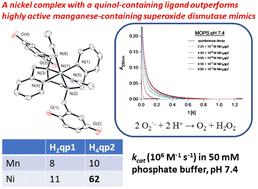
Although nickel is found in the active sites of a class of superoxide dismutase (SOD), nickel complexes with non-peptidic ligands normally do not catalyze superoxide degradation, and none has displayed activity comparable to those of the best manganese-containing SOD mimics. Here, we find that nickel complexes with polydentate quinol-containing ligands can exhibit catalytic activity comparable to those of the most efficient manganese-containing SOD mimics. The nickel complexes retain a significant portion of their activity in phosphate buffer and under operando conditions and rely on ligand-centered redox processes for catalysis. Although nickel SODs are known to cycle through Ni(II) and Ni(III) species during catalysis, cryo-mass spectrometry studies indicate that the nickel atoms in our catalysts remain in the +2 oxidation state throughout SOD mimicry.
期刊介绍:
Dalton Transactions is a journal for all areas of inorganic chemistry, which encompasses the organometallic, bioinorganic and materials chemistry of the elements, with applications including synthesis, catalysis, energy conversion/storage, electrical devices and medicine. Dalton Transactions welcomes high-quality, original submissions in all of these areas and more, where the advancement of knowledge in inorganic chemistry is significant.




 京公网安备 11010802042870号
京ICP备2023020795号-1
京公网安备 11010802042870号
京ICP备2023020795号-1

 分享
分享
 求助内容:
求助内容: 应助结果提醒方式:
 扫码关注我们
