{"title":"Neuroregulation during Bone Formation and Regeneration: Mechanisms and Strategies","authors":"Xiangrong Zhao, Meilin Yao, Yuyi Wang, Cong Feng, Yuhan Yang, Luoqiang Tian, Chongyun Bao, Xiangfeng Li, Xiangdong Zhu, Xingdong Zhang","doi":"10.1021/acsami.4c16786","DOIUrl":null,"url":null,"abstract":"The skeleton is highly innervated by numerous nerve fibers. These nerve fibers, in addition to transmitting information within the bone and mediating bone sensations, play a crucial role in regulating bone tissue formation and regeneration. Traditional bone tissue engineering (BTE) often fails to achieve satisfactory outcomes when dealing with large-scale bone defects, which is frequently related to the lack of effective reconstruction of the neurovascular network. In recent years, increasing research has revealed the critical role of nerves in bone metabolism. Nerve fibers regulate bone cells through neurotransmitters, neuropeptides, and peripheral glial cells. Furthermore, nerves also coordinate with the vascular and immune systems to jointly construct a microenvironment favorable for bone regeneration. As a signaling driver of bone formation, neuroregulation spans the entire process of bone physiological activities from the embryonic formation to postmaturity remodeling and repair. However, there is currently a lack of comprehensive summaries of these regulatory mechanisms. Therefore, this review sketches out the function of nerves during bone formation and regeneration. Then, we elaborate on the mechanisms of neurovascular coupling and neuromodulation of bone immunity. Finally, we discuss several novel strategies for neuro-bone tissue engineering (NBTE) based on neuroregulation of bone, focusing on the coordinated regeneration of nerve and bone tissue.","PeriodicalId":5,"journal":{"name":"ACS Applied Materials & Interfaces","volume":"4 1","pages":""},"PeriodicalIF":8.2000,"publicationDate":"2025-01-27","publicationTypes":"Journal Article","fieldsOfStudy":null,"isOpenAccess":false,"openAccessPdf":"","citationCount":"0","resultStr":null,"platform":"Semanticscholar","paperid":null,"PeriodicalName":"ACS Applied Materials & Interfaces","FirstCategoryId":"88","ListUrlMain":"https://doi.org/10.1021/acsami.4c16786","RegionNum":2,"RegionCategory":"材料科学","ArticlePicture":[],"TitleCN":null,"AbstractTextCN":null,"PMCID":null,"EPubDate":"","PubModel":"","JCR":"Q1","JCRName":"MATERIALS SCIENCE, MULTIDISCIPLINARY","Score":null,"Total":0}
引用次数: 0
Abstract
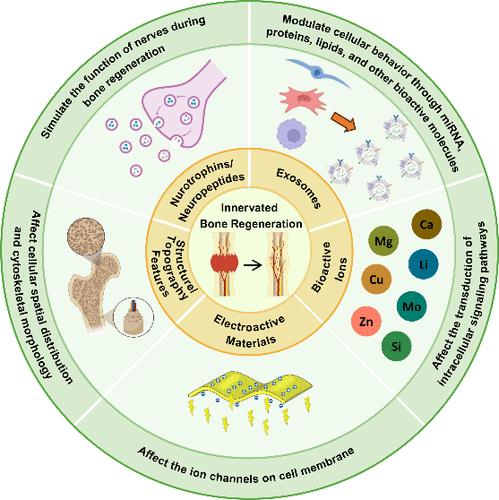
The skeleton is highly innervated by numerous nerve fibers. These nerve fibers, in addition to transmitting information within the bone and mediating bone sensations, play a crucial role in regulating bone tissue formation and regeneration. Traditional bone tissue engineering (BTE) often fails to achieve satisfactory outcomes when dealing with large-scale bone defects, which is frequently related to the lack of effective reconstruction of the neurovascular network. In recent years, increasing research has revealed the critical role of nerves in bone metabolism. Nerve fibers regulate bone cells through neurotransmitters, neuropeptides, and peripheral glial cells. Furthermore, nerves also coordinate with the vascular and immune systems to jointly construct a microenvironment favorable for bone regeneration. As a signaling driver of bone formation, neuroregulation spans the entire process of bone physiological activities from the embryonic formation to postmaturity remodeling and repair. However, there is currently a lack of comprehensive summaries of these regulatory mechanisms. Therefore, this review sketches out the function of nerves during bone formation and regeneration. Then, we elaborate on the mechanisms of neurovascular coupling and neuromodulation of bone immunity. Finally, we discuss several novel strategies for neuro-bone tissue engineering (NBTE) based on neuroregulation of bone, focusing on the coordinated regeneration of nerve and bone tissue.
期刊介绍:
ACS Applied Materials & Interfaces is a leading interdisciplinary journal that brings together chemists, engineers, physicists, and biologists to explore the development and utilization of newly-discovered materials and interfacial processes for specific applications. Our journal has experienced remarkable growth since its establishment in 2009, both in terms of the number of articles published and the impact of the research showcased. We are proud to foster a truly global community, with the majority of published articles originating from outside the United States, reflecting the rapid growth of applied research worldwide.



 京公网安备 11010802042870号
京ICP备2023020795号-1
京公网安备 11010802042870号
京ICP备2023020795号-1

 分享
分享
 求助内容:
求助内容: 应助结果提醒方式:
 扫码关注我们
