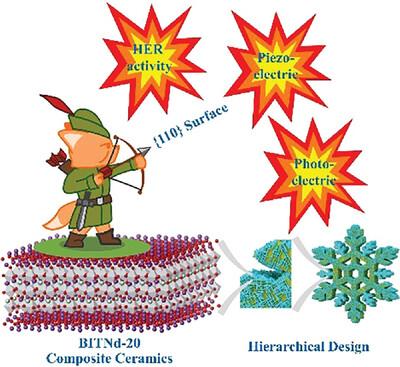
Bismuth-layered ferroelectric nanomaterials exhibit great potential for piezo-photocatalysis. However, a major challenge lies in the difficulty of recovering the catalytic powders, raising concerns regarding secondary pollution of water. In this work, a novel hierarchical porous ferroelectric ceramic containing {110} surface-exposed Bi3.15Nd0.85Ti3O12 (BIT-Nd) nanosheet arrays is grown on a porous ceramic matrix for efficient and recyclable piezo-photocatalysis. By controlling the BIT-Nd loading level of the nanosheets, the piezo-photocatalytic degradation efficiency of a Rhodamine B(RhB) (C0 = 10 mg L−1) solution reached an optimum value of 97.1% in 100 min with a first-order kinetic rate constant, k, of up to 0.0321 min−1 in Bi3.15Nd0.85Ti3O12-20 (BITNd-20) with a mass ratio of hydrothermal products to ceramics of 20%. In the presence of BITNd-20, a surprising H2 yield rate of 130 µmol·h−1 is achieved without using any cocatalyst or scavenger. Specially, the beneficial role of snowflake structures on piezoelectric potential amplification and introducing nanosheets with exposed {110} surfaces on hydrogen evolution reaction (HER) activity, piezoelectric potential output, and catalytic performance of porous ceramics has been revealed. This unique design strategy provides a new approach to enhance the piezo-photocatalytic activity by addressing environmental issues and enhancing catalytic performance to yield cleaner energy.




 京公网安备 11010802042870号
京ICP备2023020795号-1
京公网安备 11010802042870号
京ICP备2023020795号-1

 分享
分享
 求助内容:
求助内容: 应助结果提醒方式:
 扫码关注我们
