Alcohol use and HIV suppression after completion of financial incentives for alcohol abstinence and isoniazid adherence: a randomized controlled trial.
Winnie R Muyindike, Robin Fatch, Sara Lodi, Nneka I Emenyonu, Allen Kekibiina, Julian Adong, Brian Beesiga, Kara Marson, Harsha Thirumurthy, Michael G McDonell, Moses R Kamya, Gabriel Chamie, Judith A Hahn
{"title":"Alcohol use and HIV suppression after completion of financial incentives for alcohol abstinence and isoniazid adherence: a randomized controlled trial.","authors":"Winnie R Muyindike, Robin Fatch, Sara Lodi, Nneka I Emenyonu, Allen Kekibiina, Julian Adong, Brian Beesiga, Kara Marson, Harsha Thirumurthy, Michael G McDonell, Moses R Kamya, Gabriel Chamie, Judith A Hahn","doi":"10.1016/j.eclinm.2024.103045","DOIUrl":null,"url":null,"abstract":"<p><strong>Background: </strong>In a recent randomized trial, six months of financial incentives contingent for recent alcohol abstinence led to lower levels of hazardous drinking, while incentives for recent isoniazid (INH) ingestion had no impact on INH adherence, during TB preventive therapy among persons with HIV (PWH). Whether the short-term incentives influence long-term alcohol use and HIV viral suppression post-intervention is unknown.</p><p><strong>Methods: </strong>We analyzed twelve-month HIV viral suppression and alcohol use in the Drinkers' Intervention to Prevent Tuberculosis study, a randomized controlled trial among PWH with latent TB and unhealthy alcohol use in south-western Uganda. We randomly assigned 680 participants (1:1:1:1) initiating six months of INH to: Arm 1, no incentives (control); Arm 2, financial incentives contingent on recent alcohol abstinence; Arm 3, incentives contingent on recent INH use; and Arm 4, incentives for recent alcohol abstinence and INH use, rewarded separately. The 6 months post-intervention outcomes evaluated were pre-specified and included: HIV viral suppression (<200 copies/mL) and no/low alcohol use, defined as Alcohol Use Disorders Identification Test-Consumption negative (<3: women, <4: men) and phosphatidylethanol, an alcohol biomarker, <35 ng/mL. We estimated adjusted risk differences (aRD) for alcohol reduction and INH adherence interventions using multivariable logistic regression adjusting for randomization stratification factors (sex and study site), and baseline alcohol use (alcohol intervention model only). Clinicaltrials.gov registration: NCT03492216, Registered 04/10/2018.</p><p><strong>Findings: </strong>Of 600 participants with 12-month viral load results, 556/585 (95%) with baseline results were virally suppressed, and 583/600 (97%) were virally suppressed at 12-months. Twelve-month viral suppression did not differ significantly between either intervention group versus control (alcohol reduction incentives versus control aRD = -0.9% (95% CI: -3.6 to 1.7); INH adherence incentives versus control aRD = 2.2% (95% CI: -0.4 to 4.9)). Of the 617 participants with 12-month alcohol use measures, alcohol reduction incentives led to a significantly greater proportion with no/low alcohol use at 12-months (20.2% [64/317]) versus no alcohol reduction incentives (11.0% [33/300]); aRD = 8.4%, (95% CI: 3.3-13.4), p = 0.001.</p><p><strong>Interpretation: </strong>Viral suppression was high (>95%) at baseline and at 12 months: we found no effect of either 6-month alcohol reduction or INH adherence incentives on long-term viral suppression. Six months of alcohol reduction incentives were effective at promoting no/low alcohol use at 12 months, demonstrating persistent effects post-intervention.</p><p><strong>Funding: </strong>National Institutes of Health (NIH/NIAAA) U01AA026223 (PI: Hahn) and U01AA026221 (PI: Chamie), NIH/NIAAAK24 AA022586 (PI: Hahn), NIH/NIAAAK24 AA031211 (PI: Chamie), Providence/Boston Center for AIDS ResearchP30AI042853 (PI: Sara Lodi).</p>","PeriodicalId":11393,"journal":{"name":"EClinicalMedicine","volume":"80 ","pages":"103045"},"PeriodicalIF":10.0000,"publicationDate":"2025-01-08","publicationTypes":"Journal Article","fieldsOfStudy":null,"isOpenAccess":false,"openAccessPdf":"https://www.ncbi.nlm.nih.gov/pmc/articles/PMC11764067/pdf/","citationCount":"0","resultStr":null,"platform":"Semanticscholar","paperid":null,"PeriodicalName":"EClinicalMedicine","FirstCategoryId":"3","ListUrlMain":"https://doi.org/10.1016/j.eclinm.2024.103045","RegionNum":1,"RegionCategory":"医学","ArticlePicture":[],"TitleCN":null,"AbstractTextCN":null,"PMCID":null,"EPubDate":"2025/2/1 0:00:00","PubModel":"eCollection","JCR":"Q1","JCRName":"MEDICINE, GENERAL & INTERNAL","Score":null,"Total":0}
引用次数: 0
Abstract
Background: In a recent randomized trial, six months of financial incentives contingent for recent alcohol abstinence led to lower levels of hazardous drinking, while incentives for recent isoniazid (INH) ingestion had no impact on INH adherence, during TB preventive therapy among persons with HIV (PWH). Whether the short-term incentives influence long-term alcohol use and HIV viral suppression post-intervention is unknown.
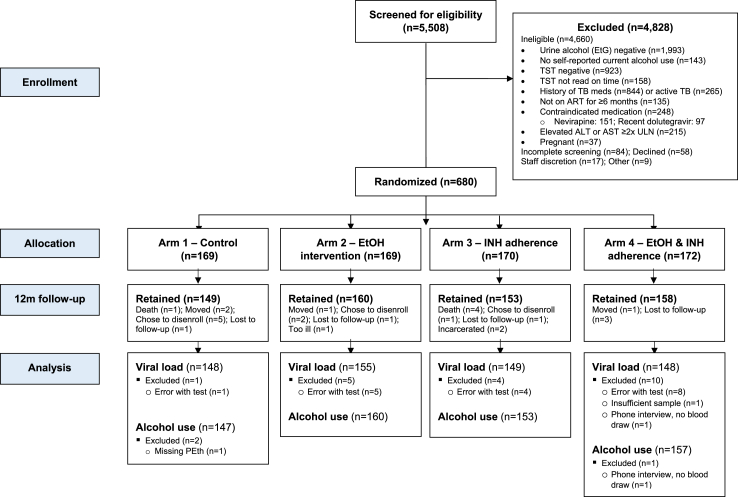
Methods: We analyzed twelve-month HIV viral suppression and alcohol use in the Drinkers' Intervention to Prevent Tuberculosis study, a randomized controlled trial among PWH with latent TB and unhealthy alcohol use in south-western Uganda. We randomly assigned 680 participants (1:1:1:1) initiating six months of INH to: Arm 1, no incentives (control); Arm 2, financial incentives contingent on recent alcohol abstinence; Arm 3, incentives contingent on recent INH use; and Arm 4, incentives for recent alcohol abstinence and INH use, rewarded separately. The 6 months post-intervention outcomes evaluated were pre-specified and included: HIV viral suppression (<200 copies/mL) and no/low alcohol use, defined as Alcohol Use Disorders Identification Test-Consumption negative (<3: women, <4: men) and phosphatidylethanol, an alcohol biomarker, <35 ng/mL. We estimated adjusted risk differences (aRD) for alcohol reduction and INH adherence interventions using multivariable logistic regression adjusting for randomization stratification factors (sex and study site), and baseline alcohol use (alcohol intervention model only). Clinicaltrials.gov registration: NCT03492216, Registered 04/10/2018.
Findings: Of 600 participants with 12-month viral load results, 556/585 (95%) with baseline results were virally suppressed, and 583/600 (97%) were virally suppressed at 12-months. Twelve-month viral suppression did not differ significantly between either intervention group versus control (alcohol reduction incentives versus control aRD = -0.9% (95% CI: -3.6 to 1.7); INH adherence incentives versus control aRD = 2.2% (95% CI: -0.4 to 4.9)). Of the 617 participants with 12-month alcohol use measures, alcohol reduction incentives led to a significantly greater proportion with no/low alcohol use at 12-months (20.2% [64/317]) versus no alcohol reduction incentives (11.0% [33/300]); aRD = 8.4%, (95% CI: 3.3-13.4), p = 0.001.
Interpretation: Viral suppression was high (>95%) at baseline and at 12 months: we found no effect of either 6-month alcohol reduction or INH adherence incentives on long-term viral suppression. Six months of alcohol reduction incentives were effective at promoting no/low alcohol use at 12 months, demonstrating persistent effects post-intervention.
Funding: National Institutes of Health (NIH/NIAAA) U01AA026223 (PI: Hahn) and U01AA026221 (PI: Chamie), NIH/NIAAAK24 AA022586 (PI: Hahn), NIH/NIAAAK24 AA031211 (PI: Chamie), Providence/Boston Center for AIDS ResearchP30AI042853 (PI: Sara Lodi).
期刊介绍:
eClinicalMedicine is a gold open-access clinical journal designed to support frontline health professionals in addressing the complex and rapid health transitions affecting societies globally. The journal aims to assist practitioners in overcoming healthcare challenges across diverse communities, spanning diagnosis, treatment, prevention, and health promotion. Integrating disciplines from various specialties and life stages, it seeks to enhance health systems as fundamental institutions within societies. With a forward-thinking approach, eClinicalMedicine aims to redefine the future of healthcare.



 京公网安备 11010802042870号
京ICP备2023020795号-1
京公网安备 11010802042870号
京ICP备2023020795号-1

 分享
分享
 求助内容:
求助内容: 应助结果提醒方式:
 扫码关注我们
