Núria Sima, Alberto Ayllon-Hermida, Carmen Fernández-Becerra, Hernando A Del Portillo
{"title":"Extracellular vesicles in malaria: proteomics insights, <i>in vitro</i> and <i>in vivo</i> studies indicate the need for transitioning to natural human infections.","authors":"Núria Sima, Alberto Ayllon-Hermida, Carmen Fernández-Becerra, Hernando A Del Portillo","doi":"10.1128/mbio.02304-24","DOIUrl":null,"url":null,"abstract":"<p><p>Globally, an estimated 2.1 billion malaria cases and 11.7 million malaria deaths were averted in the period 2000-2022. Noticeably, despite effective control measurements, in 2022 there were an estimated 249 million malaria cases in 85 malaria-endemic countries and an increase of 5 million cases compared with 2021. Further understanding the biology, epidemiology, and pathogenesis of human malaria is therefore essential for achieving malaria elimination. Extracellular vesicles (EVs) are membrane-enclosed nanoparticles pivotal in intercellular communication and secreted by all cell types. Here, we will review what is currently known about EVs in malaria, from biogenesis and cargo to molecular insights of pathophysiology. Of relevance, a meta-analysis of proteomics cargo, and comparisons between <i>in vitro</i> and <i>in vivo</i> human studies revealed striking differences with those few studies reported from patients. Thus, indicating the need for rigor standardization of methodologies and for transitioning to human infections to elucidate their physiological role. We conclude with a focus on translational aspects in diagnosis and vaccine development and highlight key gaps in the knowledge of EVs in malaria research.</p>","PeriodicalId":18315,"journal":{"name":"mBio","volume":" ","pages":"e0230424"},"PeriodicalIF":4.7000,"publicationDate":"2025-03-12","publicationTypes":"Journal Article","fieldsOfStudy":null,"isOpenAccess":false,"openAccessPdf":"https://www.ncbi.nlm.nih.gov/pmc/articles/PMC11898581/pdf/","citationCount":"0","resultStr":null,"platform":"Semanticscholar","paperid":null,"PeriodicalName":"mBio","FirstCategoryId":"99","ListUrlMain":"https://doi.org/10.1128/mbio.02304-24","RegionNum":1,"RegionCategory":"生物学","ArticlePicture":[],"TitleCN":null,"AbstractTextCN":null,"PMCID":null,"EPubDate":"2025/1/27 0:00:00","PubModel":"Epub","JCR":"Q1","JCRName":"MICROBIOLOGY","Score":null,"Total":0}
引用次数: 0
Abstract
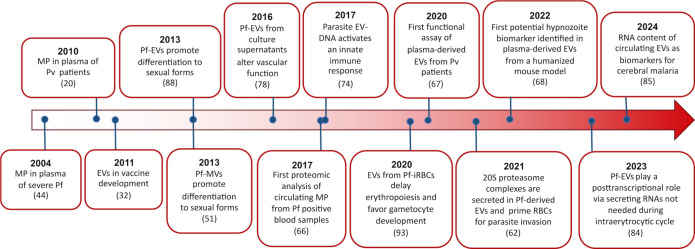
Globally, an estimated 2.1 billion malaria cases and 11.7 million malaria deaths were averted in the period 2000-2022. Noticeably, despite effective control measurements, in 2022 there were an estimated 249 million malaria cases in 85 malaria-endemic countries and an increase of 5 million cases compared with 2021. Further understanding the biology, epidemiology, and pathogenesis of human malaria is therefore essential for achieving malaria elimination. Extracellular vesicles (EVs) are membrane-enclosed nanoparticles pivotal in intercellular communication and secreted by all cell types. Here, we will review what is currently known about EVs in malaria, from biogenesis and cargo to molecular insights of pathophysiology. Of relevance, a meta-analysis of proteomics cargo, and comparisons between in vitro and in vivo human studies revealed striking differences with those few studies reported from patients. Thus, indicating the need for rigor standardization of methodologies and for transitioning to human infections to elucidate their physiological role. We conclude with a focus on translational aspects in diagnosis and vaccine development and highlight key gaps in the knowledge of EVs in malaria research.
期刊介绍:
mBio® is ASM''s first broad-scope, online-only, open access journal. mBio offers streamlined review and publication of the best research in microbiology and allied fields.





 京公网安备 11010802042870号
京ICP备2023020795号-1
京公网安备 11010802042870号
京ICP备2023020795号-1

 分享
分享
 求助内容:
求助内容: 应助结果提醒方式:
 扫码关注我们
