Daniel Wetherbee Nelson, Lynn Erickson, Jodi L Zilinski, Yanzhu Zhao, Anna Karos, Teresa Whitman, Imran K Niazi
{"title":"Concurrent Micra Leadless Pacemaker Implantation and AVN Ablation: Computer Modeling of Novel Risk Mitigation Strategy.","authors":"Daniel Wetherbee Nelson, Lynn Erickson, Jodi L Zilinski, Yanzhu Zhao, Anna Karos, Teresa Whitman, Imran K Niazi","doi":"10.1111/pace.15149","DOIUrl":null,"url":null,"abstract":"<p><strong>Background: </strong>Concurrent Micra leadless pacemaker (Medtronic, Minneapolis, Minnesota) implantation and atrioventricular node (AVN) ablation has been shown to be feasible and safe in patients with symptomatic, drug-refractory atrial fibrillation (AF). However, major complications within the 30 days after concurrent Micra implantation and AVN ablation have been reported. We evaluated the efficacy and safety of the concurrent procedure at our institution.</p><p><strong>Methods: </strong>We conducted a single-center, retrospective case series of patients who underwent concurrent Micra implantation and radiofrequency (RF) AVN ablation from January 2019 to May 2023. A simulated computer model was created to characterize the interaction between the dissipated power at the Micra cathodal electrode as a function of the distance between the RF ablation catheter and the location of the return electrode.</p><p><strong>Results: </strong>Fifteen patients were included. Most were elderly, White, female, and had persistent AF. One had transient, acute loss of ventricular capture that resulted in asystole and required emergent pacing from the ablation catheter. A proposed strategy of moving the RF return electrode to a cranial position from a caudal position was shown by computer modeling to direct more RF current away from the Micra and lower the dissipated power at the Micra cathodal electrode.</p><p><strong>Conclusion: </strong>Concurrent Micra implantation and AVN ablation is feasible and safe and has high procedural success. An acute rise in pacing threshold can occur from RF energy, resulting in asystole. Computer modeling showed that placing the RF return electrode in the cranial position resulted in lower dissipated power at the Micra cathodal electrode.</p>","PeriodicalId":54653,"journal":{"name":"Pace-Pacing and Clinical Electrophysiology","volume":" ","pages":"287-293"},"PeriodicalIF":1.3000,"publicationDate":"2025-03-01","publicationTypes":"Journal Article","fieldsOfStudy":null,"isOpenAccess":false,"openAccessPdf":"https://www.ncbi.nlm.nih.gov/pmc/articles/PMC11881209/pdf/","citationCount":"0","resultStr":null,"platform":"Semanticscholar","paperid":null,"PeriodicalName":"Pace-Pacing and Clinical Electrophysiology","FirstCategoryId":"5","ListUrlMain":"https://doi.org/10.1111/pace.15149","RegionNum":4,"RegionCategory":"医学","ArticlePicture":[],"TitleCN":null,"AbstractTextCN":null,"PMCID":null,"EPubDate":"2025/1/27 0:00:00","PubModel":"Epub","JCR":"Q3","JCRName":"CARDIAC & CARDIOVASCULAR SYSTEMS","Score":null,"Total":0}
引用次数: 0
Abstract
Background: Concurrent Micra leadless pacemaker (Medtronic, Minneapolis, Minnesota) implantation and atrioventricular node (AVN) ablation has been shown to be feasible and safe in patients with symptomatic, drug-refractory atrial fibrillation (AF). However, major complications within the 30 days after concurrent Micra implantation and AVN ablation have been reported. We evaluated the efficacy and safety of the concurrent procedure at our institution.
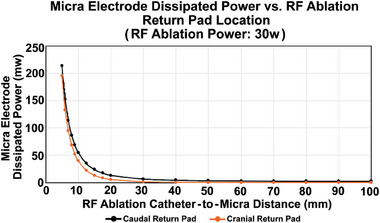
Methods: We conducted a single-center, retrospective case series of patients who underwent concurrent Micra implantation and radiofrequency (RF) AVN ablation from January 2019 to May 2023. A simulated computer model was created to characterize the interaction between the dissipated power at the Micra cathodal electrode as a function of the distance between the RF ablation catheter and the location of the return electrode.
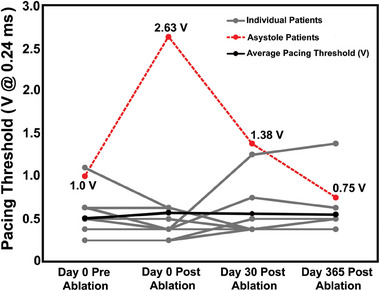
Results: Fifteen patients were included. Most were elderly, White, female, and had persistent AF. One had transient, acute loss of ventricular capture that resulted in asystole and required emergent pacing from the ablation catheter. A proposed strategy of moving the RF return electrode to a cranial position from a caudal position was shown by computer modeling to direct more RF current away from the Micra and lower the dissipated power at the Micra cathodal electrode.
Conclusion: Concurrent Micra implantation and AVN ablation is feasible and safe and has high procedural success. An acute rise in pacing threshold can occur from RF energy, resulting in asystole. Computer modeling showed that placing the RF return electrode in the cranial position resulted in lower dissipated power at the Micra cathodal electrode.
期刊介绍:
Pacing and Clinical Electrophysiology (PACE) is the foremost peer-reviewed journal in the field of pacing and implantable cardioversion defibrillation, publishing over 50% of all English language articles in its field, featuring original, review, and didactic papers, and case reports related to daily practice. Articles also include editorials, book reviews, Musings on humane topics relevant to medical practice, electrophysiology (EP) rounds, device rounds, and information concerning the quality of devices used in the practice of the specialty.



 京公网安备 11010802042870号
京ICP备2023020795号-1
京公网安备 11010802042870号
京ICP备2023020795号-1

 分享
分享
 求助内容:
求助内容: 应助结果提醒方式:
 扫码关注我们
