{"title":"Bibliometric Analysis of the Highest Cited Cosmetic Upper Facial Plastic Surgery Articles Over 50 Years.","authors":"Nitin Rangu, Evan Pistone, Jeremy Tan, Thai Do","doi":"10.1093/asjof/ojae123","DOIUrl":null,"url":null,"abstract":"<p><p>In this bibliometric analysis, the authors analyze the top 100 (T100) most cited articles on cosmetic upper facial plastic surgery. Throughout this study, the objective of the authors is to delineate the trends in cosmetic upper facial surgeries to identify prevailing techniques, emerging trends, and potential areas of future investigation. The articles were indexed from the Web of Science database and were extracted in a double-blinded manner by 2 independent graders. The search phrase used covered a wide range of cosmetic upper facial plastic surgeries, of which a short sample is included: (\"cosmetic*\" AND \"bleph*\") OR (\"cosmetic*\" AND \"upper eyelid blepharoplasty\") OR (\"cosmetic*\" AND \"lower eyelid blepharoplasty\"). In their statistical analysis of the number of citations received in each article in the T100, the authors reveal an average of 55.1 citations (a standard deviation of 38.7). Surgical methods were the most commonly cited unique study area, with 30% of the T100, followed by botulinum toxin and complication management with 29% and 15% of the T100, respectively. The unique study area with the highest average citations received was botulinum toxin, with an average of 64.7 citations. Invasive procedures made up 55% of the T100 articles. The authors found that the late 1990s and 2000s were a burgeoning period of growth in this field and highlight the evolution of many contemporary popular cosmetic procedures over time. Particularly, a growth in minimally invasive procedures was noted, with noted impacts in aesthetics training and research focus.</p><p><strong>Level of evidence 4 therapeutic: </strong></p>","PeriodicalId":72118,"journal":{"name":"Aesthetic surgery journal. Open forum","volume":"7 ","pages":"ojae123"},"PeriodicalIF":1.9000,"publicationDate":"2024-12-16","publicationTypes":"Journal Article","fieldsOfStudy":null,"isOpenAccess":false,"openAccessPdf":"https://www.ncbi.nlm.nih.gov/pmc/articles/PMC11758881/pdf/","citationCount":"0","resultStr":null,"platform":"Semanticscholar","paperid":null,"PeriodicalName":"Aesthetic surgery journal. Open forum","FirstCategoryId":"1085","ListUrlMain":"https://doi.org/10.1093/asjof/ojae123","RegionNum":0,"RegionCategory":null,"ArticlePicture":[],"TitleCN":null,"AbstractTextCN":null,"PMCID":null,"EPubDate":"2025/1/1 0:00:00","PubModel":"eCollection","JCR":"","JCRName":"","Score":null,"Total":0}
引用次数: 0
Abstract
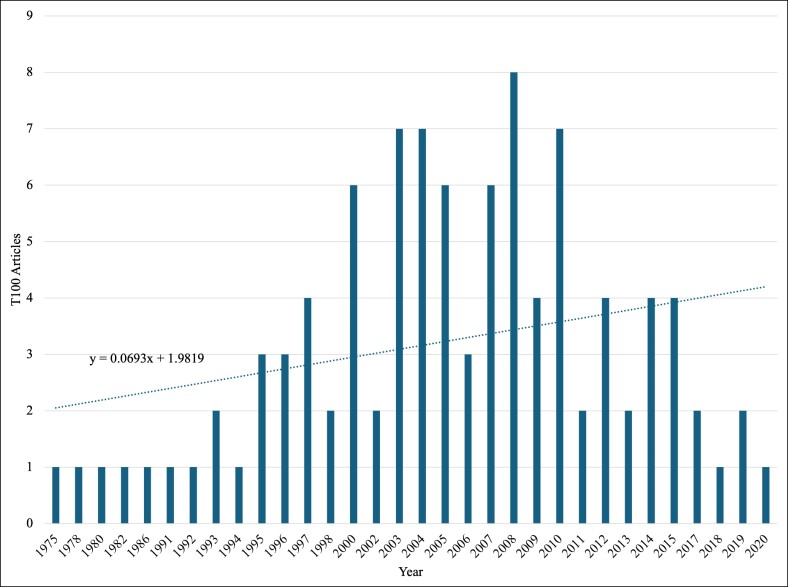
In this bibliometric analysis, the authors analyze the top 100 (T100) most cited articles on cosmetic upper facial plastic surgery. Throughout this study, the objective of the authors is to delineate the trends in cosmetic upper facial surgeries to identify prevailing techniques, emerging trends, and potential areas of future investigation. The articles were indexed from the Web of Science database and were extracted in a double-blinded manner by 2 independent graders. The search phrase used covered a wide range of cosmetic upper facial plastic surgeries, of which a short sample is included: ("cosmetic*" AND "bleph*") OR ("cosmetic*" AND "upper eyelid blepharoplasty") OR ("cosmetic*" AND "lower eyelid blepharoplasty"). In their statistical analysis of the number of citations received in each article in the T100, the authors reveal an average of 55.1 citations (a standard deviation of 38.7). Surgical methods were the most commonly cited unique study area, with 30% of the T100, followed by botulinum toxin and complication management with 29% and 15% of the T100, respectively. The unique study area with the highest average citations received was botulinum toxin, with an average of 64.7 citations. Invasive procedures made up 55% of the T100 articles. The authors found that the late 1990s and 2000s were a burgeoning period of growth in this field and highlight the evolution of many contemporary popular cosmetic procedures over time. Particularly, a growth in minimally invasive procedures was noted, with noted impacts in aesthetics training and research focus.
在这个文献计量分析中,作者分析了前100名(T100)被引用最多的美容上面部整形手术文章。在整个研究中,作者的目的是描述上面部整形手术的趋势,以确定流行的技术,新兴的趋势,以及未来研究的潜在领域。文章从Web of Science数据库中编入索引,并由2名独立评分者以双盲法提取。所使用的搜寻词组涵盖范围广泛的上面部美容整形手术,其中一个简短的样本包括:(“cosmetic*”及“bleph*”)或(“cosmetic*”及“上眼睑整容术”)或(“cosmetic*”及“下眼睑整容术”)。在对T100中每篇文章的引用次数进行统计分析时,作者发现平均引用次数为55.1次(标准差为38.7)。手术方法是最常被引用的独特研究领域,占T100的30%,其次是肉毒杆菌毒素和并发症处理,分别占T100的29%和15%。平均引用次数最高的唯一研究领域是肉毒杆菌毒素,平均引用次数为64.7次。有创手术占T100篇文章的55%。作者发现,20世纪90年代末和21世纪初是这一领域的蓬勃发展时期,并强调了许多当代流行的美容手术随着时间的推移而演变。特别是,微创手术的增长被注意到,在美学训练和研究重点方面有明显的影响。证据等级4:治疗性:





 京公网安备 11010802042870号
京ICP备2023020795号-1
京公网安备 11010802042870号
京ICP备2023020795号-1

 分享
分享

 求助内容:
求助内容: 应助结果提醒方式:
 扫码关注我们
