Shun Nanjo, Arifin, Hayato Maeda, Yoshihiro Hayashi, Kan Hatakeyama-Sato, Ryoji Himeno, Teruaki Hayakawa, Ryo Yoshida
{"title":"SPACIER: on-demand polymer design with fully automated all-atom classical molecular dynamics integrated into machine learning pipelines","authors":"Shun Nanjo, Arifin, Hayato Maeda, Yoshihiro Hayashi, Kan Hatakeyama-Sato, Ryoji Himeno, Teruaki Hayakawa, Ryo Yoshida","doi":"10.1038/s41524-024-01492-3","DOIUrl":null,"url":null,"abstract":"<p>Machine learning has rapidly advanced the design and discovery of new materials with targeted applications in various systems. First-principles calculations and other computer experiments have been integrated into material design pipelines to address the lack of experimental data and the limitations of interpolative machine learning predictors. However, the enormous computational costs and technical challenges of automating computer experiments for polymeric materials have limited the availability of open-source automated polymer design systems that integrate molecular simulations and machine learning. We developed SPACIER, an open-source software program that incorporates RadonPy, a Python library for fully automated polymer physical property calculations based on all-atom classical molecular dynamics, into a Bayesian optimization-based polymer design system to overcome these challenges. As a proof-of-concept study, we synthesized optical polymers that surpass the Pareto boundary formed by the tradeoff between the refractive index and the Abbe number.</p>","PeriodicalId":19342,"journal":{"name":"npj Computational Materials","volume":"25 1","pages":""},"PeriodicalIF":11.9000,"publicationDate":"2025-01-28","publicationTypes":"Journal Article","fieldsOfStudy":null,"isOpenAccess":false,"openAccessPdf":"","citationCount":"0","resultStr":null,"platform":"Semanticscholar","paperid":null,"PeriodicalName":"npj Computational Materials","FirstCategoryId":"88","ListUrlMain":"https://doi.org/10.1038/s41524-024-01492-3","RegionNum":1,"RegionCategory":"材料科学","ArticlePicture":[],"TitleCN":null,"AbstractTextCN":null,"PMCID":null,"EPubDate":"","PubModel":"","JCR":"Q1","JCRName":"CHEMISTRY, PHYSICAL","Score":null,"Total":0}
引用次数: 0
Abstract
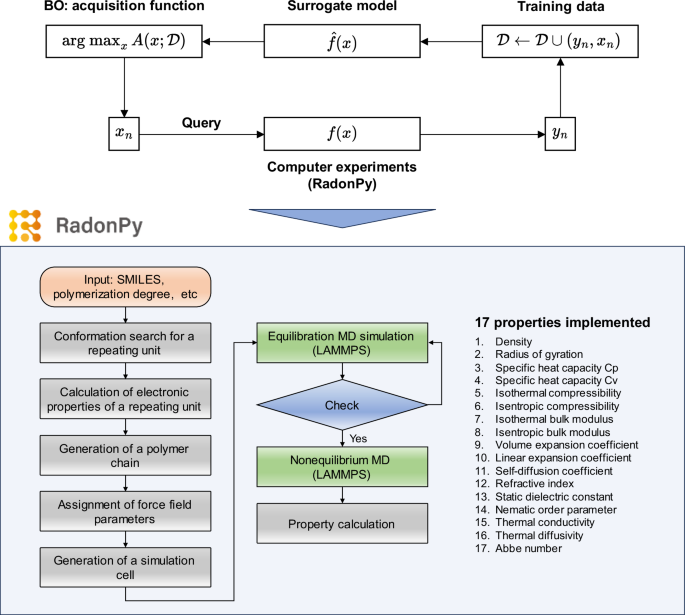
Machine learning has rapidly advanced the design and discovery of new materials with targeted applications in various systems. First-principles calculations and other computer experiments have been integrated into material design pipelines to address the lack of experimental data and the limitations of interpolative machine learning predictors. However, the enormous computational costs and technical challenges of automating computer experiments for polymeric materials have limited the availability of open-source automated polymer design systems that integrate molecular simulations and machine learning. We developed SPACIER, an open-source software program that incorporates RadonPy, a Python library for fully automated polymer physical property calculations based on all-atom classical molecular dynamics, into a Bayesian optimization-based polymer design system to overcome these challenges. As a proof-of-concept study, we synthesized optical polymers that surpass the Pareto boundary formed by the tradeoff between the refractive index and the Abbe number.
期刊介绍:
npj Computational Materials is a high-quality open access journal from Nature Research that publishes research papers applying computational approaches for the design of new materials and enhancing our understanding of existing ones. The journal also welcomes papers on new computational techniques and the refinement of current approaches that support these aims, as well as experimental papers that complement computational findings.
Some key features of npj Computational Materials include a 2-year impact factor of 12.241 (2021), article downloads of 1,138,590 (2021), and a fast turnaround time of 11 days from submission to the first editorial decision. The journal is indexed in various databases and services, including Chemical Abstracts Service (ACS), Astrophysics Data System (ADS), Current Contents/Physical, Chemical and Earth Sciences, Journal Citation Reports/Science Edition, SCOPUS, EI Compendex, INSPEC, Google Scholar, SCImago, DOAJ, CNKI, and Science Citation Index Expanded (SCIE), among others.



 京公网安备 11010802042870号
京ICP备2023020795号-1
京公网安备 11010802042870号
京ICP备2023020795号-1

 分享
分享
 求助内容:
求助内容: 应助结果提醒方式:
 扫码关注我们
