{"title":"The formation of a nuclear-spin dark state in silicon","authors":"Xinxin Cai, Habitamu Y. Walelign, John M. Nichol","doi":"10.1038/s41567-024-02773-w","DOIUrl":null,"url":null,"abstract":"Silicon-based qubits are often made by trapping individual electrons in quantum dots defined by electric gates. Quantum information can then be stored using the spin states of the electrons. However, the nuclei of the surrounding atoms also have spin degrees of freedom that couple to the electron-spin qubits and cause decoherence. The emergence of a nuclear-spin dark state has been predicted to reduce this coupling during dynamic nuclear polarization, when the electrons in the quantum dot drive the nuclei in the semiconductor into a decoupled state. Here we report the formation of a nuclear-spin dark state in a gate-defined silicon double quantum dot. We show that, as expected, the transverse electron–nuclear coupling rapidly diminishes in the dark state, and that this state depends on the synchronized precession of the nuclear spins. Moreover, the dark state significantly reduces the relaxation rate between the singlet and triplet electronic spin states. This nuclear-spin dark state has potential applications as a quantum memory or in quantum sensing, and might enable increased polarization of nuclear-spin ensembles. Electron qubits in solid-state systems often couple to nuclear spins in the surrounding material, causing decoherence. Now, nuclear spins in silicon have been put into a dark state, which could improve qubit coherence for quantum applications.","PeriodicalId":19100,"journal":{"name":"Nature Physics","volume":"21 4","pages":"536-541"},"PeriodicalIF":18.4000,"publicationDate":"2025-01-28","publicationTypes":"Journal Article","fieldsOfStudy":null,"isOpenAccess":false,"openAccessPdf":"","citationCount":"0","resultStr":null,"platform":"Semanticscholar","paperid":null,"PeriodicalName":"Nature Physics","FirstCategoryId":"101","ListUrlMain":"https://www.nature.com/articles/s41567-024-02773-w","RegionNum":1,"RegionCategory":"物理与天体物理","ArticlePicture":[],"TitleCN":null,"AbstractTextCN":null,"PMCID":null,"EPubDate":"","PubModel":"","JCR":"Q1","JCRName":"PHYSICS, MULTIDISCIPLINARY","Score":null,"Total":0}
引用次数: 0
Abstract
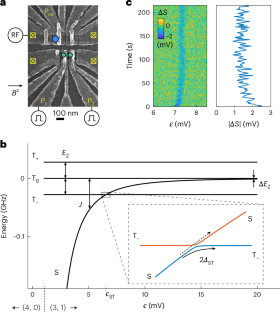
Silicon-based qubits are often made by trapping individual electrons in quantum dots defined by electric gates. Quantum information can then be stored using the spin states of the electrons. However, the nuclei of the surrounding atoms also have spin degrees of freedom that couple to the electron-spin qubits and cause decoherence. The emergence of a nuclear-spin dark state has been predicted to reduce this coupling during dynamic nuclear polarization, when the electrons in the quantum dot drive the nuclei in the semiconductor into a decoupled state. Here we report the formation of a nuclear-spin dark state in a gate-defined silicon double quantum dot. We show that, as expected, the transverse electron–nuclear coupling rapidly diminishes in the dark state, and that this state depends on the synchronized precession of the nuclear spins. Moreover, the dark state significantly reduces the relaxation rate between the singlet and triplet electronic spin states. This nuclear-spin dark state has potential applications as a quantum memory or in quantum sensing, and might enable increased polarization of nuclear-spin ensembles. Electron qubits in solid-state systems often couple to nuclear spins in the surrounding material, causing decoherence. Now, nuclear spins in silicon have been put into a dark state, which could improve qubit coherence for quantum applications.
期刊介绍:
Nature Physics is dedicated to publishing top-tier original research in physics with a fair and rigorous review process. It provides high visibility and access to a broad readership, maintaining high standards in copy editing and production, ensuring rapid publication, and maintaining independence from academic societies and other vested interests.
The journal presents two main research paper formats: Letters and Articles. Alongside primary research, Nature Physics serves as a central source for valuable information within the physics community through Review Articles, News & Views, Research Highlights covering crucial developments across the physics literature, Commentaries, Book Reviews, and Correspondence.




 京公网安备 11010802042870号
京ICP备2023020795号-1
京公网安备 11010802042870号
京ICP备2023020795号-1

 分享
分享
 求助内容:
求助内容: 应助结果提醒方式:
 扫码关注我们
