{"title":"Transposon proliferation drives genome architecture and regulatory evolution in wild and domesticated peppers","authors":"Kang Zhang, Hailong Yu, Lingkui Zhang, Yacong Cao, Xing Li, Yajie Mei, Xiang Wang, Zhenghai Zhang, Tianyao Li, Yuan Jin, Wenyuan Fan, Congcong Guan, Yihan Wang, Daiyuan Zhou, Shumin Chen, Huamao Wu, Lihao Wang, Feng Cheng","doi":"10.1038/s41477-025-01905-1","DOIUrl":null,"url":null,"abstract":"Pepper (Capsicum spp.) is a widely consumed vegetable with exceptionally large genomes in Solanaceae, yet its genomic evolutionary history remains largely unknown. Here we present 11 high-quality Capsicum genome assemblies, including two gap-free genomes, covering four wild and all five domesticated pepper species. We reconstructed the ancestral karyotype and inferred the evolutionary trajectory of peppers. The expanded and variable genome sizes were attributed to differential transposable element accumulations, which shaped 3D chromatin architecture and introduced mutations associated with traits such as fruit orientation and colour. Using a chromatin accessibility atlas of Capsicum, we highlight the influence of transposable elements on regulatory element evolution. Furthermore, by constructing a haploblock map of 124 pepper core germplasms, we uncover frequent introgressions that facilitate the formation of sweet blocky pepper and the acquisition of important traits such as resistance to pepper mild mottle virus. These findings on the genomic and functional evolution of Capsicum will benefit pepper breeding. This study presents 11 telomere-to-telomere genomes of wild and domesticated pepper, highlights how transposable elements have shaped the evolution of genome structure and regulatory elements and identifies structural variations and introgressions associated with key traits in cultivated pepper.","PeriodicalId":18904,"journal":{"name":"Nature Plants","volume":"11 2","pages":"359-375"},"PeriodicalIF":13.6000,"publicationDate":"2025-01-28","publicationTypes":"Journal Article","fieldsOfStudy":null,"isOpenAccess":false,"openAccessPdf":"","citationCount":"0","resultStr":null,"platform":"Semanticscholar","paperid":null,"PeriodicalName":"Nature Plants","FirstCategoryId":"99","ListUrlMain":"https://www.nature.com/articles/s41477-025-01905-1","RegionNum":1,"RegionCategory":"生物学","ArticlePicture":[],"TitleCN":null,"AbstractTextCN":null,"PMCID":null,"EPubDate":"","PubModel":"","JCR":"Q1","JCRName":"PLANT SCIENCES","Score":null,"Total":0}
引用次数: 0
Abstract
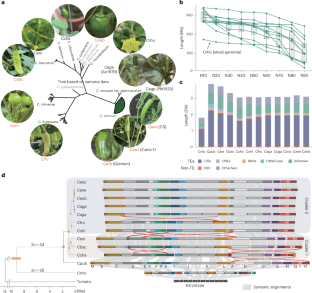
Pepper (Capsicum spp.) is a widely consumed vegetable with exceptionally large genomes in Solanaceae, yet its genomic evolutionary history remains largely unknown. Here we present 11 high-quality Capsicum genome assemblies, including two gap-free genomes, covering four wild and all five domesticated pepper species. We reconstructed the ancestral karyotype and inferred the evolutionary trajectory of peppers. The expanded and variable genome sizes were attributed to differential transposable element accumulations, which shaped 3D chromatin architecture and introduced mutations associated with traits such as fruit orientation and colour. Using a chromatin accessibility atlas of Capsicum, we highlight the influence of transposable elements on regulatory element evolution. Furthermore, by constructing a haploblock map of 124 pepper core germplasms, we uncover frequent introgressions that facilitate the formation of sweet blocky pepper and the acquisition of important traits such as resistance to pepper mild mottle virus. These findings on the genomic and functional evolution of Capsicum will benefit pepper breeding. This study presents 11 telomere-to-telomere genomes of wild and domesticated pepper, highlights how transposable elements have shaped the evolution of genome structure and regulatory elements and identifies structural variations and introgressions associated with key traits in cultivated pepper.
期刊介绍:
Nature Plants is an online-only, monthly journal publishing the best research on plants — from their evolution, development, metabolism and environmental interactions to their societal significance.





 京公网安备 11010802042870号
京ICP备2023020795号-1
京公网安备 11010802042870号
京ICP备2023020795号-1

 分享
分享
 求助内容:
求助内容: 应助结果提醒方式:
 扫码关注我们
