Shaoyun Hao, Ahmad Elgazzar, Nandakishore Ravi, Tae-Ung Wi, Peng Zhu, Yuge Feng, Yang Xia, Feng-Yang Chen, Xiaonan Shan, Haotian Wang
{"title":"Improving the operational stability of electrochemical CO2 reduction reaction via salt precipitation understanding and management","authors":"Shaoyun Hao, Ahmad Elgazzar, Nandakishore Ravi, Tae-Ung Wi, Peng Zhu, Yuge Feng, Yang Xia, Feng-Yang Chen, Xiaonan Shan, Haotian Wang","doi":"10.1038/s41560-024-01695-4","DOIUrl":null,"url":null,"abstract":"The practical application of electrochemical carbon dioxide reduction reaction (CO2RR) technology remains hindered by poor stability, primarily owing to bicarbonate salt formation at the cathode, which blocks reactant CO2 mass flow. Here, using operando characterization tools, we tracked the salt formation process and quantified salt precipitation under varying device operational conditions, elucidating a potential mechanism and optimizing anolyte conditions for long-term (>1,000 h) operation CO2RR to CO under >100 mA cm–2. Liquid droplets carrying cations and (bi)carbonate ions were observed to migrate from the catalyst/membrane interface towards the backside of the gas diffusion electrode, driven by interfacial gas evolution and CO2 flow. These droplets eventually dried, forming bicarbonate salt precipitates that blocked the gas flow channels. On the basis of this observation, we applied a hydrophobic parylene coating to the cathode gas flow channel surface, facilitating the removal of the droplets and extending stability from ~100 h to over 500 h under 200 mA cm–2. Devices for electrochemical CO2 reduction can suffer from salt precipitation that blocks gas flow, leading to instability. Hao et al. explore possible salt formation mechanisms and provide a means to mitigate it via application of hydrophobic surface coatings.","PeriodicalId":19073,"journal":{"name":"Nature Energy","volume":"10 2","pages":"266-277"},"PeriodicalIF":60.1000,"publicationDate":"2025-01-28","publicationTypes":"Journal Article","fieldsOfStudy":null,"isOpenAccess":false,"openAccessPdf":"","citationCount":"0","resultStr":null,"platform":"Semanticscholar","paperid":null,"PeriodicalName":"Nature Energy","FirstCategoryId":"88","ListUrlMain":"https://www.nature.com/articles/s41560-024-01695-4","RegionNum":1,"RegionCategory":"材料科学","ArticlePicture":[],"TitleCN":null,"AbstractTextCN":null,"PMCID":null,"EPubDate":"","PubModel":"","JCR":"Q1","JCRName":"ENERGY & FUELS","Score":null,"Total":0}
引用次数: 0
Abstract
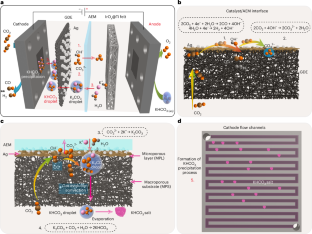
The practical application of electrochemical carbon dioxide reduction reaction (CO2RR) technology remains hindered by poor stability, primarily owing to bicarbonate salt formation at the cathode, which blocks reactant CO2 mass flow. Here, using operando characterization tools, we tracked the salt formation process and quantified salt precipitation under varying device operational conditions, elucidating a potential mechanism and optimizing anolyte conditions for long-term (>1,000 h) operation CO2RR to CO under >100 mA cm–2. Liquid droplets carrying cations and (bi)carbonate ions were observed to migrate from the catalyst/membrane interface towards the backside of the gas diffusion electrode, driven by interfacial gas evolution and CO2 flow. These droplets eventually dried, forming bicarbonate salt precipitates that blocked the gas flow channels. On the basis of this observation, we applied a hydrophobic parylene coating to the cathode gas flow channel surface, facilitating the removal of the droplets and extending stability from ~100 h to over 500 h under 200 mA cm–2. Devices for electrochemical CO2 reduction can suffer from salt precipitation that blocks gas flow, leading to instability. Hao et al. explore possible salt formation mechanisms and provide a means to mitigate it via application of hydrophobic surface coatings.
电化学二氧化碳还原反应(CO2RR)技术的实际应用仍然受到稳定性差的阻碍,主要是由于阴极处形成的碳酸氢盐阻碍了反应物CO2质量流动。在这里,我们使用操作氧化物表征工具,在不同的设备操作条件下跟踪了盐的形成过程并量化了盐的沉淀,阐明了潜在的机制,并优化了在100 mA cm-2下长期(1000 h)运行CO2RR到CO的阳极液条件。观察到携带阳离子和(bi)碳酸盐离子的液滴在界面气体演化和CO2流动的驱动下从催化剂/膜界面向气体扩散电极的背面迁移。这些液滴最终干燥,形成碳酸氢盐沉淀,阻塞了气体流动通道。在此基础上,我们在阴极气体流道表面涂上疏水性聚对二甲苯涂层,有助于去除液滴,并将稳定性从200 mA cm-2下的~100 h延长到500 h以上。
Nature EnergyEnergy-Energy Engineering and Power Technology
CiteScore
75.10
自引率
1.10%
发文量
193
期刊介绍:
Nature Energy is a monthly, online-only journal committed to showcasing the most impactful research on energy, covering everything from its generation and distribution to the societal implications of energy technologies and policies.
With a focus on exploring all facets of the ongoing energy discourse, Nature Energy delves into topics such as energy generation, storage, distribution, management, and the societal impacts of energy technologies and policies. Emphasizing studies that push the boundaries of knowledge and contribute to the development of next-generation solutions, the journal serves as a platform for the exchange of ideas among stakeholders at the forefront of the energy sector.
Maintaining the hallmark standards of the Nature brand, Nature Energy boasts a dedicated team of professional editors, a rigorous peer-review process, meticulous copy-editing and production, rapid publication times, and editorial independence.
In addition to original research articles, Nature Energy also publishes a range of content types, including Comments, Perspectives, Reviews, News & Views, Features, and Correspondence, covering a diverse array of disciplines relevant to the field of energy.




 京公网安备 11010802042870号
京ICP备2023020795号-1
京公网安备 11010802042870号
京ICP备2023020795号-1

 分享
分享
 求助内容:
求助内容: 应助结果提醒方式:
 扫码关注我们
