Pierre Masselot, Malcolm N. Mistry, Shilpa Rao, Veronika Huber, Ana Monteiro, Evangelia Samoli, Massimo Stafoggia, Francesca de’Donato, David Garcia-Leon, Juan-Carlos Ciscar, Luc Feyen, Alexandra Schneider, Klea Katsouyanni, Ana Maria Vicedo-Cabrera, Kristin Aunan, Antonio Gasparrini
{"title":"Estimating future heat-related and cold-related mortality under climate change, demographic and adaptation scenarios in 854 European cities","authors":"Pierre Masselot, Malcolm N. Mistry, Shilpa Rao, Veronika Huber, Ana Monteiro, Evangelia Samoli, Massimo Stafoggia, Francesca de’Donato, David Garcia-Leon, Juan-Carlos Ciscar, Luc Feyen, Alexandra Schneider, Klea Katsouyanni, Ana Maria Vicedo-Cabrera, Kristin Aunan, Antonio Gasparrini","doi":"10.1038/s41591-024-03452-2","DOIUrl":null,"url":null,"abstract":"Previous health impact assessments of temperature-related mortality in Europe indicated that the mortality burden attributable to cold is much larger than for heat. Questions remain as to whether climate change can result in a net decrease in temperature-related mortality. In this study, we estimated how climate change could affect future heat-related and cold-related mortality in 854 European urban areas, under several climate, demographic and adaptation scenarios. We showed that, with no adaptation to heat, the increase in heat-related deaths consistently exceeds any decrease in cold-related deaths across all considered scenarios in Europe. Under the lowest mitigation and adaptation scenario (SSP3-7.0), we estimate a net death burden due to climate change increasing by 49.9% and cumulating 2,345,410 (95% confidence interval = 327,603 to 4,775,853) climate change-related deaths between 2015 and 2099. This net effect would remain positive even under high adaptation scenarios, whereby a risk attenuation of 50% is still insufficient to reverse the trend under SSP3-7.0. Regional differences suggest a slight net decrease of death rates in Northern European countries but high vulnerability of the Mediterranean region and Eastern Europe areas. Unless strong mitigation and adaptation measures are implemented, most European cities should experience an increase of their temperature-related mortality burden. Modeled analyses of 854 European cities show that net temperature-related mortality will increase because of an increase in heat-related mortality exceeding future reductions in cold-related mortality under current climate change projections and even in the presence of high adaptation scenarios.","PeriodicalId":19037,"journal":{"name":"Nature Medicine","volume":"31 4","pages":"1294-1302"},"PeriodicalIF":50.0000,"publicationDate":"2025-01-27","publicationTypes":"Journal Article","fieldsOfStudy":null,"isOpenAccess":false,"openAccessPdf":"https://www.nature.comhttps://www.nature.com/articles/s41591-024-03452-2.pdf","citationCount":"0","resultStr":null,"platform":"Semanticscholar","paperid":null,"PeriodicalName":"Nature Medicine","FirstCategoryId":"3","ListUrlMain":"https://www.nature.com/articles/s41591-024-03452-2","RegionNum":1,"RegionCategory":"医学","ArticlePicture":[],"TitleCN":null,"AbstractTextCN":null,"PMCID":null,"EPubDate":"","PubModel":"","JCR":"Q1","JCRName":"BIOCHEMISTRY & MOLECULAR BIOLOGY","Score":null,"Total":0}
引用次数: 0
Abstract
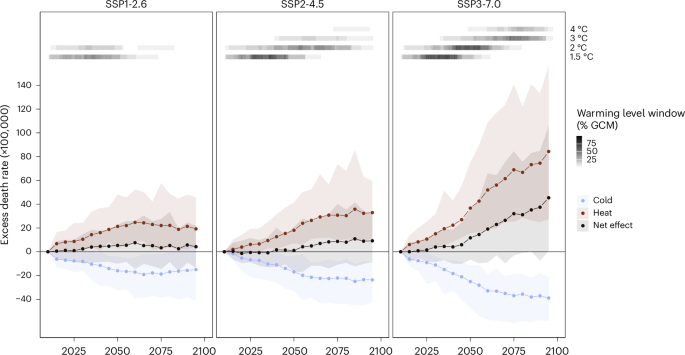
Previous health impact assessments of temperature-related mortality in Europe indicated that the mortality burden attributable to cold is much larger than for heat. Questions remain as to whether climate change can result in a net decrease in temperature-related mortality. In this study, we estimated how climate change could affect future heat-related and cold-related mortality in 854 European urban areas, under several climate, demographic and adaptation scenarios. We showed that, with no adaptation to heat, the increase in heat-related deaths consistently exceeds any decrease in cold-related deaths across all considered scenarios in Europe. Under the lowest mitigation and adaptation scenario (SSP3-7.0), we estimate a net death burden due to climate change increasing by 49.9% and cumulating 2,345,410 (95% confidence interval = 327,603 to 4,775,853) climate change-related deaths between 2015 and 2099. This net effect would remain positive even under high adaptation scenarios, whereby a risk attenuation of 50% is still insufficient to reverse the trend under SSP3-7.0. Regional differences suggest a slight net decrease of death rates in Northern European countries but high vulnerability of the Mediterranean region and Eastern Europe areas. Unless strong mitigation and adaptation measures are implemented, most European cities should experience an increase of their temperature-related mortality burden. Modeled analyses of 854 European cities show that net temperature-related mortality will increase because of an increase in heat-related mortality exceeding future reductions in cold-related mortality under current climate change projections and even in the presence of high adaptation scenarios.
期刊介绍:
Nature Medicine is a monthly journal publishing original peer-reviewed research in all areas of medicine. The publication focuses on originality, timeliness, interdisciplinary interest, and the impact on improving human health. In addition to research articles, Nature Medicine also publishes commissioned content such as News, Reviews, and Perspectives. This content aims to provide context for the latest advances in translational and clinical research, reaching a wide audience of M.D. and Ph.D. readers. All editorial decisions for the journal are made by a team of full-time professional editors.
Nature Medicine consider all types of clinical research, including:
-Case-reports and small case series
-Clinical trials, whether phase 1, 2, 3 or 4
-Observational studies
-Meta-analyses
-Biomarker studies
-Public and global health studies
Nature Medicine is also committed to facilitating communication between translational and clinical researchers. As such, we consider “hybrid” studies with preclinical and translational findings reported alongside data from clinical studies.




 京公网安备 11010802042870号
京ICP备2023020795号-1
京公网安备 11010802042870号
京ICP备2023020795号-1

 分享
分享
 求助内容:
求助内容: 应助结果提醒方式:
 扫码关注我们
