Anca C. Parau , Senem Büyüksungur , Guanhao Li , Quan Liu , Ernesto Badillo , Laura Blum , Jürgen Schmidt , Iulian Pana , Catalin Vitelaru , Ioana M. Marinescu , Mihaela Dinu , Michael Smuglov , Christina Schmuttermaier , Tugba E. Tanir , Harald Klüter , Nesrin Hasirci , Julia Kzhyshkowska , Alina Vladescu Dragomir
{"title":"Zn-doped CaP coating equips Ti implants with corrosion resistance, biomineralization, antibacterial and immunotolerant activities","authors":"Anca C. Parau , Senem Büyüksungur , Guanhao Li , Quan Liu , Ernesto Badillo , Laura Blum , Jürgen Schmidt , Iulian Pana , Catalin Vitelaru , Ioana M. Marinescu , Mihaela Dinu , Michael Smuglov , Christina Schmuttermaier , Tugba E. Tanir , Harald Klüter , Nesrin Hasirci , Julia Kzhyshkowska , Alina Vladescu Dragomir","doi":"10.1016/j.jare.2025.01.045","DOIUrl":null,"url":null,"abstract":"<div><h3>Introduction</h3><div>Chronic inflammation leading to implant failure present major challenges in orthopedics, dentistry, and reconstructive surgery. Titanium alloys, while widely used, often provoke inflammatory complications. Zinc (Zn)-doped calcium phosphate (CaP) coatings offer potential to enhance implant integration by improving corrosion resistance, bioactivity, and immunocompatibility.</div></div><div><h3>Objectives</h3><div>The objective of the study was to develope novel coating composition based on zinc-doped CaP coatings on Ti64 alloy implants that for the first time combines improved corrosion resistance, antibacterial properties and principally improved compatibility with the innate immunity primarily due to the proper programming of resident tissue macrophages to promote long-term implant acceptance.</div></div><div><h3>Methods</h3><div>Ti64 substrates were coated with CaP and Zn-doped CaP using the microarc oxidation (MAO) technique. The adhesion between substrate and coatings are investigated by the progressive scratch test. The corrosion resistance and bioactivity were evaluated through electrochemical tests and simulated body fluid immersion. RNA sequencing was used to assess inflammatory responses in human primary macrophages. Antibacterial efficacy was tested against <em>Escherichia coli</em> and <em>Staphylococcus aureus</em>.</div></div><div><h3>Results</h3><div>Zn addition significantly increased the adhesion of the coatings to Ti64 alloy, doubling up the critical load (from 4 N to 11 N). Zn-doped CaP coatings demonstrated enhanced corrosion resistance and increased biomineralization. RNA sequencing revealed that Zn addition suppressed inflammatory and promoted tolerogenic macrophage programming. Most pronounced effects was compensatory effect Zn on the CaP-supressed oxidative phosphorylation and lysosomal pathways in healing macrophages, and by upregulation of metallothioneins. Zn-doped coatings also exhibited superior antibacterial efficacy, reducing <em>E. coli</em> and <em>S. aureus</em> colonization by 99 % and 90 %, respectively.</div></div><div><h3>Conclusion</h3><div>Zn-doped CaP coatings on Ti64 implants significantly improved corrosion resistance, bioactivity, and antibacterial performance. We developed an advanced multifunctional biomaterial equipped with beneficial anti-inflammatory and tissue integrative programming of innate immunity providing principal advantages for the long-term implant integration and reducing the implant failure risks.</div></div>","PeriodicalId":14952,"journal":{"name":"Journal of Advanced Research","volume":"77 ","pages":"Pages 689-704"},"PeriodicalIF":13.0000,"publicationDate":"2025-11-01","publicationTypes":"Journal Article","fieldsOfStudy":null,"isOpenAccess":false,"openAccessPdf":"","citationCount":"0","resultStr":null,"platform":"Semanticscholar","paperid":null,"PeriodicalName":"Journal of Advanced Research","FirstCategoryId":"103","ListUrlMain":"https://www.sciencedirect.com/science/article/pii/S2090123225000645","RegionNum":1,"RegionCategory":"综合性期刊","ArticlePicture":[],"TitleCN":null,"AbstractTextCN":null,"PMCID":null,"EPubDate":"","PubModel":"","JCR":"Q1","JCRName":"MULTIDISCIPLINARY SCIENCES","Score":null,"Total":0}
引用次数: 0
Abstract
Introduction
Chronic inflammation leading to implant failure present major challenges in orthopedics, dentistry, and reconstructive surgery. Titanium alloys, while widely used, often provoke inflammatory complications. Zinc (Zn)-doped calcium phosphate (CaP) coatings offer potential to enhance implant integration by improving corrosion resistance, bioactivity, and immunocompatibility.
Objectives
The objective of the study was to develope novel coating composition based on zinc-doped CaP coatings on Ti64 alloy implants that for the first time combines improved corrosion resistance, antibacterial properties and principally improved compatibility with the innate immunity primarily due to the proper programming of resident tissue macrophages to promote long-term implant acceptance.
Methods
Ti64 substrates were coated with CaP and Zn-doped CaP using the microarc oxidation (MAO) technique. The adhesion between substrate and coatings are investigated by the progressive scratch test. The corrosion resistance and bioactivity were evaluated through electrochemical tests and simulated body fluid immersion. RNA sequencing was used to assess inflammatory responses in human primary macrophages. Antibacterial efficacy was tested against Escherichia coli and Staphylococcus aureus.
Results
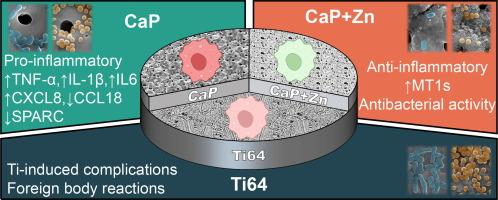
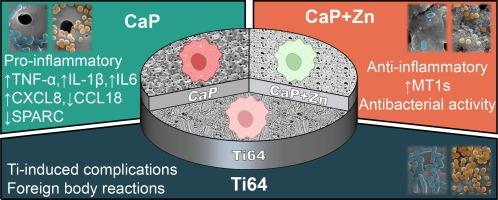
Zn addition significantly increased the adhesion of the coatings to Ti64 alloy, doubling up the critical load (from 4 N to 11 N). Zn-doped CaP coatings demonstrated enhanced corrosion resistance and increased biomineralization. RNA sequencing revealed that Zn addition suppressed inflammatory and promoted tolerogenic macrophage programming. Most pronounced effects was compensatory effect Zn on the CaP-supressed oxidative phosphorylation and lysosomal pathways in healing macrophages, and by upregulation of metallothioneins. Zn-doped coatings also exhibited superior antibacterial efficacy, reducing E. coli and S. aureus colonization by 99 % and 90 %, respectively.
Conclusion
Zn-doped CaP coatings on Ti64 implants significantly improved corrosion resistance, bioactivity, and antibacterial performance. We developed an advanced multifunctional biomaterial equipped with beneficial anti-inflammatory and tissue integrative programming of innate immunity providing principal advantages for the long-term implant integration and reducing the implant failure risks.
期刊介绍:
Journal of Advanced Research (J. Adv. Res.) is an applied/natural sciences, peer-reviewed journal that focuses on interdisciplinary research. The journal aims to contribute to applied research and knowledge worldwide through the publication of original and high-quality research articles in the fields of Medicine, Pharmaceutical Sciences, Dentistry, Physical Therapy, Veterinary Medicine, and Basic and Biological Sciences.
The following abstracting and indexing services cover the Journal of Advanced Research: PubMed/Medline, Essential Science Indicators, Web of Science, Scopus, PubMed Central, PubMed, Science Citation Index Expanded, Directory of Open Access Journals (DOAJ), and INSPEC.




 京公网安备 11010802042870号
京ICP备2023020795号-1
京公网安备 11010802042870号
京ICP备2023020795号-1

 分享
分享
 求助内容:
求助内容: 应助结果提醒方式:
 扫码关注我们
