How Do Solvent–Polymer–Surface Interactions Affect the Physisorption of Polymer Chains during Flow-Induced Translocation through Inorganic Oxide Nanochannels?
Yiren Wang, Jianing Zhou, Haorong Huang, Tao Zheng, Lianwei Li
{"title":"How Do Solvent–Polymer–Surface Interactions Affect the Physisorption of Polymer Chains during Flow-Induced Translocation through Inorganic Oxide Nanochannels?","authors":"Yiren Wang, Jianing Zhou, Haorong Huang, Tao Zheng, Lianwei Li","doi":"10.1021/acs.macromol.4c01723","DOIUrl":null,"url":null,"abstract":"This work aims to explore how polymer–surface–solvent ternary interactions play a synergistical role in affecting the physisorption of PBA<sub>N</sub> [poly(benzyl acrylate)] chains inside 20 and 100 nm Whatman anodic aluminum oxide nanochannels in flow field by considering the Flory interaction parameter (χ<sub>F</sub>), adsorption parameter (χ<sub>S</sub>), solution concentration (<i>C</i>), and degree of polymerization (<i>N</i>). By using a homemade triple-pump system for in situ monitoring the transmembrane pressure during the solvent switching process, we have found: (1) a combination of χ<sub>F</sub> and χ<sub>S</sub> significantly impacts the adsorption and reversibility of PBA<sub>N</sub> chains in toluene, ethyl acetate, and tetrahydrofuran, and an extremely slow kinetics process is revealed in dimethylformamide; (2) the adsorption kinetic curves for different PBA<sub>N</sub> chain lengths are all nicely described by the dual exponential fitting including the fast and slow modes, which can be attributed to the fast approaching of whole chain and the slow reorganization of local conformation, respectively, and the conformational reorganization is found to be the most significant in dimethylformamide; (3) a universal two-regime scaling dependence <i>A</i><sub>occupy</sub><i>/A</i><sub>total</sub> ∼ <i>N</i><sup>γ</sup> is observed between the cross-sectional coverage factor (<i>A</i><sub>occupy</sub><i>/A</i><sub>total</sub>) and <i>N</i>, with γ ∼ 0.50 in the weak confinement regime when <i>A</i><sub>occupy</sub><i>/A</i><sub>total</sub> < 0.30 and γ ∼ 1.5 in the strong confinement when <i>A</i><sub>occupy</sub><i>/A</i><sub>total</sub> > 0.30, independent of pore size, chain length, and solvent type, indicating the dominant effect of the crowding effect when <i>A</i><sub>occupy</sub><i>/A</i><sub>total</sub> > 0.30; (4) the adsorption reversibility and desorption efficiency are found to increase with the solvent quality and polarity in 20 and 100 nm systems during the solvent switching process, which provides a method for the regulation of adsorption thickness; (5) an extremely weak dependence of <i>A</i><sub>occupy</sub><i>/A</i><sub>total</sub> ∼ <i>C</i> is observed, which is consistent with Silberberg’s prediction. Our present result provides useful guidance for understanding and comparing the behavior of chain adsorption in the nonidealized and idealized membrane system.","PeriodicalId":51,"journal":{"name":"Macromolecules","volume":"15 1","pages":""},"PeriodicalIF":5.2000,"publicationDate":"2025-01-28","publicationTypes":"Journal Article","fieldsOfStudy":null,"isOpenAccess":false,"openAccessPdf":"","citationCount":"0","resultStr":null,"platform":"Semanticscholar","paperid":null,"PeriodicalName":"Macromolecules","FirstCategoryId":"92","ListUrlMain":"https://doi.org/10.1021/acs.macromol.4c01723","RegionNum":1,"RegionCategory":"化学","ArticlePicture":[],"TitleCN":null,"AbstractTextCN":null,"PMCID":null,"EPubDate":"","PubModel":"","JCR":"Q1","JCRName":"POLYMER SCIENCE","Score":null,"Total":0}
引用次数: 0
Abstract
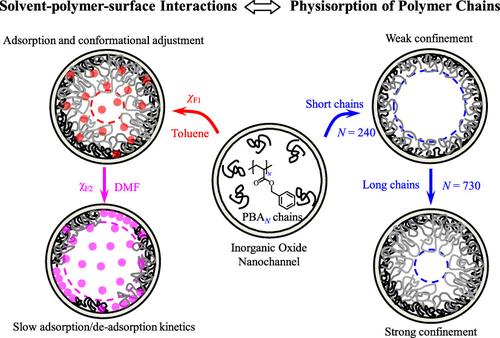
This work aims to explore how polymer–surface–solvent ternary interactions play a synergistical role in affecting the physisorption of PBAN [poly(benzyl acrylate)] chains inside 20 and 100 nm Whatman anodic aluminum oxide nanochannels in flow field by considering the Flory interaction parameter (χF), adsorption parameter (χS), solution concentration (C), and degree of polymerization (N). By using a homemade triple-pump system for in situ monitoring the transmembrane pressure during the solvent switching process, we have found: (1) a combination of χF and χS significantly impacts the adsorption and reversibility of PBAN chains in toluene, ethyl acetate, and tetrahydrofuran, and an extremely slow kinetics process is revealed in dimethylformamide; (2) the adsorption kinetic curves for different PBAN chain lengths are all nicely described by the dual exponential fitting including the fast and slow modes, which can be attributed to the fast approaching of whole chain and the slow reorganization of local conformation, respectively, and the conformational reorganization is found to be the most significant in dimethylformamide; (3) a universal two-regime scaling dependence Aoccupy/Atotal ∼ Nγ is observed between the cross-sectional coverage factor (Aoccupy/Atotal) and N, with γ ∼ 0.50 in the weak confinement regime when Aoccupy/Atotal < 0.30 and γ ∼ 1.5 in the strong confinement when Aoccupy/Atotal > 0.30, independent of pore size, chain length, and solvent type, indicating the dominant effect of the crowding effect when Aoccupy/Atotal > 0.30; (4) the adsorption reversibility and desorption efficiency are found to increase with the solvent quality and polarity in 20 and 100 nm systems during the solvent switching process, which provides a method for the regulation of adsorption thickness; (5) an extremely weak dependence of Aoccupy/Atotal ∼ C is observed, which is consistent with Silberberg’s prediction. Our present result provides useful guidance for understanding and comparing the behavior of chain adsorption in the nonidealized and idealized membrane system.
本研究旨在通过考虑Flory相互作用参数(χF)、吸附参数(χS)、溶液浓度(C),探讨聚合物-表面-溶剂三元相互作用如何协同影响PBAN[聚丙烯酸苄酯]链在20 nm和100 nm Whatman阳极氧化铝纳米通道内的物理吸附。采用自制的三泵系统对溶剂切换过程中的跨膜压力进行原位监测,发现:(1)χF和χS组合显著影响PBAN链对甲苯、乙酸乙酯和四氢呋喃的吸附和可逆性,且对二甲基甲酰胺的吸附和可逆性表现为极慢的动力学过程;(2)不同链长的PBAN吸附动力学曲线均表现为快慢双指数拟合模式,这主要归因于全链的快速逼近和局部构象的缓慢重组,其中二甲基甲酰胺的构象重组最为显著;(3)在横截面覆盖因子(Aoccupy/ total)和N之间观察到普遍的双区尺度依赖性,当Aoccupy/ total <时,弱约束区γ ~ 0.50;当Aoccupy/ total >时,强约束为0.30和γ ~ 1.5;0.30,与孔径、链长、溶剂类型无关,说明挤占/ total >时挤占效应占主导地位;0.30;(4)在20 nm和100 nm体系中,随着溶剂质量和极性的增加,吸附的可逆性和解吸效率增加,这为调节吸附厚度提供了一种方法;(5)观察到Aoccupy/ total ~ C的依赖性极弱,这与Silberberg的预测一致。本研究结果为理解和比较非理想和理想膜系统中的链式吸附行为提供了有益的指导。
期刊介绍:
Macromolecules publishes original, fundamental, and impactful research on all aspects of polymer science. Topics of interest include synthesis (e.g., controlled polymerizations, polymerization catalysis, post polymerization modification, new monomer structures and polymer architectures, and polymerization mechanisms/kinetics analysis); phase behavior, thermodynamics, dynamic, and ordering/disordering phenomena (e.g., self-assembly, gelation, crystallization, solution/melt/solid-state characteristics); structure and properties (e.g., mechanical and rheological properties, surface/interfacial characteristics, electronic and transport properties); new state of the art characterization (e.g., spectroscopy, scattering, microscopy, rheology), simulation (e.g., Monte Carlo, molecular dynamics, multi-scale/coarse-grained modeling), and theoretical methods. Renewable/sustainable polymers, polymer networks, responsive polymers, electro-, magneto- and opto-active macromolecules, inorganic polymers, charge-transporting polymers (ion-containing, semiconducting, and conducting), nanostructured polymers, and polymer composites are also of interest. Typical papers published in Macromolecules showcase important and innovative concepts, experimental methods/observations, and theoretical/computational approaches that demonstrate a fundamental advance in the understanding of polymers.



 京公网安备 11010802042870号
京ICP备2023020795号-1
京公网安备 11010802042870号
京ICP备2023020795号-1

 分享
分享
 求助内容:
求助内容: 应助结果提醒方式:
 扫码关注我们
