{"title":"Effect of imidazole-based additives on the voltage of dye sensitized solar cells with Cu(II/I) redox mediators","authors":"Ladislav Kavan , Michael Graetzel","doi":"10.1016/j.electacta.2025.145758","DOIUrl":null,"url":null,"abstract":"<div><div>Acetonitrile solutions of Cu(tmby)<sub>2</sub><sup>2+</sup> exhibit aging-dependent changes of UV–Vis spectra, which were attributed to partial reduction to Cu(tmby)<sub>2</sub><sup>+</sup>. This effect is boosted by the addition of imidazole bases, i.e., N-methyl-benzimidazole (NMB) or 5‑chloro-1-ethyl-2-methyl-imidazole (CEMI). These bases have only small effect on the diffusion coefficients of Cu(tmby)<sub>2</sub><sup>2+</sup>, but downshift the redox potential of Cu(tmby)<sub>2</sub><sup>2+/+</sup> by ca. 0.1–0.2 V. The addition of CEMI to the electrolyte solution decreases the flatband potential of the TiO<sub>2</sub> anatase (101) face. The corresponding position of conduction band minimum is upshifted by 0.19 or 0.26 eV, depending on the counterion type, Li<sup>+</sup> or Na<sup>+</sup>, respectively. The formal redox potentials of Cu(tmby)<sub>2</sub><sup>2+/+</sup> in the CEMI-modified electrolyte solution, interrelated with the respective flatband potentials in TiO<sub>2</sub>, provide a refined estimate of the maximum accessible open-circuit photovoltage of DSSC.</div></div>","PeriodicalId":305,"journal":{"name":"Electrochimica Acta","volume":"517 ","pages":"Article 145758"},"PeriodicalIF":5.6000,"publicationDate":"2025-03-20","publicationTypes":"Journal Article","fieldsOfStudy":null,"isOpenAccess":false,"openAccessPdf":"","citationCount":"0","resultStr":null,"platform":"Semanticscholar","paperid":null,"PeriodicalName":"Electrochimica Acta","FirstCategoryId":"88","ListUrlMain":"https://www.sciencedirect.com/science/article/pii/S0013468625001215","RegionNum":3,"RegionCategory":"材料科学","ArticlePicture":[],"TitleCN":null,"AbstractTextCN":null,"PMCID":null,"EPubDate":"2025/1/27 0:00:00","PubModel":"Epub","JCR":"Q1","JCRName":"ELECTROCHEMISTRY","Score":null,"Total":0}
引用次数: 0
Abstract
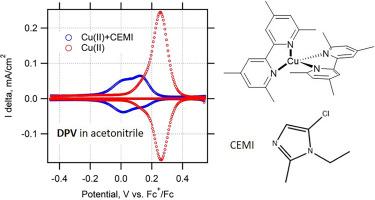
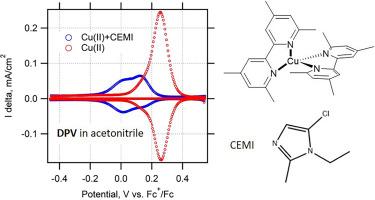
Acetonitrile solutions of Cu(tmby)22+ exhibit aging-dependent changes of UV–Vis spectra, which were attributed to partial reduction to Cu(tmby)2+. This effect is boosted by the addition of imidazole bases, i.e., N-methyl-benzimidazole (NMB) or 5‑chloro-1-ethyl-2-methyl-imidazole (CEMI). These bases have only small effect on the diffusion coefficients of Cu(tmby)22+, but downshift the redox potential of Cu(tmby)22+/+ by ca. 0.1–0.2 V. The addition of CEMI to the electrolyte solution decreases the flatband potential of the TiO2 anatase (101) face. The corresponding position of conduction band minimum is upshifted by 0.19 or 0.26 eV, depending on the counterion type, Li+ or Na+, respectively. The formal redox potentials of Cu(tmby)22+/+ in the CEMI-modified electrolyte solution, interrelated with the respective flatband potentials in TiO2, provide a refined estimate of the maximum accessible open-circuit photovoltage of DSSC.
期刊介绍:
Electrochimica Acta is an international journal. It is intended for the publication of both original work and reviews in the field of electrochemistry. Electrochemistry should be interpreted to mean any of the research fields covered by the Divisions of the International Society of Electrochemistry listed below, as well as emerging scientific domains covered by ISE New Topics Committee.




 京公网安备 11010802042870号
京ICP备2023020795号-1
京公网安备 11010802042870号
京ICP备2023020795号-1

 分享
分享
 求助内容:
求助内容: 应助结果提醒方式:
 扫码关注我们
