{"title":"Ultrathin heterogeneous nanolayer structure of FeCoNiCu multi-principal element alloy for robust water electrolysis","authors":"Zhiyi Ding, Ziyang Chen, Xinyang Liu, Junjie Liu, Tong Wang, Aiying Chen, Bin Gan, Yong Zhang","doi":"10.1016/j.cej.2025.160016","DOIUrl":null,"url":null,"abstract":"Developing efficient, cost-effective alloy catalysts for the hydrogen evolution reaction (HER) is a promising strategy to convert electrical energy to chemical fuels efficiently, however, it remains challenge. Herein, a designed non-equimolar FeCoNiCu multi-principal element alloys (MPEAs) catalyst, fabricated via a simple physical metallurgy and chemical dealloying, exhibits HER performance comparable to commercial noble metal counterpart. The optimal (FeCoNi)<sub>70</sub>Cu<sub>30</sub> (at.%) catalysts display a remarkable minimum overpotential of 34 mV (@10 mA cm<sup>−2</sup>) and a Tafel slope of 48 mV dec<sup>-1</sup>. Meanwhile, the electrocatalyst exhibits excellent 24 h long-term durability stability at a high current density of −500 mA cm<sup>−2</sup><sub>.</sub> This is attributed to the multi-scale substructure of distinctive, self-supporting Colosseum-inspired skeletal structure, coupled with nanoscale porous architecture attached to ultra-thin serrated amorphous nanolayer structure, significantly enhancing the specific surface and active sites. This study provides a novel strategy for designing high-performance non-precious metal catalysts with heterogeneous substructures based on multicomponent combinations.","PeriodicalId":270,"journal":{"name":"Chemical Engineering Journal","volume":"67 1","pages":""},"PeriodicalIF":13.2000,"publicationDate":"2025-01-27","publicationTypes":"Journal Article","fieldsOfStudy":null,"isOpenAccess":false,"openAccessPdf":"","citationCount":"0","resultStr":null,"platform":"Semanticscholar","paperid":null,"PeriodicalName":"Chemical Engineering Journal","FirstCategoryId":"5","ListUrlMain":"https://doi.org/10.1016/j.cej.2025.160016","RegionNum":1,"RegionCategory":"工程技术","ArticlePicture":[],"TitleCN":null,"AbstractTextCN":null,"PMCID":null,"EPubDate":"","PubModel":"","JCR":"Q1","JCRName":"ENGINEERING, CHEMICAL","Score":null,"Total":0}
引用次数: 0
Abstract
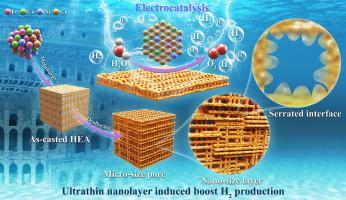
Developing efficient, cost-effective alloy catalysts for the hydrogen evolution reaction (HER) is a promising strategy to convert electrical energy to chemical fuels efficiently, however, it remains challenge. Herein, a designed non-equimolar FeCoNiCu multi-principal element alloys (MPEAs) catalyst, fabricated via a simple physical metallurgy and chemical dealloying, exhibits HER performance comparable to commercial noble metal counterpart. The optimal (FeCoNi)70Cu30 (at.%) catalysts display a remarkable minimum overpotential of 34 mV (@10 mA cm−2) and a Tafel slope of 48 mV dec-1. Meanwhile, the electrocatalyst exhibits excellent 24 h long-term durability stability at a high current density of −500 mA cm−2. This is attributed to the multi-scale substructure of distinctive, self-supporting Colosseum-inspired skeletal structure, coupled with nanoscale porous architecture attached to ultra-thin serrated amorphous nanolayer structure, significantly enhancing the specific surface and active sites. This study provides a novel strategy for designing high-performance non-precious metal catalysts with heterogeneous substructures based on multicomponent combinations.
开发高效、经济的析氢反应合金催化剂是将电能高效转化为化学燃料的一个很有前景的策略,但这仍然是一个挑战。本文设计了一种非等摩尔FeCoNiCu多主元素合金(mpea)催化剂,通过简单的物理冶金和化学合金化制备,具有与商业贵金属相当的HER性能。最佳(FeCoNi)70Cu30 (at.%)催化剂的过电位最小值为34 mV(@10 mA cm−2),Tafel斜率为48 mV dec1。同时,电催化剂在−500 mA cm−2的高电流密度下表现出良好的24 h长期耐久性稳定性。这归功于独特的多尺度亚结构,自支撑的罗马竞技场式骨架结构,加上附着在超薄锯齿状非晶纳米层结构上的纳米级多孔结构,显著提高了比表面和活性位点。本研究为设计基于多组分组合的非贵金属多相亚结构催化剂提供了一种新思路。
期刊介绍:
The Chemical Engineering Journal is an international research journal that invites contributions of original and novel fundamental research. It aims to provide an international platform for presenting original fundamental research, interpretative reviews, and discussions on new developments in chemical engineering. The journal welcomes papers that describe novel theory and its practical application, as well as those that demonstrate the transfer of techniques from other disciplines. It also welcomes reports on carefully conducted experimental work that is soundly interpreted. The main focus of the journal is on original and rigorous research results that have broad significance. The Catalysis section within the Chemical Engineering Journal focuses specifically on Experimental and Theoretical studies in the fields of heterogeneous catalysis, molecular catalysis, and biocatalysis. These studies have industrial impact on various sectors such as chemicals, energy, materials, foods, healthcare, and environmental protection.




 京公网安备 11010802042870号
京ICP备2023020795号-1
京公网安备 11010802042870号
京ICP备2023020795号-1

 分享
分享
 求助内容:
求助内容: 应助结果提醒方式:
 扫码关注我们
