Hee Jae Kim , Sun Kim , Jun Ho Yu , Jae-Hong Lim , Hitoshi Yashiro , Seung-Taek Myung
{"title":"Unlocking long-term stability: Electrolyte additives for suppressing zinc dendrite growth in aqueous zinc metal batteries","authors":"Hee Jae Kim , Sun Kim , Jun Ho Yu , Jae-Hong Lim , Hitoshi Yashiro , Seung-Taek Myung","doi":"10.1016/j.cej.2025.160017","DOIUrl":null,"url":null,"abstract":"<div><div>Aqueous zinc-ion batteries (AZIBs) have attracted great attention for energy storage because of the safety of zinc metal in ambient air. However, the growth of zinc dendrites during repeated electrochemical cycles have hindered their practical use. To address this issue, we introduced ZnBr<sub>2</sub> as an additive in an aqueous 1 M ZnSO<sub>4</sub> electrolyte, effectively suppressing the dendritic growth on the surface of the zinc-metal anode. Significant improvement in Zn||Zn symmetric cell tests using 10 wt% ZnBr<sub>2</sub>-added electrolyte was observed, with a lifespan of 12,500 cycles achieved even at a high current density of 50 mA cm<sup>−2</sup> with an areal capacity of 1 mAh cm<sup>−2</sup>. Raman spectroscopy reveals formation of HBr in the electrolyte after 12 h deposition of zinc. The presence of HBr in the electrolyte effectively suppresses the dendritic growth of zinc, as visualized by an <em>operando</em> beaker-cell test and synchrotron tomography. We further demonstrated the compatibility and excellent rate performance of the additive-based electrolyte in Zn || NaV<sub>3</sub>O<sub>8</sub> full cells. Our findings provide a simple and cost-effective method to suppress dendritic growth of zinc in zinc-metal batteries.</div></div>","PeriodicalId":270,"journal":{"name":"Chemical Engineering Journal","volume":"506 ","pages":"Article 160017"},"PeriodicalIF":13.2000,"publicationDate":"2025-01-15","publicationTypes":"Journal Article","fieldsOfStudy":null,"isOpenAccess":false,"openAccessPdf":"","citationCount":"0","resultStr":null,"platform":"Semanticscholar","paperid":null,"PeriodicalName":"Chemical Engineering Journal","FirstCategoryId":"5","ListUrlMain":"https://www.sciencedirect.com/science/article/pii/S1385894725008162","RegionNum":1,"RegionCategory":"工程技术","ArticlePicture":[],"TitleCN":null,"AbstractTextCN":null,"PMCID":null,"EPubDate":"2025/1/27 0:00:00","PubModel":"Epub","JCR":"Q1","JCRName":"ENGINEERING, CHEMICAL","Score":null,"Total":0}
引用次数: 0
Abstract
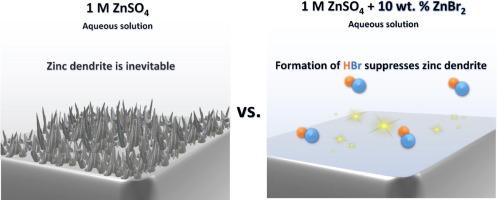
Aqueous zinc-ion batteries (AZIBs) have attracted great attention for energy storage because of the safety of zinc metal in ambient air. However, the growth of zinc dendrites during repeated electrochemical cycles have hindered their practical use. To address this issue, we introduced ZnBr2 as an additive in an aqueous 1 M ZnSO4 electrolyte, effectively suppressing the dendritic growth on the surface of the zinc-metal anode. Significant improvement in Zn||Zn symmetric cell tests using 10 wt% ZnBr2-added electrolyte was observed, with a lifespan of 12,500 cycles achieved even at a high current density of 50 mA cm−2 with an areal capacity of 1 mAh cm−2. Raman spectroscopy reveals formation of HBr in the electrolyte after 12 h deposition of zinc. The presence of HBr in the electrolyte effectively suppresses the dendritic growth of zinc, as visualized by an operando beaker-cell test and synchrotron tomography. We further demonstrated the compatibility and excellent rate performance of the additive-based electrolyte in Zn || NaV3O8 full cells. Our findings provide a simple and cost-effective method to suppress dendritic growth of zinc in zinc-metal batteries.
由于锌金属在环境空气中的安全性,水溶液锌离子电池(AZIBs)在储能方面受到广泛关注。然而,锌枝晶在反复电化学循环过程中的生长阻碍了其实际应用。为了解决这个问题,我们将ZnBr2作为添加剂引入到1 M ZnSO4水溶液中,有效地抑制了锌金属阳极表面的枝晶生长。使用添加了10 wt% znbr2的电解质,锌对称电池测试得到了显著改善,即使在50 mA cm - 2的高电流密度下,面积容量为1 mAh cm - 2,寿命也达到了12,500次循环。拉曼光谱揭示了12 h锌沉积后电解质中HBr的形成。电解质中HBr的存在有效地抑制了锌的枝晶生长,这是通过操作蛋白烧杯细胞测试和同步加速器断层扫描可见的。我们进一步证明了添加剂基电解质在Zn || NaV3O8充满电池中的相容性和优异的倍率性能。我们的发现为抑制锌金属电池中锌的枝晶生长提供了一种简单而经济的方法
期刊介绍:
The Chemical Engineering Journal is an international research journal that invites contributions of original and novel fundamental research. It aims to provide an international platform for presenting original fundamental research, interpretative reviews, and discussions on new developments in chemical engineering. The journal welcomes papers that describe novel theory and its practical application, as well as those that demonstrate the transfer of techniques from other disciplines. It also welcomes reports on carefully conducted experimental work that is soundly interpreted. The main focus of the journal is on original and rigorous research results that have broad significance. The Catalysis section within the Chemical Engineering Journal focuses specifically on Experimental and Theoretical studies in the fields of heterogeneous catalysis, molecular catalysis, and biocatalysis. These studies have industrial impact on various sectors such as chemicals, energy, materials, foods, healthcare, and environmental protection.




 京公网安备 11010802042870号
京ICP备2023020795号-1
京公网安备 11010802042870号
京ICP备2023020795号-1

 分享
分享
 求助内容:
求助内容: 应助结果提醒方式:
 扫码关注我们
