{"title":"Rational Design of Nanozymes for Engineered Cascade Catalytic Cancer Therapy","authors":"Xiuna Jia, Erkang Wang, Jin Wang","doi":"10.1021/acs.chemrev.4c00882","DOIUrl":null,"url":null,"abstract":"Nanozymes have shown significant potential in cancer catalytic therapy by strategically catalyzing tumor-associated substances and metabolites into toxic reactive oxygen species (ROS) <i>in situ</i>, thereby inducing oxidative stress and promoting cancer cell death. However, within the complex tumor microenvironment (TME), the rational design of nanozymes and factors like activity, reaction substrates, and the TME itself significantly influence the efficiency of ROS generation. To address these limitations, recent research has focused on exploring the factors that affect activity and developing nanozyme-based cascade catalytic systems, which can trigger two or more cascade catalytic processes within tumors, thereby producing more therapeutic substances and achieving efficient and stable cancer therapy with minimal side effects. This area has shown remarkable progress. This Perspective provides a comprehensive overview of nanozymes, covering their classification and fundamentals. The regulation of nanozyme activity and efficient strategies of rational design are discussed in detail. Furthermore, representative paradigms for the successful construction of cascade catalytic systems for cancer treatment are summarized with a focus on revealing the underlying catalytic mechanisms. Finally, we address the current challenges and future prospects for the development of nanozyme-based cascade catalytic systems in biomedical applications.","PeriodicalId":32,"journal":{"name":"Chemical Reviews","volume":"28 1","pages":""},"PeriodicalIF":55.8000,"publicationDate":"2025-01-27","publicationTypes":"Journal Article","fieldsOfStudy":null,"isOpenAccess":false,"openAccessPdf":"","citationCount":"0","resultStr":null,"platform":"Semanticscholar","paperid":null,"PeriodicalName":"Chemical Reviews","FirstCategoryId":"92","ListUrlMain":"https://doi.org/10.1021/acs.chemrev.4c00882","RegionNum":1,"RegionCategory":"化学","ArticlePicture":[],"TitleCN":null,"AbstractTextCN":null,"PMCID":null,"EPubDate":"","PubModel":"","JCR":"Q1","JCRName":"CHEMISTRY, MULTIDISCIPLINARY","Score":null,"Total":0}
引用次数: 0
Abstract
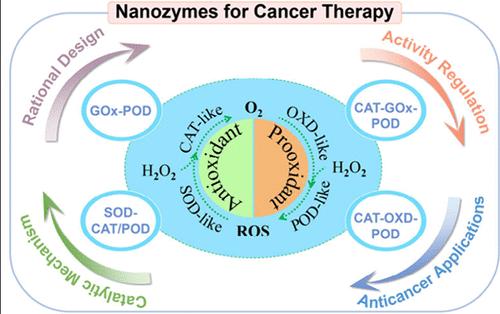
Nanozymes have shown significant potential in cancer catalytic therapy by strategically catalyzing tumor-associated substances and metabolites into toxic reactive oxygen species (ROS) in situ, thereby inducing oxidative stress and promoting cancer cell death. However, within the complex tumor microenvironment (TME), the rational design of nanozymes and factors like activity, reaction substrates, and the TME itself significantly influence the efficiency of ROS generation. To address these limitations, recent research has focused on exploring the factors that affect activity and developing nanozyme-based cascade catalytic systems, which can trigger two or more cascade catalytic processes within tumors, thereby producing more therapeutic substances and achieving efficient and stable cancer therapy with minimal side effects. This area has shown remarkable progress. This Perspective provides a comprehensive overview of nanozymes, covering their classification and fundamentals. The regulation of nanozyme activity and efficient strategies of rational design are discussed in detail. Furthermore, representative paradigms for the successful construction of cascade catalytic systems for cancer treatment are summarized with a focus on revealing the underlying catalytic mechanisms. Finally, we address the current challenges and future prospects for the development of nanozyme-based cascade catalytic systems in biomedical applications.
期刊介绍:
Chemical Reviews is a highly regarded and highest-ranked journal covering the general topic of chemistry. Its mission is to provide comprehensive, authoritative, critical, and readable reviews of important recent research in organic, inorganic, physical, analytical, theoretical, and biological chemistry.
Since 1985, Chemical Reviews has also published periodic thematic issues that focus on a single theme or direction of emerging research.



 京公网安备 11010802042870号
京ICP备2023020795号-1
京公网安备 11010802042870号
京ICP备2023020795号-1

 分享
分享
 求助内容:
求助内容: 应助结果提醒方式:
 扫码关注我们
