Pratik Mishra, Devendra Nath Goswami, Santosh Kumar, Rajan Jha
{"title":"Polymer-Layered Optical Wearable (PLOW) for Healthcare Applications: Temperature and Stretching Monitoring","authors":"Pratik Mishra, Devendra Nath Goswami, Santosh Kumar, Rajan Jha","doi":"10.1021/acsami.4c21034","DOIUrl":null,"url":null,"abstract":"Thermal and stretching characteristics are crucial variables in healthcare, robotics, and human-machine interaction applications. Here, we present a single-mode fiber-based, balloon-shaped, single- and dual polymer-layered optical wearable (PLOW) system that can sense both temperature and stretching. These two types of PLOWs are compared in terms of their detection performance across all criteria. Dual polymer-based systems have a substantial temperature sensitivity of −1.39 nm/°C, while single polymer ones show a sensitivity of −0.18 nm/°C. The increased sensitivity is attributed to the higher thermo-optic coefficient of the bipolymer (polymer jacket and PDMS) encasing. In terms of stretching sensing, single PLOWs beat dual ones for both longitudinal and lateral stretching due to the large change in shape variable at the same extrusion pressure in single PLOWs. The fast temporal response, high-temperature tolerance, long-term stability, and stretching sensitivity of both PLOWs make them ideal for real-time monitoring of skin temperature, wrist pulse, voice recognition, and different mechanical stimuli. These measures are critical for correctly assessing invasive human health parameters. We believe that these technologies will hold tremendous promise in wearable optical systems, with applications ranging from healthcare to humanoid robotics.","PeriodicalId":5,"journal":{"name":"ACS Applied Materials & Interfaces","volume":"12 1","pages":""},"PeriodicalIF":8.2000,"publicationDate":"2025-01-28","publicationTypes":"Journal Article","fieldsOfStudy":null,"isOpenAccess":false,"openAccessPdf":"","citationCount":"0","resultStr":null,"platform":"Semanticscholar","paperid":null,"PeriodicalName":"ACS Applied Materials & Interfaces","FirstCategoryId":"88","ListUrlMain":"https://doi.org/10.1021/acsami.4c21034","RegionNum":2,"RegionCategory":"材料科学","ArticlePicture":[],"TitleCN":null,"AbstractTextCN":null,"PMCID":null,"EPubDate":"","PubModel":"","JCR":"Q1","JCRName":"MATERIALS SCIENCE, MULTIDISCIPLINARY","Score":null,"Total":0}
引用次数: 0
Abstract
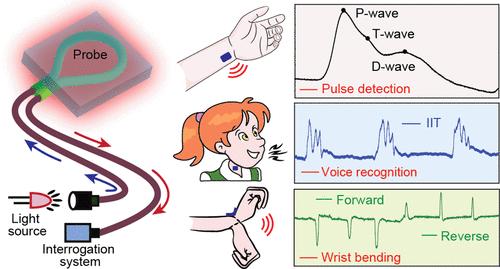
Thermal and stretching characteristics are crucial variables in healthcare, robotics, and human-machine interaction applications. Here, we present a single-mode fiber-based, balloon-shaped, single- and dual polymer-layered optical wearable (PLOW) system that can sense both temperature and stretching. These two types of PLOWs are compared in terms of their detection performance across all criteria. Dual polymer-based systems have a substantial temperature sensitivity of −1.39 nm/°C, while single polymer ones show a sensitivity of −0.18 nm/°C. The increased sensitivity is attributed to the higher thermo-optic coefficient of the bipolymer (polymer jacket and PDMS) encasing. In terms of stretching sensing, single PLOWs beat dual ones for both longitudinal and lateral stretching due to the large change in shape variable at the same extrusion pressure in single PLOWs. The fast temporal response, high-temperature tolerance, long-term stability, and stretching sensitivity of both PLOWs make them ideal for real-time monitoring of skin temperature, wrist pulse, voice recognition, and different mechanical stimuli. These measures are critical for correctly assessing invasive human health parameters. We believe that these technologies will hold tremendous promise in wearable optical systems, with applications ranging from healthcare to humanoid robotics.
期刊介绍:
ACS Applied Materials & Interfaces is a leading interdisciplinary journal that brings together chemists, engineers, physicists, and biologists to explore the development and utilization of newly-discovered materials and interfacial processes for specific applications. Our journal has experienced remarkable growth since its establishment in 2009, both in terms of the number of articles published and the impact of the research showcased. We are proud to foster a truly global community, with the majority of published articles originating from outside the United States, reflecting the rapid growth of applied research worldwide.



 京公网安备 11010802042870号
京ICP备2023020795号-1
京公网安备 11010802042870号
京ICP备2023020795号-1

 分享
分享
 求助内容:
求助内容: 应助结果提醒方式:
 扫码关注我们
