Siyang Cheng, Yuanhang Yang, Xueliang Zhu, Yahui Li, Hao Li, Wenqi Xiong, Zhuo Zheng, Sheng Li, Yong Liu, Xiaoze Liu, Qianqian Lin, Shengjun Yuan, Enzheng Shi and Zhiping Wang
{"title":"Enhanced electrical performance of perovskite solar cells via strain engineering†","authors":"Siyang Cheng, Yuanhang Yang, Xueliang Zhu, Yahui Li, Hao Li, Wenqi Xiong, Zhuo Zheng, Sheng Li, Yong Liu, Xiaoze Liu, Qianqian Lin, Shengjun Yuan, Enzheng Shi and Zhiping Wang","doi":"10.1039/D4EE03760J","DOIUrl":null,"url":null,"abstract":"<p >Strain plays a pivotal role in determining the electronic properties and overall performance of perovskite solar cells. Here, we identify that the conventional crystallization process induces strain heterogeneity along the vertical direction within perovskite films due to the fast solvent evaporation at the gas–liquid interface, leading to a gradual crystallization from top to bottom. By combining experimental and modelling analyses, we find that this heterogeneity modulates the energy band landscape within the perovskite, consequently restricting charge transport within the film. We address this issue by incorporating a small amount of 2-([2,2′-bithiophen]-5-yl) ethan-1-aminium iodide into perovskites, which selectively binds with the lead halide octahedra in the top surface region, regulating spatial strain distribution in a manner that promotes favourable charge transport. Applying this strategy in formamidinium-cesium-based inverted cells, we achieve an efficiency of 25.96% (certified 25.2%), with a high electrical performance of 1.014 V, surpassing 88% of the Shockley–Queisser limit. The regulated strain also demonstrates a positive impact on device stability. The best encapsulated cell, operated at the maximum power point, retains 88% of its initial efficiency after aging under one sun illumination at 55 ± 5 °C for 1500 hours in ambient air.</p>","PeriodicalId":72,"journal":{"name":"Energy & Environmental Science","volume":" 5","pages":" 2452-2461"},"PeriodicalIF":30.8000,"publicationDate":"2025-01-28","publicationTypes":"Journal Article","fieldsOfStudy":null,"isOpenAccess":false,"openAccessPdf":"","citationCount":"0","resultStr":null,"platform":"Semanticscholar","paperid":null,"PeriodicalName":"Energy & Environmental Science","FirstCategoryId":"88","ListUrlMain":"https://pubs.rsc.org/en/content/articlelanding/2025/ee/d4ee03760j","RegionNum":1,"RegionCategory":"材料科学","ArticlePicture":[],"TitleCN":null,"AbstractTextCN":null,"PMCID":null,"EPubDate":"","PubModel":"","JCR":"Q1","JCRName":"CHEMISTRY, MULTIDISCIPLINARY","Score":null,"Total":0}
引用次数: 0
Abstract
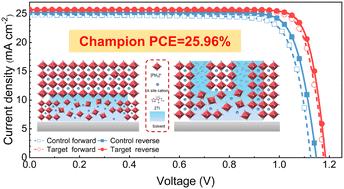
Strain plays a pivotal role in determining the electronic properties and overall performance of perovskite solar cells. Here, we identify that the conventional crystallization process induces strain heterogeneity along the vertical direction within perovskite films due to the fast solvent evaporation at the gas–liquid interface, leading to a gradual crystallization from top to bottom. By combining experimental and modelling analyses, we find that this heterogeneity modulates the energy band landscape within the perovskite, consequently restricting charge transport within the film. We address this issue by incorporating a small amount of 2-([2,2′-bithiophen]-5-yl) ethan-1-aminium iodide into perovskites, which selectively binds with the lead halide octahedra in the top surface region, regulating spatial strain distribution in a manner that promotes favourable charge transport. Applying this strategy in formamidinium-cesium-based inverted cells, we achieve an efficiency of 25.96% (certified 25.2%), with a high electrical performance of 1.014 V, surpassing 88% of the Shockley–Queisser limit. The regulated strain also demonstrates a positive impact on device stability. The best encapsulated cell, operated at the maximum power point, retains 88% of its initial efficiency after aging under one sun illumination at 55 ± 5 °C for 1500 hours in ambient air.
应变在决定钙钛矿太阳能电池的电子性能和整体性能方面起着关键作用。在这里,我们发现传统的结晶过程由于在气液界面处溶剂的快速蒸发导致钙钛矿膜内沿垂直方向的应变非均质性,导致从上到下逐渐结晶。通过结合实验和模型分析,我们发现这种非均质性调节了钙钛矿内部的能带景观,从而限制了薄膜内的电荷输运。我们通过在钙钛矿中加入少量的2-([2,2'-bithiophen]-5-yl) e -1-碘化铵来解决这个问题,钙钛矿可以选择性地与顶部表面区域的卤化铅八面体结合,以促进有利的电荷传输的方式调节空间应变分布。将该策略应用于基于formamidium -cesium的倒置电池,我们实现了25.96%的效率(认证为25.2%),具有1.014 V的高电性能,超过了Shockley-Queisser极限的88%。调节应变也显示出对器件稳定性的积极影响。最好的封装电池,在最大功率点运行,在55±5°C的环境空气中一次太阳照射1500小时后,老化后仍保持其初始效率的88%。
期刊介绍:
Energy & Environmental Science, a peer-reviewed scientific journal, publishes original research and review articles covering interdisciplinary topics in the (bio)chemical and (bio)physical sciences, as well as chemical engineering disciplines. Published monthly by the Royal Society of Chemistry (RSC), a not-for-profit publisher, Energy & Environmental Science is recognized as a leading journal. It boasts an impressive impact factor of 8.500 as of 2009, ranking 8th among 140 journals in the category "Chemistry, Multidisciplinary," second among 71 journals in "Energy & Fuels," second among 128 journals in "Engineering, Chemical," and first among 181 scientific journals in "Environmental Sciences."
Energy & Environmental Science publishes various types of articles, including Research Papers (original scientific work), Review Articles, Perspectives, and Minireviews (feature review-type articles of broad interest), Communications (original scientific work of an urgent nature), Opinions (personal, often speculative viewpoints or hypotheses on current topics), and Analysis Articles (in-depth examination of energy-related issues).



 京公网安备 11010802042870号
京ICP备2023020795号-1
京公网安备 11010802042870号
京ICP备2023020795号-1

 分享
分享
 求助内容:
求助内容: 应助结果提醒方式:
 扫码关注我们
