Byungwook Kang, Jonghun Park, Byunghoon Kim, Sung-O Park, Jaekyun Yoo, Seungju Yu, Hyuk-Joon Kim, Jun-Hyuk Song and Kisuk Kang
{"title":"Elucidating lithium-ion diffusion kinetics in cation-disordered rocksalt cathodes†","authors":"Byungwook Kang, Jonghun Park, Byunghoon Kim, Sung-O Park, Jaekyun Yoo, Seungju Yu, Hyuk-Joon Kim, Jun-Hyuk Song and Kisuk Kang","doi":"10.1039/D4EE04580G","DOIUrl":null,"url":null,"abstract":"<p >Disordered rocksalt (DRX) cathodes have emerged as a promising alternative to conventional nickel/cobalt-based layered oxides owing to their higher specific capacities using earth-abundant elements. However, the poor rate capability of DRX is a critical bottleneck in practical battery operations, which is often attributed to sluggish lithium and/or electronic conduction. In this study, we elucidated the lithium diffusion mechanism in DRX, exploiting a ‘diffusion cluster’ model within a machine-learning scheme, thus effectively addressing the complexity of randomly distributed cations in the structure. Our findings revealed that DRXs intrinsically possess various diffusion paths with activation barriers that widely range from 200 meV to 1.3 eV owing to diverse lithium hopping environments created by disordered cations. Notably, we discovered that migration bottlenecks along lithium percolation paths are primarily caused by large energy differences between lithium sites (as high as ∼1 eV) rather than the transition state energy during lithium hopping, contrary to the conventional diffusion mechanism in ordered structures. The significantly broad distribution of lithium site energies is attributed to the distortion of the shape and size of lithium sites in oxides caused by disordered cations in DRX, <em>e.g.</em>, Li<small><sub>1.2</sub></small>Mn<small><sub>0.4</sub></small>Ti<small><sub>0.4</sub></small>O<small><sub>2</sub></small>. Consequently, the large energy step from one site to the other acts as a <em>de facto</em> barrier for lithium hopping, impeding the overall lithium diffusion process. This new finding suggests that the key to improve the rate performance of DRX lies in flattening the landscape of lithium site energies, thus balancing the degree of cation disorder in DRX.</p>","PeriodicalId":72,"journal":{"name":"Energy & Environmental Science","volume":" 5","pages":" 2330-2341"},"PeriodicalIF":30.8000,"publicationDate":"2025-01-28","publicationTypes":"Journal Article","fieldsOfStudy":null,"isOpenAccess":false,"openAccessPdf":"","citationCount":"0","resultStr":null,"platform":"Semanticscholar","paperid":null,"PeriodicalName":"Energy & Environmental Science","FirstCategoryId":"88","ListUrlMain":"https://pubs.rsc.org/en/content/articlelanding/2025/ee/d4ee04580g","RegionNum":1,"RegionCategory":"材料科学","ArticlePicture":[],"TitleCN":null,"AbstractTextCN":null,"PMCID":null,"EPubDate":"","PubModel":"","JCR":"Q1","JCRName":"CHEMISTRY, MULTIDISCIPLINARY","Score":null,"Total":0}
引用次数: 0
Abstract
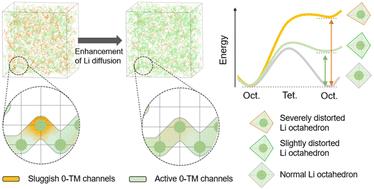
Disordered rocksalt (DRX) cathodes have emerged as a promising alternative to conventional nickel/cobalt-based layered oxides owing to their higher specific capacities using earth-abundant elements. However, the poor rate capability of DRX is a critical bottleneck in practical battery operations, which is often attributed to sluggish lithium and/or electronic conduction. In this study, we elucidated the lithium diffusion mechanism in DRX, exploiting a ‘diffusion cluster’ model within a machine-learning scheme, thus effectively addressing the complexity of randomly distributed cations in the structure. Our findings revealed that DRXs intrinsically possess various diffusion paths with activation barriers that widely range from 200 meV to 1.3 eV owing to diverse lithium hopping environments created by disordered cations. Notably, we discovered that migration bottlenecks along lithium percolation paths are primarily caused by large energy differences between lithium sites (as high as ∼1 eV) rather than the transition state energy during lithium hopping, contrary to the conventional diffusion mechanism in ordered structures. The significantly broad distribution of lithium site energies is attributed to the distortion of the shape and size of lithium sites in oxides caused by disordered cations in DRX, e.g., Li1.2Mn0.4Ti0.4O2. Consequently, the large energy step from one site to the other acts as a de facto barrier for lithium hopping, impeding the overall lithium diffusion process. This new finding suggests that the key to improve the rate performance of DRX lies in flattening the landscape of lithium site energies, thus balancing the degree of cation disorder in DRX.
期刊介绍:
Energy & Environmental Science, a peer-reviewed scientific journal, publishes original research and review articles covering interdisciplinary topics in the (bio)chemical and (bio)physical sciences, as well as chemical engineering disciplines. Published monthly by the Royal Society of Chemistry (RSC), a not-for-profit publisher, Energy & Environmental Science is recognized as a leading journal. It boasts an impressive impact factor of 8.500 as of 2009, ranking 8th among 140 journals in the category "Chemistry, Multidisciplinary," second among 71 journals in "Energy & Fuels," second among 128 journals in "Engineering, Chemical," and first among 181 scientific journals in "Environmental Sciences."
Energy & Environmental Science publishes various types of articles, including Research Papers (original scientific work), Review Articles, Perspectives, and Minireviews (feature review-type articles of broad interest), Communications (original scientific work of an urgent nature), Opinions (personal, often speculative viewpoints or hypotheses on current topics), and Analysis Articles (in-depth examination of energy-related issues).




 京公网安备 11010802042870号
京ICP备2023020795号-1
京公网安备 11010802042870号
京ICP备2023020795号-1

 分享
分享
 求助内容:
求助内容: 应助结果提醒方式:
 扫码关注我们
