Yuting Wang, Zhuang Yang, Hao Xiu, Fan Fan, Pan An, Yongpeng Cui, Yajun Wang, Wenqing Yao
{"title":"Recent Progress in Advanced Catalytic Strategies for C─F Bond Cleavage in Waste Refrigerants: A Review","authors":"Yuting Wang, Zhuang Yang, Hao Xiu, Fan Fan, Pan An, Yongpeng Cui, Yajun Wang, Wenqing Yao","doi":"10.1002/adfm.202420883","DOIUrl":null,"url":null,"abstract":"<p>The degradation of fluorinated refrigerants, known for their highly stable carbon-fluorine (C─F) bonds, poses significant environmental and technical challenges. This review addresses these challenges by analyzing two core degradation mechanisms: molecular polarization (MP) and free radical attack (FRA), and exploring their applications in thermal catalytic and photocatalytic processes. MP redistributes electron density to weaken C─F bonds, facilitating adsorption and bond cleavage, while radical attack involves reactive species that directly break chemical bonds. However, both mechanisms have limitations: MP alone may lack the kinetic drive for dissociation, and radical-based methods often suffer from low selectivity, short radical lifetimes, and the formation of toxic intermediates. The section on thermal catalytic degradation discusses how elevated temperatures enhance bond cleavage through MP, addressing adsorption challenges and accelerating dissociation. The part on photocatalytic degradation focuses on the role of light-activated processes in generating reactive radicals and facilitating bond breaking, with an emphasis on visible and ultraviolet light-driven reactions. The review concludes by exploring the potential of hybrid catalytic systems that combine thermal and photocatalytic processes, providing insights into the complementary use of these mechanisms for the degradation of persistent fluorinated compounds.</p>","PeriodicalId":112,"journal":{"name":"Advanced Functional Materials","volume":"35 19","pages":""},"PeriodicalIF":19.0000,"publicationDate":"2025-01-28","publicationTypes":"Journal Article","fieldsOfStudy":null,"isOpenAccess":false,"openAccessPdf":"","citationCount":"0","resultStr":null,"platform":"Semanticscholar","paperid":null,"PeriodicalName":"Advanced Functional Materials","FirstCategoryId":"88","ListUrlMain":"https://advanced.onlinelibrary.wiley.com/doi/10.1002/adfm.202420883","RegionNum":1,"RegionCategory":"材料科学","ArticlePicture":[],"TitleCN":null,"AbstractTextCN":null,"PMCID":null,"EPubDate":"","PubModel":"","JCR":"Q1","JCRName":"CHEMISTRY, MULTIDISCIPLINARY","Score":null,"Total":0}
引用次数: 0
Abstract
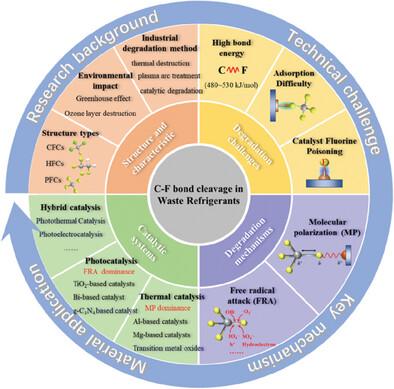
The degradation of fluorinated refrigerants, known for their highly stable carbon-fluorine (C─F) bonds, poses significant environmental and technical challenges. This review addresses these challenges by analyzing two core degradation mechanisms: molecular polarization (MP) and free radical attack (FRA), and exploring their applications in thermal catalytic and photocatalytic processes. MP redistributes electron density to weaken C─F bonds, facilitating adsorption and bond cleavage, while radical attack involves reactive species that directly break chemical bonds. However, both mechanisms have limitations: MP alone may lack the kinetic drive for dissociation, and radical-based methods often suffer from low selectivity, short radical lifetimes, and the formation of toxic intermediates. The section on thermal catalytic degradation discusses how elevated temperatures enhance bond cleavage through MP, addressing adsorption challenges and accelerating dissociation. The part on photocatalytic degradation focuses on the role of light-activated processes in generating reactive radicals and facilitating bond breaking, with an emphasis on visible and ultraviolet light-driven reactions. The review concludes by exploring the potential of hybrid catalytic systems that combine thermal and photocatalytic processes, providing insights into the complementary use of these mechanisms for the degradation of persistent fluorinated compounds.
期刊介绍:
Firmly established as a top-tier materials science journal, Advanced Functional Materials reports breakthrough research in all aspects of materials science, including nanotechnology, chemistry, physics, and biology every week.
Advanced Functional Materials is known for its rapid and fair peer review, quality content, and high impact, making it the first choice of the international materials science community.







 京公网安备 11010802042870号
京ICP备2023020795号-1
京公网安备 11010802042870号
京ICP备2023020795号-1

 分享
分享
 求助内容:
求助内容: 应助结果提醒方式:
 扫码关注我们
