Kanghee Park, Hye Won Lee, Euichang Kim, Won-Mook Choi, Danbi Lee, Ju Hyun Shim, Kang Mo Kim, Young-Suk Lim, Han Chu Lee, Changhoon Yoo, Baek-Yeol Ryoo, Seungbong Han, Jonggi Choi
{"title":"Risk of Variceal Bleeding in Patients Receiving Atezolizumab–Bevacizumab Treatment for Hepatocellular Carcinoma","authors":"Kanghee Park, Hye Won Lee, Euichang Kim, Won-Mook Choi, Danbi Lee, Ju Hyun Shim, Kang Mo Kim, Young-Suk Lim, Han Chu Lee, Changhoon Yoo, Baek-Yeol Ryoo, Seungbong Han, Jonggi Choi","doi":"10.1111/apt.18526","DOIUrl":null,"url":null,"abstract":"<div>\n \n \n <section>\n \n <h3> Background and Aims</h3>\n \n <p>Real-world data on the variceal bleeding (VB) risk in patients receiving atezolizumab–bevacizumab (Atezo–Bev) treatment remain limited. This study aimed to assess the risk of VB and identify risk factors in patients with advanced hepatocellular carcinoma (HCC) receiving Atezo–Bev treatment.</p>\n </section>\n \n <section>\n \n <h3> Methods</h3>\n \n <p>This retrospective study included 640 patients with HCC who underwent endoscopy before Atezo–Bev treatment at two hospitals in Korea. The primary outcome was the occurrence of VB, with non-VB events considered as competing events.</p>\n </section>\n \n <section>\n \n <h3> Results</h3>\n \n <p>Of the 640 patients, the mean age was 61.3 years, and 528 (82.5%) patients were male. The main aetiology of HCC was chronic hepatitis B virus (69.5%), and 563 (88.0%) had BCLC stage C. Portal vein invasion (PVI) was present in 313 (48.9%). During a median follow-up of 5.6 months, 45 (7.0%) patients developed VB. The cumulative incidence of VB was 6.3% at 6 months and 7.4% at 12 months. No patient died from VB. Multivariable analysis revealed that the main PVI (subdistribution hazard ratio [SHR]: 3.49, 95% confidence interval [CI]: 1.63–7.44), low platelet count (SHR: 0.994, 95% CI: 0.99–1.00), a history of gastrointestinal (GI) bleeding (SHR: 3.70, 95% CI: 1.49–9.16) and varices needing treatment (VNT; SHR: 2.67, 95% CI: 1.26–5.64) increased the risk of VB.</p>\n </section>\n \n <section>\n \n <h3> Conclusion</h3>\n \n <p>A low platelet count, main PVI, history of GI bleeding and VNT were significant risk factors for VB in patients receiving Atezo–Bev treatment for HCC. Identifying these factors can guide clinicians in assessing and managing VB risk in clinical settings.</p>\n </section>\n </div>","PeriodicalId":121,"journal":{"name":"Alimentary Pharmacology & Therapeutics","volume":"61 8","pages":"1310-1317"},"PeriodicalIF":6.7000,"publicationDate":"2025-01-28","publicationTypes":"Journal Article","fieldsOfStudy":null,"isOpenAccess":false,"openAccessPdf":"","citationCount":"0","resultStr":null,"platform":"Semanticscholar","paperid":null,"PeriodicalName":"Alimentary Pharmacology & Therapeutics","FirstCategoryId":"3","ListUrlMain":"https://onlinelibrary.wiley.com/doi/10.1111/apt.18526","RegionNum":1,"RegionCategory":"医学","ArticlePicture":[],"TitleCN":null,"AbstractTextCN":null,"PMCID":null,"EPubDate":"","PubModel":"","JCR":"Q1","JCRName":"GASTROENTEROLOGY & HEPATOLOGY","Score":null,"Total":0}
引用次数: 0
Abstract
Background and Aims
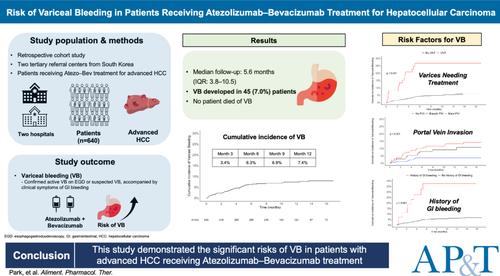
Real-world data on the variceal bleeding (VB) risk in patients receiving atezolizumab–bevacizumab (Atezo–Bev) treatment remain limited. This study aimed to assess the risk of VB and identify risk factors in patients with advanced hepatocellular carcinoma (HCC) receiving Atezo–Bev treatment.
Methods
This retrospective study included 640 patients with HCC who underwent endoscopy before Atezo–Bev treatment at two hospitals in Korea. The primary outcome was the occurrence of VB, with non-VB events considered as competing events.
Results
Of the 640 patients, the mean age was 61.3 years, and 528 (82.5%) patients were male. The main aetiology of HCC was chronic hepatitis B virus (69.5%), and 563 (88.0%) had BCLC stage C. Portal vein invasion (PVI) was present in 313 (48.9%). During a median follow-up of 5.6 months, 45 (7.0%) patients developed VB. The cumulative incidence of VB was 6.3% at 6 months and 7.4% at 12 months. No patient died from VB. Multivariable analysis revealed that the main PVI (subdistribution hazard ratio [SHR]: 3.49, 95% confidence interval [CI]: 1.63–7.44), low platelet count (SHR: 0.994, 95% CI: 0.99–1.00), a history of gastrointestinal (GI) bleeding (SHR: 3.70, 95% CI: 1.49–9.16) and varices needing treatment (VNT; SHR: 2.67, 95% CI: 1.26–5.64) increased the risk of VB.
Conclusion
A low platelet count, main PVI, history of GI bleeding and VNT were significant risk factors for VB in patients receiving Atezo–Bev treatment for HCC. Identifying these factors can guide clinicians in assessing and managing VB risk in clinical settings.
期刊介绍:
Alimentary Pharmacology & Therapeutics is a global pharmacology journal focused on the impact of drugs on the human gastrointestinal and hepato-biliary systems. It covers a diverse range of topics, often with immediate clinical relevance to its readership.