Kristoffer Jonsson, Anne-Lise Routier-Kierzkowska, Rishikesh P. Bhalerao
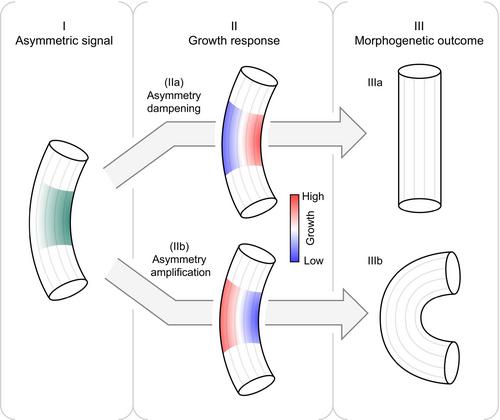
{"title":"The asymmetry engine: how plants harness asymmetries to shape their bodies","authors":"Kristoffer Jonsson, Anne-Lise Routier-Kierzkowska, Rishikesh P. Bhalerao","doi":"10.1111/nph.20413","DOIUrl":null,"url":null,"abstract":"<p>Plant development depends on growth asymmetry to establish body plans and adapt to environmental stimuli. We explore how plants initiate, propagate, and regulate organ-wide growth asymmetries. External cues, such as light and gravity, and internal signals, including stochastic cellular growth variability, drive these asymmetries. The plant hormone auxin orchestrates growth asymmetry through its distribution and transport. Mechanochemical feedback loops, exemplified by apical hook formation, further amplify growth asymmetries, illustrating the dynamic interplay between biochemical signals and physical forces. Growth asymmetry itself can serve as a continuous cue, influencing subsequent growth decisions. By examining specific cellular programs and their responses to asymmetric cues, we propose that the decision to either amplify or dampen these asymmetries is key to shaping plant organs.</p>","PeriodicalId":214,"journal":{"name":"New Phytologist","volume":"245 6","pages":"2422-2427"},"PeriodicalIF":8.1000,"publicationDate":"2025-01-28","publicationTypes":"Journal Article","fieldsOfStudy":null,"isOpenAccess":false,"openAccessPdf":"https://onlinelibrary.wiley.com/doi/epdf/10.1111/nph.20413","citationCount":"0","resultStr":null,"platform":"Semanticscholar","paperid":null,"PeriodicalName":"New Phytologist","FirstCategoryId":"99","ListUrlMain":"https://nph.onlinelibrary.wiley.com/doi/10.1111/nph.20413","RegionNum":1,"RegionCategory":"生物学","ArticlePicture":[],"TitleCN":null,"AbstractTextCN":null,"PMCID":null,"EPubDate":"","PubModel":"","JCR":"Q1","JCRName":"PLANT SCIENCES","Score":null,"Total":0}
引用次数: 0
Abstract
Plant development depends on growth asymmetry to establish body plans and adapt to environmental stimuli. We explore how plants initiate, propagate, and regulate organ-wide growth asymmetries. External cues, such as light and gravity, and internal signals, including stochastic cellular growth variability, drive these asymmetries. The plant hormone auxin orchestrates growth asymmetry through its distribution and transport. Mechanochemical feedback loops, exemplified by apical hook formation, further amplify growth asymmetries, illustrating the dynamic interplay between biochemical signals and physical forces. Growth asymmetry itself can serve as a continuous cue, influencing subsequent growth decisions. By examining specific cellular programs and their responses to asymmetric cues, we propose that the decision to either amplify or dampen these asymmetries is key to shaping plant organs.
期刊介绍:
New Phytologist is an international electronic journal published 24 times a year. It is owned by the New Phytologist Foundation, a non-profit-making charitable organization dedicated to promoting plant science. The journal publishes excellent, novel, rigorous, and timely research and scholarship in plant science and its applications. The articles cover topics in five sections: Physiology & Development, Environment, Interaction, Evolution, and Transformative Plant Biotechnology. These sections encompass intracellular processes, global environmental change, and encourage cross-disciplinary approaches. The journal recognizes the use of techniques from molecular and cell biology, functional genomics, modeling, and system-based approaches in plant science. Abstracting and Indexing Information for New Phytologist includes Academic Search, AgBiotech News & Information, Agroforestry Abstracts, Biochemistry & Biophysics Citation Index, Botanical Pesticides, CAB Abstracts®, Environment Index, Global Health, and Plant Breeding Abstracts, and others.





 京公网安备 11010802042870号
京ICP备2023020795号-1
京公网安备 11010802042870号
京ICP备2023020795号-1

 分享
分享
 求助内容:
求助内容: 应助结果提醒方式:
 扫码关注我们
