Aaron Potkay, Antoine Cabon, Richard L. Peters, Patrick Fonti, Gerard Sapes, Anna Sala, Artur Stefanski, Ethan Butler, Raimundo Bermudez, Rebecca Montgomery, Peter B. Reich, Xue Feng
{"title":"Generalized Stomatal Optimization of Evolutionary Fitness Proxies for Predicting Plant Gas Exchange Under Drought, Heatwaves, and Elevated CO2","authors":"Aaron Potkay, Antoine Cabon, Richard L. Peters, Patrick Fonti, Gerard Sapes, Anna Sala, Artur Stefanski, Ethan Butler, Raimundo Bermudez, Rebecca Montgomery, Peter B. Reich, Xue Feng","doi":"10.1111/gcb.70049","DOIUrl":null,"url":null,"abstract":"<p>Stomata control plant water loss and photosynthetic carbon gain. Developing more generalized and accurate stomatal models is essential for earth system models and predicting responses under novel environmental conditions associated with global change. Plant optimality theories offer one promising approach, but most such theories assume that stomatal conductance maximizes photosynthetic net carbon assimilation subject to some cost or <i>constraint</i> of water. We move beyond this approach by developing a new, generalized optimality theory of stomatal conductance, optimizing any non-foliar proxy that requires water and carbon reserves, like growth, survival, and reproduction. We overcome two prior limitations. First, we reconcile the computational efficiency of <i>instantaneous</i> optimization with a more biologically meaningful <i>dynamic feedback</i> optimization over plant lifespans. Second, we incorporate <i>non-steady-state</i> physics in the optimization to account for the temporal changes in the water, carbon, and energy storage within a plant and its environment that occur over the timescales that stomata act, contrary to previous theories. Our optimal stomatal conductance compares well to observations from seedlings, saplings, and mature trees from field and greenhouse experiments. Our model predicts predispositions to mortality during the 2018 European drought and captures realistic responses to environmental cues, including the partial alleviation of heat stress by evaporative cooling and the negative effect of accumulating foliar soluble carbohydrates, promoting closure under elevated CO<sub>2</sub>. We advance stomatal optimality theory by incorporating generalized evolutionary fitness proxies and enhance its utility without compromising its realism, offering promise for future models to more realistically and accurately predict global carbon and water fluxes.</p>","PeriodicalId":175,"journal":{"name":"Global Change Biology","volume":"31 1","pages":""},"PeriodicalIF":12.0000,"publicationDate":"2025-01-28","publicationTypes":"Journal Article","fieldsOfStudy":null,"isOpenAccess":false,"openAccessPdf":"https://onlinelibrary.wiley.com/doi/epdf/10.1111/gcb.70049","citationCount":"0","resultStr":null,"platform":"Semanticscholar","paperid":null,"PeriodicalName":"Global Change Biology","FirstCategoryId":"93","ListUrlMain":"https://onlinelibrary.wiley.com/doi/10.1111/gcb.70049","RegionNum":1,"RegionCategory":"环境科学与生态学","ArticlePicture":[],"TitleCN":null,"AbstractTextCN":null,"PMCID":null,"EPubDate":"","PubModel":"","JCR":"Q1","JCRName":"BIODIVERSITY CONSERVATION","Score":null,"Total":0}
引用次数: 0
Abstract
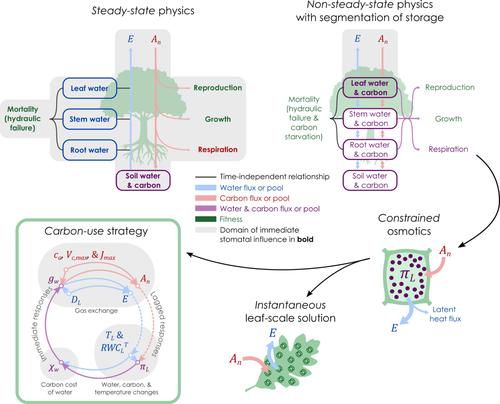
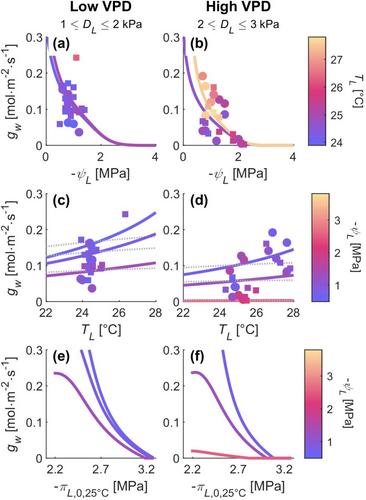
Stomata control plant water loss and photosynthetic carbon gain. Developing more generalized and accurate stomatal models is essential for earth system models and predicting responses under novel environmental conditions associated with global change. Plant optimality theories offer one promising approach, but most such theories assume that stomatal conductance maximizes photosynthetic net carbon assimilation subject to some cost or constraint of water. We move beyond this approach by developing a new, generalized optimality theory of stomatal conductance, optimizing any non-foliar proxy that requires water and carbon reserves, like growth, survival, and reproduction. We overcome two prior limitations. First, we reconcile the computational efficiency of instantaneous optimization with a more biologically meaningful dynamic feedback optimization over plant lifespans. Second, we incorporate non-steady-state physics in the optimization to account for the temporal changes in the water, carbon, and energy storage within a plant and its environment that occur over the timescales that stomata act, contrary to previous theories. Our optimal stomatal conductance compares well to observations from seedlings, saplings, and mature trees from field and greenhouse experiments. Our model predicts predispositions to mortality during the 2018 European drought and captures realistic responses to environmental cues, including the partial alleviation of heat stress by evaporative cooling and the negative effect of accumulating foliar soluble carbohydrates, promoting closure under elevated CO2. We advance stomatal optimality theory by incorporating generalized evolutionary fitness proxies and enhance its utility without compromising its realism, offering promise for future models to more realistically and accurately predict global carbon and water fluxes.
期刊介绍:
Global Change Biology is an environmental change journal committed to shaping the future and addressing the world's most pressing challenges, including sustainability, climate change, environmental protection, food and water safety, and global health.
Dedicated to fostering a profound understanding of the impacts of global change on biological systems and offering innovative solutions, the journal publishes a diverse range of content, including primary research articles, technical advances, research reviews, reports, opinions, perspectives, commentaries, and letters. Starting with the 2024 volume, Global Change Biology will transition to an online-only format, enhancing accessibility and contributing to the evolution of scholarly communication.



 京公网安备 11010802042870号
京ICP备2023020795号-1
京公网安备 11010802042870号
京ICP备2023020795号-1

 分享
分享
 求助内容:
求助内容: 应助结果提醒方式:
 扫码关注我们
