Synthesis and Characterization of Lipid-Polyzwitterion Diblock Copolymers for Optimizing Micelle Formation to Enhance Anticancer Drug Delivery in 2D and 3D Cell Cultures
Chitinart Thedrattanawong , Miao Zhang , Zhongxing Zhang , Xia Song , Jingling Zhu , Xuehao Tian , Jun Li , Yuting Wen
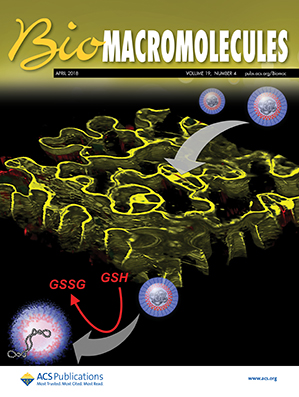
{"title":"Synthesis and Characterization of Lipid-Polyzwitterion Diblock Copolymers for Optimizing Micelle Formation to Enhance Anticancer Drug Delivery in 2D and 3D Cell Cultures","authors":"Chitinart Thedrattanawong , Miao Zhang , Zhongxing Zhang , Xia Song , Jingling Zhu , Xuehao Tian , Jun Li , Yuting Wen","doi":"10.1021/acs.biomac.4c01370","DOIUrl":null,"url":null,"abstract":"<div><div>Amphiphilic polymers with distinct polarity differences, known as sharp polarity contrast polymers (SPCPs), have gained much attention for their ability to form micelles with low critical micelle concentrations (CMCs) and potential in anticancer drug delivery. This study addresses the limited research on structure–property relationships of SPCPs by developing various SPCPs and exploring their physicochemical properties and biological applications. Specifically, the superhydrophobic aliphatic palmitoyl (Pal) was coupled to the superhydrophilic zwitterionic poly(2-methacryloyloxyethyl phosphorylcholine) (pMPC) to form Pal-pMPC diblock copolymers. Adjusting the lengths of hydrophilic chains allowed the creation of structures with varying hydrophilic–hydrophobic ratios for micelle formation. Comprehensive evaluations were carried out, including particle size, CMC, chain exchange rates, cellular uptake efficiency, and anticancer effectiveness. Our findings indicate that micelles with optimal hydrophilic–hydrophobic ratios significantly enhanced cellular uptake and cytotoxicity in both two-dimensional (2D) and three-dimensional (3D) tumor models, offering valuable insights for designing SPCPs for anticancer drug delivery.</div></div><div><div><span><figure><span><img><ol><li><span><span>Download: <span>Download high-res image (88KB)</span></span></span></li><li><span><span>Download: <span>Download full-size image</span></span></span></li></ol></span></figure></span></div></div>","PeriodicalId":30,"journal":{"name":"Biomacromolecules","volume":"26 2","pages":"Pages 1032-1043"},"PeriodicalIF":5.4000,"publicationDate":"2025-02-10","publicationTypes":"Journal Article","fieldsOfStudy":null,"isOpenAccess":false,"openAccessPdf":"","citationCount":"0","resultStr":null,"platform":"Semanticscholar","paperid":null,"PeriodicalName":"Biomacromolecules","FirstCategoryId":"92","ListUrlMain":"https://www.sciencedirect.com/org/science/article/pii/S1525779725000479","RegionNum":2,"RegionCategory":"化学","ArticlePicture":[],"TitleCN":null,"AbstractTextCN":null,"PMCID":null,"EPubDate":"2025/1/27 0:00:00","PubModel":"Epub","JCR":"Q1","JCRName":"BIOCHEMISTRY & MOLECULAR BIOLOGY","Score":null,"Total":0}
引用次数: 0
Abstract
Amphiphilic polymers with distinct polarity differences, known as sharp polarity contrast polymers (SPCPs), have gained much attention for their ability to form micelles with low critical micelle concentrations (CMCs) and potential in anticancer drug delivery. This study addresses the limited research on structure–property relationships of SPCPs by developing various SPCPs and exploring their physicochemical properties and biological applications. Specifically, the superhydrophobic aliphatic palmitoyl (Pal) was coupled to the superhydrophilic zwitterionic poly(2-methacryloyloxyethyl phosphorylcholine) (pMPC) to form Pal-pMPC diblock copolymers. Adjusting the lengths of hydrophilic chains allowed the creation of structures with varying hydrophilic–hydrophobic ratios for micelle formation. Comprehensive evaluations were carried out, including particle size, CMC, chain exchange rates, cellular uptake efficiency, and anticancer effectiveness. Our findings indicate that micelles with optimal hydrophilic–hydrophobic ratios significantly enhanced cellular uptake and cytotoxicity in both two-dimensional (2D) and three-dimensional (3D) tumor models, offering valuable insights for designing SPCPs for anticancer drug delivery.
期刊介绍:
Biomacromolecules is a leading forum for the dissemination of cutting-edge research at the interface of polymer science and biology. Submissions to Biomacromolecules should contain strong elements of innovation in terms of macromolecular design, synthesis and characterization, or in the application of polymer materials to biology and medicine.
Topics covered by Biomacromolecules include, but are not exclusively limited to: sustainable polymers, polymers based on natural and renewable resources, degradable polymers, polymer conjugates, polymeric drugs, polymers in biocatalysis, biomacromolecular assembly, biomimetic polymers, polymer-biomineral hybrids, biomimetic-polymer processing, polymer recycling, bioactive polymer surfaces, original polymer design for biomedical applications such as immunotherapy, drug delivery, gene delivery, antimicrobial applications, diagnostic imaging and biosensing, polymers in tissue engineering and regenerative medicine, polymeric scaffolds and hydrogels for cell culture and delivery.




 京公网安备 11010802042870号
京ICP备2023020795号-1
京公网安备 11010802042870号
京ICP备2023020795号-1

 分享
分享
 求助内容:
求助内容: 应助结果提醒方式:
 扫码关注我们
