Carmine Zoccali, Francesca Mallamaci, Mehmet Kanbay, Katherine R Tuttle, Peter Kotanko, Raffaele De Caterina, Guido Grassi, Giuseppe Mancia
{"title":"The autonomic nervous system and inflammation in chronic kidney disease.","authors":"Carmine Zoccali, Francesca Mallamaci, Mehmet Kanbay, Katherine R Tuttle, Peter Kotanko, Raffaele De Caterina, Guido Grassi, Giuseppe Mancia","doi":"10.1093/ndt/gfaf020","DOIUrl":null,"url":null,"abstract":"<p><p>The autonomic nervous system plays a crucial role in regulating physiological processes and maintaining homeostasis through its two branches: the sympathetic nervous system and the parasympathetic nervous system. Dysregulation of the autonomic system, characterized by increased sympathetic activity and reduced parasympathetic tone, is a common feature in chronic kidney disease (CKD) and cardiovascular disease. This imbalance contributes to a pro-inflammatory state, exacerbating disease progression and increasing the risk for cardiovascular events. The sympathetic system promotes inflammation by releasing catecholamines, which activate adrenergic receptors on immune cells. The parasympathetic system exerts anti-inflammatory effects via the cholinergic anti-inflammatory pathway mediated by the vagus nerve. Targeting the autonomic system to restore the balance between the sympathetic and the parasympathetic components offers promising approaches to reduce inflammation and improve outcomes in CKD and cardiovascular disease. β-Blockers, angiotensin-converting enzyme inhibitors, and angiotensin II receptor blockers are pharmacological agents that modulate sympathetic activity and have shown anti-inflammatory effects. Lifestyle interventions, such as a healthy diet, physical exercise, mindfulness, and meditation, enhance parasympathetic activity and improve autonomic function. Vagus nerve stimulation has emerged as a promising therapy, demonstrating significant potential in reducing inflammation and improving clinical outcomes in various conditions, including CKD, myocardial infarction, and stroke. Despite mixed results in heart failure trials, vagal nerve stimulation has consistently improved quality-of-life measures. Understanding the mechanisms underlying autonomic system regulation of inflammation can inform the development of novel therapeutic strategies to restore autonomic balance and improve patient outcomes in CKD and cardiovascular disease.</p>","PeriodicalId":19078,"journal":{"name":"Nephrology Dialysis Transplantation","volume":" ","pages":"1470-1482"},"PeriodicalIF":5.6000,"publicationDate":"2025-08-01","publicationTypes":"Journal Article","fieldsOfStudy":null,"isOpenAccess":false,"openAccessPdf":"","citationCount":"0","resultStr":null,"platform":"Semanticscholar","paperid":null,"PeriodicalName":"Nephrology Dialysis Transplantation","FirstCategoryId":"3","ListUrlMain":"https://doi.org/10.1093/ndt/gfaf020","RegionNum":2,"RegionCategory":"医学","ArticlePicture":[],"TitleCN":null,"AbstractTextCN":null,"PMCID":null,"EPubDate":"","PubModel":"","JCR":"Q1","JCRName":"TRANSPLANTATION","Score":null,"Total":0}
引用次数: 0
Abstract
The autonomic nervous system plays a crucial role in regulating physiological processes and maintaining homeostasis through its two branches: the sympathetic nervous system and the parasympathetic nervous system. Dysregulation of the autonomic system, characterized by increased sympathetic activity and reduced parasympathetic tone, is a common feature in chronic kidney disease (CKD) and cardiovascular disease. This imbalance contributes to a pro-inflammatory state, exacerbating disease progression and increasing the risk for cardiovascular events. The sympathetic system promotes inflammation by releasing catecholamines, which activate adrenergic receptors on immune cells. The parasympathetic system exerts anti-inflammatory effects via the cholinergic anti-inflammatory pathway mediated by the vagus nerve. Targeting the autonomic system to restore the balance between the sympathetic and the parasympathetic components offers promising approaches to reduce inflammation and improve outcomes in CKD and cardiovascular disease. β-Blockers, angiotensin-converting enzyme inhibitors, and angiotensin II receptor blockers are pharmacological agents that modulate sympathetic activity and have shown anti-inflammatory effects. Lifestyle interventions, such as a healthy diet, physical exercise, mindfulness, and meditation, enhance parasympathetic activity and improve autonomic function. Vagus nerve stimulation has emerged as a promising therapy, demonstrating significant potential in reducing inflammation and improving clinical outcomes in various conditions, including CKD, myocardial infarction, and stroke. Despite mixed results in heart failure trials, vagal nerve stimulation has consistently improved quality-of-life measures. Understanding the mechanisms underlying autonomic system regulation of inflammation can inform the development of novel therapeutic strategies to restore autonomic balance and improve patient outcomes in CKD and cardiovascular disease.
期刊介绍:
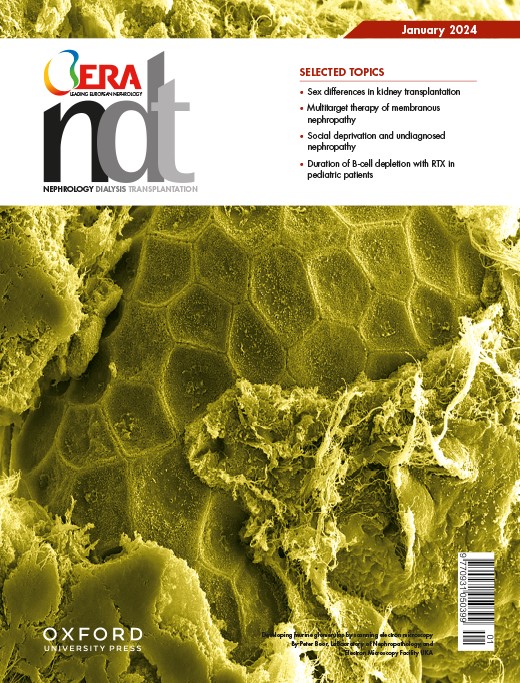
Nephrology Dialysis Transplantation (ndt) is the leading nephrology journal in Europe and renowned worldwide, devoted to original clinical and laboratory research in nephrology, dialysis and transplantation. ndt is an official journal of the [ERA-EDTA](http://www.era-edta.org/) (European Renal Association-European Dialysis and Transplant Association). Published monthly, the journal provides an essential resource for researchers and clinicians throughout the world. All research articles in this journal have undergone peer review.
Print ISSN: 0931-0509.




 京公网安备 11010802042870号
京ICP备2023020795号-1
京公网安备 11010802042870号
京ICP备2023020795号-1

 分享
分享
 求助内容:
求助内容: 应助结果提醒方式:
 扫码关注我们
