{"title":"Brain State-Dependent Neocortico-Hippocampal Network Dynamics Are Modulated by Postnatal Stimuli.","authors":"Yoshiaki Shinohara, Shinnosuke Koketsu, Nobuhiko Ohno, Hajime Hirase, Takatoshi Ueki","doi":"10.1523/JNEUROSCI.0053-21.2025","DOIUrl":null,"url":null,"abstract":"<p><p>Neurons in the cerebral cortex and hippocampus discharge synchronously in a brain state-dependent manner to transfer information. Published studies have highlighted the temporal coordination of neuronal activities between the hippocampus and a neocortical area; however, how the spatial extent of neocortical activity relates to hippocampal activity remains partially unknown. We imaged mesoscopic neocortical activity while recording hippocampal local field potentials in anesthetized and unanesthetized GCaMP-expressing transgenic mice. We found that neocortical activity elevates around hippocampal sharp wave ripples (SWRs). SWR-associated neocortical activities occurred predominantly in vision-related regions including the visual, retrosplenial, and frontal cortex. While pre-SWR neocortical activities were frequently observed in awake and natural sleeping states, post-SWR neocortical activity decreased significantly in the latter. Urethane-anesthetized mice also exhibited SWR-correlated calcium elevation, but in longer timescale than observed in natural sleeping mice. During hippocampal theta oscillation states, phase-locked oscillations of calcium activity were observed throughout the entire neocortical areas. In addition, possible environmental effects on neocortico-hippocampal dynamics were assessed in this study by comparing mice reared in ISO (isolated condition) and ENR (enriched environment). In both SWR and theta oscillations, mice reared in ISO exhibited clearer brain state-dependent dynamics than those reared in ENR. Our data demonstrate that the neocortex and hippocampus exhibit heterogeneous activity patterns that characterize brain states, and postnatal experience plays a significant role in modulating these patterns.</p>","PeriodicalId":50114,"journal":{"name":"Journal of Neuroscience","volume":" ","pages":""},"PeriodicalIF":4.0000,"publicationDate":"2025-03-05","publicationTypes":"Journal Article","fieldsOfStudy":null,"isOpenAccess":false,"openAccessPdf":"https://www.ncbi.nlm.nih.gov/pmc/articles/PMC11884400/pdf/","citationCount":"0","resultStr":null,"platform":"Semanticscholar","paperid":null,"PeriodicalName":"Journal of Neuroscience","FirstCategoryId":"3","ListUrlMain":"https://doi.org/10.1523/JNEUROSCI.0053-21.2025","RegionNum":2,"RegionCategory":"医学","ArticlePicture":[],"TitleCN":null,"AbstractTextCN":null,"PMCID":null,"EPubDate":"","PubModel":"","JCR":"Q1","JCRName":"NEUROSCIENCES","Score":null,"Total":0}
引用次数: 0
Abstract
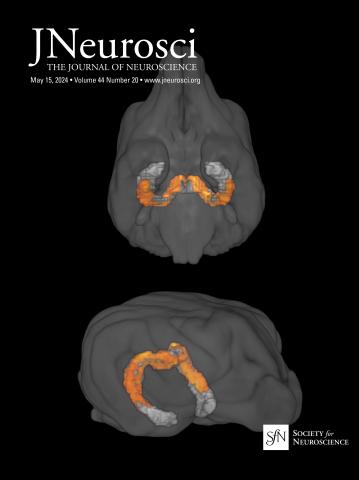
Neurons in the cerebral cortex and hippocampus discharge synchronously in a brain state-dependent manner to transfer information. Published studies have highlighted the temporal coordination of neuronal activities between the hippocampus and a neocortical area; however, how the spatial extent of neocortical activity relates to hippocampal activity remains partially unknown. We imaged mesoscopic neocortical activity while recording hippocampal local field potentials in anesthetized and unanesthetized GCaMP-expressing transgenic mice. We found that neocortical activity elevates around hippocampal sharp wave ripples (SWRs). SWR-associated neocortical activities occurred predominantly in vision-related regions including the visual, retrosplenial, and frontal cortex. While pre-SWR neocortical activities were frequently observed in awake and natural sleeping states, post-SWR neocortical activity decreased significantly in the latter. Urethane-anesthetized mice also exhibited SWR-correlated calcium elevation, but in longer timescale than observed in natural sleeping mice. During hippocampal theta oscillation states, phase-locked oscillations of calcium activity were observed throughout the entire neocortical areas. In addition, possible environmental effects on neocortico-hippocampal dynamics were assessed in this study by comparing mice reared in ISO (isolated condition) and ENR (enriched environment). In both SWR and theta oscillations, mice reared in ISO exhibited clearer brain state-dependent dynamics than those reared in ENR. Our data demonstrate that the neocortex and hippocampus exhibit heterogeneous activity patterns that characterize brain states, and postnatal experience plays a significant role in modulating these patterns.
大脑皮层和海马神经元以脑状态依赖的方式同步放电传递信息。已发表的研究强调了海马体和新皮层区域之间神经元活动的时间协调,然而,新皮层活动的空间范围如何与海马体活动相关仍然部分未知。在麻醉和未麻醉表达gcamp的转基因小鼠中,我们在记录海马局部场电位的同时,对新皮层活动进行了介观成像。我们发现海马锐波波纹(SWR)周围的新皮层活动升高。swr相关的新皮质活动主要发生在视觉相关区域,包括视觉、脾后和额叶皮质。虽然在清醒和自然睡眠状态下,swr前的新皮层活动经常被观察到,但在后者,swr后的新皮层活动明显下降。脲烷麻醉小鼠也表现出swr相关的钙升高,但时间尺度比自然睡眠小鼠更长。在海马体θ波振荡状态下,整个新皮质区域都观察到钙活性的锁相振荡。此外,本研究通过比较在ISO(孤立环境)和ENR(富集环境)中饲养的小鼠,评估了环境对新皮质-海马动力学的可能影响。在SWR和θ波振荡中,ISO饲养的小鼠比ENR饲养的小鼠表现出更清晰的大脑状态依赖动力学。我们的数据表明,新皮层和海马体表现出表征大脑状态的异质性活动模式,而出生后的经历在调节这些模式中起着重要作用。海马体是记忆形成的中心。然而,在海马体中形成的记忆并不是永久储存的,而是逐渐转移到大脑皮层,新皮层和海马体之间的同步活动已经被假设(关于海马体独立记忆见(Sutherland and Rudy, 1989))。然而,海马体和整个新皮质区域之间的时空动态仍然部分未被探索。同时用海马脑电图(EEG)测量皮质钙的活动,发现广泛的新皮质区活动与海马脑电图有时间关联。动物的新皮质-海马动力学主要受清醒/睡眠状态的调控。即使观察到相似的脑电图模式,新皮层和海马体之间的时间动态在清醒和睡眠期间表现出不同的模式。此外,动物出生后的经历调节了这种动态。
期刊介绍:
JNeurosci (ISSN 0270-6474) is an official journal of the Society for Neuroscience. It is published weekly by the Society, fifty weeks a year, one volume a year. JNeurosci publishes papers on a broad range of topics of general interest to those working on the nervous system. Authors now have an Open Choice option for their published articles



 京公网安备 11010802042870号
京ICP备2023020795号-1
京公网安备 11010802042870号
京ICP备2023020795号-1

 分享
分享
 求助内容:
求助内容: 应助结果提醒方式:
 扫码关注我们
