{"title":"Proteo-Transcriptomic Analysis Reveals the Mechanisms Underlying Escherichia coli Phenotypic Shifts Under Blue Light","authors":"Shuqi Shi, Wenlu Qi, Jinming Zhang, Caice Liang, Wei Liu, Hui Han, Wei Zhuang, Tianpeng Chen, Wenjun Sun, Yong Chen","doi":"10.1002/bit.28939","DOIUrl":null,"url":null,"abstract":"<div>\n \n <p>Bacteria can adapt their lifestyles, including microbial growth, metabolism, and biofilm formation, in response to light signaling. However, the molecular pathways through which blue light affects the lifestyle of <i>Escherichia coli</i> (<i>E. coli</i>) remain incomplete and poorly understood. To address this gap, transcriptomic and proteomic approaches were employed to analyze the physiological differences of <i>E. coli</i> under dark and blue light conditions. Our results indicate that, compared to dark conditions, blue light attenuates flagellar assembly, reduces cell motility and communication, and decreases biofilm formation in <i>E. coli</i>. In addition, this study elucidates the signaling pathways involved in the blue light-mediated regulation of <i>E. coli</i> behavior, providing a theoretical framework for understanding how <i>E. coli</i> responds to blue light signaling to modulate biofilm formation for the production of food chemicals.</p></div>","PeriodicalId":9168,"journal":{"name":"Biotechnology and Bioengineering","volume":"122 5","pages":"1258-1271"},"PeriodicalIF":3.6000,"publicationDate":"2025-01-28","publicationTypes":"Journal Article","fieldsOfStudy":null,"isOpenAccess":false,"openAccessPdf":"","citationCount":"0","resultStr":null,"platform":"Semanticscholar","paperid":null,"PeriodicalName":"Biotechnology and Bioengineering","FirstCategoryId":"5","ListUrlMain":"https://analyticalsciencejournals.onlinelibrary.wiley.com/doi/10.1002/bit.28939","RegionNum":2,"RegionCategory":"生物学","ArticlePicture":[],"TitleCN":null,"AbstractTextCN":null,"PMCID":null,"EPubDate":"","PubModel":"","JCR":"Q2","JCRName":"BIOTECHNOLOGY & APPLIED MICROBIOLOGY","Score":null,"Total":0}
引用次数: 0
Abstract
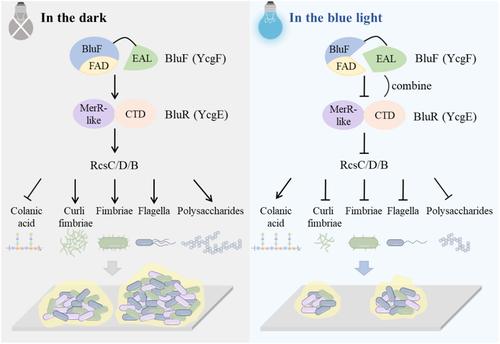
Bacteria can adapt their lifestyles, including microbial growth, metabolism, and biofilm formation, in response to light signaling. However, the molecular pathways through which blue light affects the lifestyle of Escherichia coli (E. coli) remain incomplete and poorly understood. To address this gap, transcriptomic and proteomic approaches were employed to analyze the physiological differences of E. coli under dark and blue light conditions. Our results indicate that, compared to dark conditions, blue light attenuates flagellar assembly, reduces cell motility and communication, and decreases biofilm formation in E. coli. In addition, this study elucidates the signaling pathways involved in the blue light-mediated regulation of E. coli behavior, providing a theoretical framework for understanding how E. coli responds to blue light signaling to modulate biofilm formation for the production of food chemicals.
期刊介绍:
Biotechnology & Bioengineering publishes Perspectives, Articles, Reviews, Mini-Reviews, and Communications to the Editor that embrace all aspects of biotechnology. These include:
-Enzyme systems and their applications, including enzyme reactors, purification, and applied aspects of protein engineering
-Animal-cell biotechnology, including media development
-Applied aspects of cellular physiology, metabolism, and energetics
-Biocatalysis and applied enzymology, including enzyme reactors, protein engineering, and nanobiotechnology
-Biothermodynamics
-Biofuels, including biomass and renewable resource engineering
-Biomaterials, including delivery systems and materials for tissue engineering
-Bioprocess engineering, including kinetics and modeling of biological systems, transport phenomena in bioreactors, bioreactor design, monitoring, and control
-Biosensors and instrumentation
-Computational and systems biology, including bioinformatics and genomic/proteomic studies
-Environmental biotechnology, including biofilms, algal systems, and bioremediation
-Metabolic and cellular engineering
-Plant-cell biotechnology
-Spectroscopic and other analytical techniques for biotechnological applications
-Synthetic biology
-Tissue engineering, stem-cell bioengineering, regenerative medicine, gene therapy and delivery systems
The editors will consider papers for publication based on novelty, their immediate or future impact on biotechnological processes, and their contribution to the advancement of biochemical engineering science. Submission of papers dealing with routine aspects of bioprocessing, description of established equipment, and routine applications of established methodologies (e.g., control strategies, modeling, experimental methods) is discouraged. Theoretical papers will be judged based on the novelty of the approach and their potential impact, or on their novel capability to predict and elucidate experimental observations.







 京公网安备 11010802042870号
京ICP备2023020795号-1
京公网安备 11010802042870号
京ICP备2023020795号-1

 分享
分享
 求助内容:
求助内容: 应助结果提醒方式:
 扫码关注我们
