Masoud Mirzaei , Russell F. Burmester , Bernard A. Housen , Vadim A. Kravchinsky
{"title":"Paleomagnetic consequence of thermal evolution of the North American Passive Margin: The Jurassic APWP controversy","authors":"Masoud Mirzaei , Russell F. Burmester , Bernard A. Housen , Vadim A. Kravchinsky","doi":"10.1016/j.gr.2025.01.007","DOIUrl":null,"url":null,"abstract":"<div><div>This study revisits the long-standing controversy in selecting Jurassic paleomagnetic data to define the North American (NA) craton APWP. Data from igneous rocks in the eastern part of NA and select global data rotated into NA coordinates define a high-latitude path. In contrast, the data from mostly sedimentary rocks in the NA Southwest interior (southwestern group) describe a lower-latitude path. Analysis suggests that previous explanations, such as inclination error in the southwestern group, cannot fully explain the disparity, and raises concerns that some magnetization of the eastern group may be partially secondary or younger, and others do not average secular variation. We present a new hypothesis that attributes the discrepancy to the post-tilt magnetization of the eastern NA continental margin caused by thermally induced non-uniform relative vertical movements during the post breakup evolution of northeast NA. This is tested by comparing mid-Jurassic paleomagnetic data of the eastern group with the coeval directions calculated from an updated late Triassic-Early Cretaceous reference NA APWP, presented here defined using a select and refined set of paleomagnetic poles mostly from southwestern region. One resolution is that a) after the breakup of NA from Africa (∼190 Ma), the thermally uplifted oceanside of the margin started to subside, while the more in-land regions experienced uplift due to landward lateral heat propagation in the lithosphere; b) during ∼190–140 Ma, the differential vertical motion tilted the edge of the margin eastward, about a horizontal axis with ∼53.5° azimuth. This eastward tilting peaked at ∼175–165 Ma and gradually decreased until ∼145–140 Ma. During this phase, the eastern group igneous rocks were emplaced and magnetized in this tilted framework; c) after ∼140–110 Ma, subsidence dominated the entire region. However, higher subsidence rates in more in-land parts tilted the marginal part along with their magnetizations acquired in the eastward-tilted position back (westward) to their current attitudes.</div></div>","PeriodicalId":12761,"journal":{"name":"Gondwana Research","volume":"140 ","pages":"Pages 89-100"},"PeriodicalIF":7.2000,"publicationDate":"2025-01-19","publicationTypes":"Journal Article","fieldsOfStudy":null,"isOpenAccess":false,"openAccessPdf":"","citationCount":"0","resultStr":null,"platform":"Semanticscholar","paperid":null,"PeriodicalName":"Gondwana Research","FirstCategoryId":"89","ListUrlMain":"https://www.sciencedirect.com/science/article/pii/S1342937X25000115","RegionNum":1,"RegionCategory":"地球科学","ArticlePicture":[],"TitleCN":null,"AbstractTextCN":null,"PMCID":null,"EPubDate":"","PubModel":"","JCR":"Q1","JCRName":"GEOSCIENCES, MULTIDISCIPLINARY","Score":null,"Total":0}
引用次数: 0
Abstract
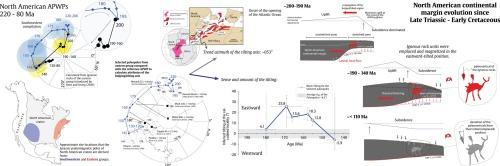
This study revisits the long-standing controversy in selecting Jurassic paleomagnetic data to define the North American (NA) craton APWP. Data from igneous rocks in the eastern part of NA and select global data rotated into NA coordinates define a high-latitude path. In contrast, the data from mostly sedimentary rocks in the NA Southwest interior (southwestern group) describe a lower-latitude path. Analysis suggests that previous explanations, such as inclination error in the southwestern group, cannot fully explain the disparity, and raises concerns that some magnetization of the eastern group may be partially secondary or younger, and others do not average secular variation. We present a new hypothesis that attributes the discrepancy to the post-tilt magnetization of the eastern NA continental margin caused by thermally induced non-uniform relative vertical movements during the post breakup evolution of northeast NA. This is tested by comparing mid-Jurassic paleomagnetic data of the eastern group with the coeval directions calculated from an updated late Triassic-Early Cretaceous reference NA APWP, presented here defined using a select and refined set of paleomagnetic poles mostly from southwestern region. One resolution is that a) after the breakup of NA from Africa (∼190 Ma), the thermally uplifted oceanside of the margin started to subside, while the more in-land regions experienced uplift due to landward lateral heat propagation in the lithosphere; b) during ∼190–140 Ma, the differential vertical motion tilted the edge of the margin eastward, about a horizontal axis with ∼53.5° azimuth. This eastward tilting peaked at ∼175–165 Ma and gradually decreased until ∼145–140 Ma. During this phase, the eastern group igneous rocks were emplaced and magnetized in this tilted framework; c) after ∼140–110 Ma, subsidence dominated the entire region. However, higher subsidence rates in more in-land parts tilted the marginal part along with their magnetizations acquired in the eastward-tilted position back (westward) to their current attitudes.
期刊介绍:
Gondwana Research (GR) is an International Journal aimed to promote high quality research publications on all topics related to solid Earth, particularly with reference to the origin and evolution of continents, continental assemblies and their resources. GR is an "all earth science" journal with no restrictions on geological time, terrane or theme and covers a wide spectrum of topics in geosciences such as geology, geomorphology, palaeontology, structure, petrology, geochemistry, stable isotopes, geochronology, economic geology, exploration geology, engineering geology, geophysics, and environmental geology among other themes, and provides an appropriate forum to integrate studies from different disciplines and different terrains. In addition to regular articles and thematic issues, the journal invites high profile state-of-the-art reviews on thrust area topics for its column, ''GR FOCUS''. Focus articles include short biographies and photographs of the authors. Short articles (within ten printed pages) for rapid publication reporting important discoveries or innovative models of global interest will be considered under the category ''GR LETTERS''.



 京公网安备 11010802042870号
京ICP备2023020795号-1
京公网安备 11010802042870号
京ICP备2023020795号-1

 分享
分享
 求助内容:
求助内容: 应助结果提醒方式:
 扫码关注我们
