Massimo Corda , Olena Vovk , Maya Marinova , Thomas Len , Vita A. Kondratenko , Evgenii V. Kondratenko , Vitaly V. Ordomsky , Andrei Y. Khodakov
{"title":"Syngas conversion to light olefins over silver metallic nanoparticles in bifunctional catalysts","authors":"Massimo Corda , Olena Vovk , Maya Marinova , Thomas Len , Vita A. Kondratenko , Evgenii V. Kondratenko , Vitaly V. Ordomsky , Andrei Y. Khodakov","doi":"10.1016/j.cej.2025.159700","DOIUrl":null,"url":null,"abstract":"<div><div>The interest in the production of light olefins stems from their pivotal role as building blocks in the chemical industry. In the direct synthesis of light olefins from syngas via the methanol-mediated route over bifunctional catalysts, intermediate hydrogenation of CO to methanol occurs on a metal oxide catalyst, followed by the conversion of methanol to light olefins over a zeolite.</div><div>This work introduces a novel approach to the synthesis of light olefins from syngas by proposing the use of metallic silver-supported nanoparticles as a key component in the design of bifunctional catalysts. Departing from the traditional use of metal oxide catalysts, we propose the application of metallic silver, which has not previously been explored in this context. Transient kinetic experiments have shown irreversible adsorption of carbon monoxide on zirconia-supported silver catalyst under the reaction conditions. The resulting hybrid zirconia-supported silver catalysts, paired with SAPO-34 zeolite, demonstrate a remarkable enhancement in the selectivity toward light olefins and a significant reduction in methane production compared to conventional zinc-zirconia based systems. This work challenges the traditional approaches to designing catalysts for selectively converting carbon monoxide into light olefins using conventional oxide-zeolite (OX-ZEO) catalysts.</div></div>","PeriodicalId":270,"journal":{"name":"Chemical Engineering Journal","volume":"506 ","pages":"Article 159700"},"PeriodicalIF":13.2000,"publicationDate":"2025-01-15","publicationTypes":"Journal Article","fieldsOfStudy":null,"isOpenAccess":false,"openAccessPdf":"","citationCount":"0","resultStr":null,"platform":"Semanticscholar","paperid":null,"PeriodicalName":"Chemical Engineering Journal","FirstCategoryId":"5","ListUrlMain":"https://www.sciencedirect.com/science/article/pii/S1385894725004991","RegionNum":1,"RegionCategory":"工程技术","ArticlePicture":[],"TitleCN":null,"AbstractTextCN":null,"PMCID":null,"EPubDate":"2025/1/28 0:00:00","PubModel":"Epub","JCR":"Q1","JCRName":"ENGINEERING, CHEMICAL","Score":null,"Total":0}
引用次数: 0
Abstract
The interest in the production of light olefins stems from their pivotal role as building blocks in the chemical industry. In the direct synthesis of light olefins from syngas via the methanol-mediated route over bifunctional catalysts, intermediate hydrogenation of CO to methanol occurs on a metal oxide catalyst, followed by the conversion of methanol to light olefins over a zeolite.
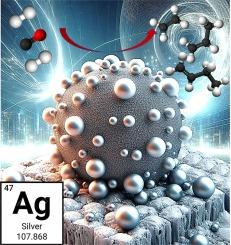
This work introduces a novel approach to the synthesis of light olefins from syngas by proposing the use of metallic silver-supported nanoparticles as a key component in the design of bifunctional catalysts. Departing from the traditional use of metal oxide catalysts, we propose the application of metallic silver, which has not previously been explored in this context. Transient kinetic experiments have shown irreversible adsorption of carbon monoxide on zirconia-supported silver catalyst under the reaction conditions. The resulting hybrid zirconia-supported silver catalysts, paired with SAPO-34 zeolite, demonstrate a remarkable enhancement in the selectivity toward light olefins and a significant reduction in methane production compared to conventional zinc-zirconia based systems. This work challenges the traditional approaches to designing catalysts for selectively converting carbon monoxide into light olefins using conventional oxide-zeolite (OX-ZEO) catalysts.
期刊介绍:
The Chemical Engineering Journal is an international research journal that invites contributions of original and novel fundamental research. It aims to provide an international platform for presenting original fundamental research, interpretative reviews, and discussions on new developments in chemical engineering. The journal welcomes papers that describe novel theory and its practical application, as well as those that demonstrate the transfer of techniques from other disciplines. It also welcomes reports on carefully conducted experimental work that is soundly interpreted. The main focus of the journal is on original and rigorous research results that have broad significance. The Catalysis section within the Chemical Engineering Journal focuses specifically on Experimental and Theoretical studies in the fields of heterogeneous catalysis, molecular catalysis, and biocatalysis. These studies have industrial impact on various sectors such as chemicals, energy, materials, foods, healthcare, and environmental protection.




 京公网安备 11010802042870号
京ICP备2023020795号-1
京公网安备 11010802042870号
京ICP备2023020795号-1

 分享
分享
 求助内容:
求助内容: 应助结果提醒方式:
 扫码关注我们
