Ying Yuan , Xuxin Li , Xiong Sun, Yuying Sun, Mei Yang, Bei Liu, Duanguang Yang, Huaming Li, Yijiang Liu
{"title":"Recent advances in functionalizing ZIFs and their derived carbon materials towards electrocatalytic water splitting","authors":"Ying Yuan , Xuxin Li , Xiong Sun, Yuying Sun, Mei Yang, Bei Liu, Duanguang Yang, Huaming Li, Yijiang Liu","doi":"10.1016/j.nanoen.2025.110727","DOIUrl":null,"url":null,"abstract":"<div><div>Hydrogen energy, as a promising alternative to accomplish the energy conversion and storage, has inspired tremendous research interests in the past decades. Particularly, the green hydrogen production by electrocatalytic water splitting (EWS) is crucial for the advance of renewable and clean energy resources. However, the sluggish anodic oxygen evolution reactions (OER) and cathodic hydrogen evolution reactions (HER) are prime roadblocks for the commercial application. The exploration of efficient, durable and low-cost bifunctional electrocatalysts for OER and HER is pivotal for the scalable production of green hydrogen through EWS. Zeolitic imidazolate frameworks (ZIFs), consisted of metal cations and organic ligands, are emerging as prominent precursors for the exploration of bifunctional electrocatalysts for water splitting owing to their unique characteristics, such as 3D porous networks, large specific surface area, tunable composition, variable architecture, as well as high chemical and thermal stability. By pyrolysis of ZIFs, the resultant carbon materials have nearly inherited the merits of ZIFs and are also famous for various actives species, i.e., self-doped nitrogen, metal-nitrogen, and metal nanoparticles/alloy/metal oxides, etc., which are beneficial to the electrocatalytic performance. In this review, we survey the recent progress in developing of efficient OER and HER bifunctional electrocatalysts for EWS, highlighting different modification strategies for the preparation of ZIFs-derived multi-doped porous carbon materials. First, the general descriptions of EWS and ZIFs materials are introduced. Subsequently, the pristine ZIFs derived carbon materials and their catalytic performance are presented. Afterwards, the pre-modification, in-situ modification and the post-modification of ZIFs and the resulting carbon materials are detailed in Section 3, 4 and 5, including the synthetic methods, electrocatalytic performance, the correlations of composition-structure-performance. Finally, we summarize the corresponding challenges and future perspectives in this rapidly growing field.</div></div>","PeriodicalId":394,"journal":{"name":"Nano Energy","volume":"136 ","pages":"Article 110727"},"PeriodicalIF":17.1000,"publicationDate":"2025-04-01","publicationTypes":"Journal Article","fieldsOfStudy":null,"isOpenAccess":false,"openAccessPdf":"","citationCount":"0","resultStr":null,"platform":"Semanticscholar","paperid":null,"PeriodicalName":"Nano Energy","FirstCategoryId":"88","ListUrlMain":"https://www.sciencedirect.com/science/article/pii/S2211285525000862","RegionNum":1,"RegionCategory":"材料科学","ArticlePicture":[],"TitleCN":null,"AbstractTextCN":null,"PMCID":null,"EPubDate":"2025/1/28 0:00:00","PubModel":"Epub","JCR":"Q1","JCRName":"CHEMISTRY, PHYSICAL","Score":null,"Total":0}
引用次数: 0
Abstract
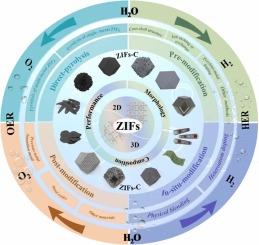
Hydrogen energy, as a promising alternative to accomplish the energy conversion and storage, has inspired tremendous research interests in the past decades. Particularly, the green hydrogen production by electrocatalytic water splitting (EWS) is crucial for the advance of renewable and clean energy resources. However, the sluggish anodic oxygen evolution reactions (OER) and cathodic hydrogen evolution reactions (HER) are prime roadblocks for the commercial application. The exploration of efficient, durable and low-cost bifunctional electrocatalysts for OER and HER is pivotal for the scalable production of green hydrogen through EWS. Zeolitic imidazolate frameworks (ZIFs), consisted of metal cations and organic ligands, are emerging as prominent precursors for the exploration of bifunctional electrocatalysts for water splitting owing to their unique characteristics, such as 3D porous networks, large specific surface area, tunable composition, variable architecture, as well as high chemical and thermal stability. By pyrolysis of ZIFs, the resultant carbon materials have nearly inherited the merits of ZIFs and are also famous for various actives species, i.e., self-doped nitrogen, metal-nitrogen, and metal nanoparticles/alloy/metal oxides, etc., which are beneficial to the electrocatalytic performance. In this review, we survey the recent progress in developing of efficient OER and HER bifunctional electrocatalysts for EWS, highlighting different modification strategies for the preparation of ZIFs-derived multi-doped porous carbon materials. First, the general descriptions of EWS and ZIFs materials are introduced. Subsequently, the pristine ZIFs derived carbon materials and their catalytic performance are presented. Afterwards, the pre-modification, in-situ modification and the post-modification of ZIFs and the resulting carbon materials are detailed in Section 3, 4 and 5, including the synthetic methods, electrocatalytic performance, the correlations of composition-structure-performance. Finally, we summarize the corresponding challenges and future perspectives in this rapidly growing field.
期刊介绍:
Nano Energy is a multidisciplinary, rapid-publication forum of original peer-reviewed contributions on the science and engineering of nanomaterials and nanodevices used in all forms of energy harvesting, conversion, storage, utilization and policy. Through its mixture of articles, reviews, communications, research news, and information on key developments, Nano Energy provides a comprehensive coverage of this exciting and dynamic field which joins nanoscience and nanotechnology with energy science. The journal is relevant to all those who are interested in nanomaterials solutions to the energy problem.
Nano Energy publishes original experimental and theoretical research on all aspects of energy-related research which utilizes nanomaterials and nanotechnology. Manuscripts of four types are considered: review articles which inform readers of the latest research and advances in energy science; rapid communications which feature exciting research breakthroughs in the field; full-length articles which report comprehensive research developments; and news and opinions which comment on topical issues or express views on the developments in related fields.



 京公网安备 11010802042870号
京ICP备2023020795号-1
京公网安备 11010802042870号
京ICP备2023020795号-1

 分享
分享
 求助内容:
求助内容: 应助结果提醒方式:
 扫码关注我们
