Huilin Ge , Shuqi Zhao , Baoying Dai , Shaoqiang Chen , Yuchen Pan , Youguo Lu , Yannan Xie , Chunxiao Jiang
{"title":"Acoustic triboelectric nanogenerator for underwater acoustic communication","authors":"Huilin Ge , Shuqi Zhao , Baoying Dai , Shaoqiang Chen , Yuchen Pan , Youguo Lu , Yannan Xie , Chunxiao Jiang","doi":"10.1016/j.nanoen.2025.110738","DOIUrl":null,"url":null,"abstract":"<div><div>Underwater acoustic communication is essential for both military and civilian applications. With the accelerated exploration and development of oceanic resources, the demand for advanced underwater acoustic communication technologies has grown increasingly urgent. However, this communication method faces several challenges, including delays in signal travel, restricted coverage, and reduced bandwidth, all of which reduce the operational efficiency and potential of underwater systems. In 2012, Professor Wang introduced the triboelectric nanogenerator (TENG), a device that leverages the triboelectric effect to provide an innovative solution for addressing these challenges. This article commences with an elucidation of the fundamental principles governing acoustic TENGs, succeeded by a comprehensive overview of various resonant cavity structures designed to boost the efficiency of sound energy harvesting. Additionally, it delves into the operational frequency range of acoustic TENGs, with particular emphasis on both ultrasonic and low-frequency sound waves for self-powered triboelectric sensors. Finally, the article reviews the latest research on the applications of acoustic TENGs in underwater positioning, monitoring, wireless communication, and control. The content underscores the substantial potential of acoustic TENGs in enhancing underwater wireless communication, presenting a promising new avenue for the advancement of future underwater technologies.</div></div>","PeriodicalId":394,"journal":{"name":"Nano Energy","volume":"136 ","pages":"Article 110738"},"PeriodicalIF":17.1000,"publicationDate":"2025-04-01","publicationTypes":"Journal Article","fieldsOfStudy":null,"isOpenAccess":false,"openAccessPdf":"","citationCount":"0","resultStr":null,"platform":"Semanticscholar","paperid":null,"PeriodicalName":"Nano Energy","FirstCategoryId":"88","ListUrlMain":"https://www.sciencedirect.com/science/article/pii/S2211285525000977","RegionNum":1,"RegionCategory":"材料科学","ArticlePicture":[],"TitleCN":null,"AbstractTextCN":null,"PMCID":null,"EPubDate":"2025/1/28 0:00:00","PubModel":"Epub","JCR":"Q1","JCRName":"CHEMISTRY, PHYSICAL","Score":null,"Total":0}
引用次数: 0
Abstract
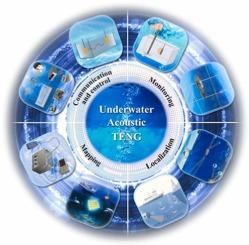
Underwater acoustic communication is essential for both military and civilian applications. With the accelerated exploration and development of oceanic resources, the demand for advanced underwater acoustic communication technologies has grown increasingly urgent. However, this communication method faces several challenges, including delays in signal travel, restricted coverage, and reduced bandwidth, all of which reduce the operational efficiency and potential of underwater systems. In 2012, Professor Wang introduced the triboelectric nanogenerator (TENG), a device that leverages the triboelectric effect to provide an innovative solution for addressing these challenges. This article commences with an elucidation of the fundamental principles governing acoustic TENGs, succeeded by a comprehensive overview of various resonant cavity structures designed to boost the efficiency of sound energy harvesting. Additionally, it delves into the operational frequency range of acoustic TENGs, with particular emphasis on both ultrasonic and low-frequency sound waves for self-powered triboelectric sensors. Finally, the article reviews the latest research on the applications of acoustic TENGs in underwater positioning, monitoring, wireless communication, and control. The content underscores the substantial potential of acoustic TENGs in enhancing underwater wireless communication, presenting a promising new avenue for the advancement of future underwater technologies.
期刊介绍:
Nano Energy is a multidisciplinary, rapid-publication forum of original peer-reviewed contributions on the science and engineering of nanomaterials and nanodevices used in all forms of energy harvesting, conversion, storage, utilization and policy. Through its mixture of articles, reviews, communications, research news, and information on key developments, Nano Energy provides a comprehensive coverage of this exciting and dynamic field which joins nanoscience and nanotechnology with energy science. The journal is relevant to all those who are interested in nanomaterials solutions to the energy problem.
Nano Energy publishes original experimental and theoretical research on all aspects of energy-related research which utilizes nanomaterials and nanotechnology. Manuscripts of four types are considered: review articles which inform readers of the latest research and advances in energy science; rapid communications which feature exciting research breakthroughs in the field; full-length articles which report comprehensive research developments; and news and opinions which comment on topical issues or express views on the developments in related fields.



 京公网安备 11010802042870号
京ICP备2023020795号-1
京公网安备 11010802042870号
京ICP备2023020795号-1

 分享
分享
 求助内容:
求助内容: 应助结果提醒方式:
 扫码关注我们
