Chaoyang Li , Alberto Tiraferri , Peng Tang , Jun Ma , Baicang Liu
{"title":"Current status, potential assessment, and future directions of biological treatments of unconventional oil and gas wastewater","authors":"Chaoyang Li , Alberto Tiraferri , Peng Tang , Jun Ma , Baicang Liu","doi":"10.1016/j.watres.2025.123217","DOIUrl":null,"url":null,"abstract":"<div><div>Unconventional oil and gas (UOG) extraction techniques typically involve the production of large volumes of so-called flowback and produced water (FPW), a site-specific wastewater stream characterized by complex organic and inorganic composition. Sustainable and cost-effective management of FPW, as well as mitigation of its environmental risks and impacts, represents substantial challenges for governments, industries, and societies worldwide. Among various treatment technologies, biological processes have gained interest due to their low installation and operational costs. However, the interaction of FPW's complex composition with microorganisms poses challenging scientific and engineering questions. This review examines the water quality characteristics and sources of FPW from twelve UOG extraction sites in China and North America, revealing strong spatio-temporal heterogeneity of organic, inorganic, and microbial components across different reservoirs. The complex and variable water quality, large wastewater volumes, and high treatment demands have driven the exploration of biological treatments for FPW. This work systematically reviews and analyzes the operating conditions, treatment efficiency, and technical applicability of suspended sludge reactors, attached sludge reactors, mixed systems, and resource/energy recovery systems. Developing skid-mounted equipment based on suspended sludge reactors to handle variations in wastewater quantity and innovating the form of attached sludge reactors, especially in enriching salt-tolerant microbes for in-situ FPW treatment, are deemed essential. The dominant microorganisms playing a key role in the biological treatment are also discussed, with focus on two different inoculation sources (activated sludge and FPW). <em>Roseovarius</em> from FPW and <em>Pseudomonas</em> from activated sludge have strong adaptability to different reactors. The review further underscores the need to integrate biological treatments with complementary technologies. Finally, it advocates for the establishment of robust and scalable biological treatments through research in three main directions: (i) exploring microbial resources in original FPW; (ii) using omics technologies to elucidate microbial function and species interaction; (iii) pre-designing environmental and operational conditions to optimize treatment efficiency.</div></div>","PeriodicalId":443,"journal":{"name":"Water Research","volume":"275 ","pages":"Article 123217"},"PeriodicalIF":12.8000,"publicationDate":"2025-05-01","publicationTypes":"Journal Article","fieldsOfStudy":null,"isOpenAccess":false,"openAccessPdf":"","citationCount":"0","resultStr":null,"platform":"Semanticscholar","paperid":null,"PeriodicalName":"Water Research","FirstCategoryId":"93","ListUrlMain":"https://www.sciencedirect.com/science/article/pii/S0043135425001319","RegionNum":1,"RegionCategory":"环境科学与生态学","ArticlePicture":[],"TitleCN":null,"AbstractTextCN":null,"PMCID":null,"EPubDate":"2025/1/29 0:00:00","PubModel":"Epub","JCR":"Q1","JCRName":"ENGINEERING, ENVIRONMENTAL","Score":null,"Total":0}
引用次数: 0
Abstract
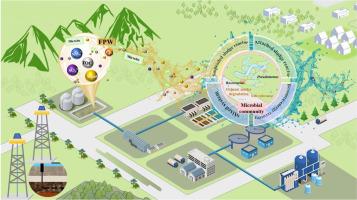
Unconventional oil and gas (UOG) extraction techniques typically involve the production of large volumes of so-called flowback and produced water (FPW), a site-specific wastewater stream characterized by complex organic and inorganic composition. Sustainable and cost-effective management of FPW, as well as mitigation of its environmental risks and impacts, represents substantial challenges for governments, industries, and societies worldwide. Among various treatment technologies, biological processes have gained interest due to their low installation and operational costs. However, the interaction of FPW's complex composition with microorganisms poses challenging scientific and engineering questions. This review examines the water quality characteristics and sources of FPW from twelve UOG extraction sites in China and North America, revealing strong spatio-temporal heterogeneity of organic, inorganic, and microbial components across different reservoirs. The complex and variable water quality, large wastewater volumes, and high treatment demands have driven the exploration of biological treatments for FPW. This work systematically reviews and analyzes the operating conditions, treatment efficiency, and technical applicability of suspended sludge reactors, attached sludge reactors, mixed systems, and resource/energy recovery systems. Developing skid-mounted equipment based on suspended sludge reactors to handle variations in wastewater quantity and innovating the form of attached sludge reactors, especially in enriching salt-tolerant microbes for in-situ FPW treatment, are deemed essential. The dominant microorganisms playing a key role in the biological treatment are also discussed, with focus on two different inoculation sources (activated sludge and FPW). Roseovarius from FPW and Pseudomonas from activated sludge have strong adaptability to different reactors. The review further underscores the need to integrate biological treatments with complementary technologies. Finally, it advocates for the establishment of robust and scalable biological treatments through research in three main directions: (i) exploring microbial resources in original FPW; (ii) using omics technologies to elucidate microbial function and species interaction; (iii) pre-designing environmental and operational conditions to optimize treatment efficiency.
期刊介绍:
Water Research, along with its open access companion journal Water Research X, serves as a platform for publishing original research papers covering various aspects of the science and technology related to the anthropogenic water cycle, water quality, and its management worldwide. The audience targeted by the journal comprises biologists, chemical engineers, chemists, civil engineers, environmental engineers, limnologists, and microbiologists. The scope of the journal include:
•Treatment processes for water and wastewaters (municipal, agricultural, industrial, and on-site treatment), including resource recovery and residuals management;
•Urban hydrology including sewer systems, stormwater management, and green infrastructure;
•Drinking water treatment and distribution;
•Potable and non-potable water reuse;
•Sanitation, public health, and risk assessment;
•Anaerobic digestion, solid and hazardous waste management, including source characterization and the effects and control of leachates and gaseous emissions;
•Contaminants (chemical, microbial, anthropogenic particles such as nanoparticles or microplastics) and related water quality sensing, monitoring, fate, and assessment;
•Anthropogenic impacts on inland, tidal, coastal and urban waters, focusing on surface and ground waters, and point and non-point sources of pollution;
•Environmental restoration, linked to surface water, groundwater and groundwater remediation;
•Analysis of the interfaces between sediments and water, and between water and atmosphere, focusing specifically on anthropogenic impacts;
•Mathematical modelling, systems analysis, machine learning, and beneficial use of big data related to the anthropogenic water cycle;
•Socio-economic, policy, and regulations studies.





 京公网安备 11010802042870号
京ICP备2023020795号-1
京公网安备 11010802042870号
京ICP备2023020795号-1

 分享
分享
 求助内容:
求助内容: 应助结果提醒方式:
 扫码关注我们
