{"title":"Ceramic membrane fouling caused by recycling biological activated carbon filter backwash water: Effective backwash with ozone micro-nano bubbles","authors":"Wei Liu , Tao Lin , Xiaoshu Yan","doi":"10.1016/j.watres.2025.123219","DOIUrl":null,"url":null,"abstract":"<div><div>The widespread use of ceramic membranes in wastewater recycling is still hampered by membrane fouling problems. Frequent chemical cleaning increases operating and maintenance costs. This work proposes ozone micro-nano-bubble (O<sub>3</sub>-MNB) backwash as a new backwashing method to control the ceramic membrane fouling. Activated carbon filter backwash water (ACFBW) was used as feed water for the ceramic membrane and the effect of O<sub>3</sub>-MNB backwash was compared with tap water backwash, air-micro-nano-bubble (Air-MNB) backwash and ozone water backwash. The results of the flux tests showed that the irreversible fouling resistance (R<sub>Fi</sub>) for the O<sub>3</sub>-MNB backwash was only 4.8 %, 10.0 % and 23.3 % of the R<sub>Fi</sub> for the tap water backwash, Air-MNB backwash and O<sub>3</sub> water backwash, respectively. The results of the SEM and CLSM analyses demonstrated that the combination of ozone with MNB for backwashing was an effective method for the removal of viable cells and majority of proteins and polysaccharides from the surface of the ceramic membrane. However, the application of ozone also led to the release of microbial DNA, which increased its binding to Al₂O₃ on the ceramic membrane. Furthermore, the increased ozone concentration transported by the MNB could promote the generation of a large number of hydroxyl radicals (•OH) due to the effect of Al₂O₃, which potentially enhanced the oxidation of macromolecular contaminants in the pores. At the same time, the electrostatic repulsion and hydrophobic action provided by the MNB improved the efficacy of peeling off the filter cake layer when cleaning the membrane pores. Consequently, this study demonstrated the effectiveness of O<sub>3</sub>-MNB backwash in the long-term operation of ceramic membranes and provided insights into the fundamental mechanism by which this process controlled the membrane fouling.</div></div>","PeriodicalId":443,"journal":{"name":"Water Research","volume":"275 ","pages":"Article 123219"},"PeriodicalIF":12.4000,"publicationDate":"2025-05-01","publicationTypes":"Journal Article","fieldsOfStudy":null,"isOpenAccess":false,"openAccessPdf":"","citationCount":"0","resultStr":null,"platform":"Semanticscholar","paperid":null,"PeriodicalName":"Water Research","FirstCategoryId":"93","ListUrlMain":"https://www.sciencedirect.com/science/article/pii/S0043135425001332","RegionNum":1,"RegionCategory":"环境科学与生态学","ArticlePicture":[],"TitleCN":null,"AbstractTextCN":null,"PMCID":null,"EPubDate":"2025/1/29 0:00:00","PubModel":"Epub","JCR":"Q1","JCRName":"ENGINEERING, ENVIRONMENTAL","Score":null,"Total":0}
引用次数: 0
Abstract
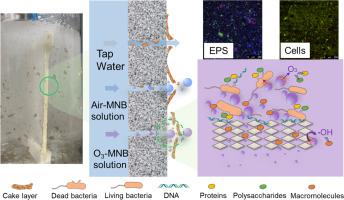
The widespread use of ceramic membranes in wastewater recycling is still hampered by membrane fouling problems. Frequent chemical cleaning increases operating and maintenance costs. This work proposes ozone micro-nano-bubble (O3-MNB) backwash as a new backwashing method to control the ceramic membrane fouling. Activated carbon filter backwash water (ACFBW) was used as feed water for the ceramic membrane and the effect of O3-MNB backwash was compared with tap water backwash, air-micro-nano-bubble (Air-MNB) backwash and ozone water backwash. The results of the flux tests showed that the irreversible fouling resistance (RFi) for the O3-MNB backwash was only 4.8 %, 10.0 % and 23.3 % of the RFi for the tap water backwash, Air-MNB backwash and O3 water backwash, respectively. The results of the SEM and CLSM analyses demonstrated that the combination of ozone with MNB for backwashing was an effective method for the removal of viable cells and majority of proteins and polysaccharides from the surface of the ceramic membrane. However, the application of ozone also led to the release of microbial DNA, which increased its binding to Al₂O₃ on the ceramic membrane. Furthermore, the increased ozone concentration transported by the MNB could promote the generation of a large number of hydroxyl radicals (•OH) due to the effect of Al₂O₃, which potentially enhanced the oxidation of macromolecular contaminants in the pores. At the same time, the electrostatic repulsion and hydrophobic action provided by the MNB improved the efficacy of peeling off the filter cake layer when cleaning the membrane pores. Consequently, this study demonstrated the effectiveness of O3-MNB backwash in the long-term operation of ceramic membranes and provided insights into the fundamental mechanism by which this process controlled the membrane fouling.
期刊介绍:
Water Research, along with its open access companion journal Water Research X, serves as a platform for publishing original research papers covering various aspects of the science and technology related to the anthropogenic water cycle, water quality, and its management worldwide. The audience targeted by the journal comprises biologists, chemical engineers, chemists, civil engineers, environmental engineers, limnologists, and microbiologists. The scope of the journal include:
•Treatment processes for water and wastewaters (municipal, agricultural, industrial, and on-site treatment), including resource recovery and residuals management;
•Urban hydrology including sewer systems, stormwater management, and green infrastructure;
•Drinking water treatment and distribution;
•Potable and non-potable water reuse;
•Sanitation, public health, and risk assessment;
•Anaerobic digestion, solid and hazardous waste management, including source characterization and the effects and control of leachates and gaseous emissions;
•Contaminants (chemical, microbial, anthropogenic particles such as nanoparticles or microplastics) and related water quality sensing, monitoring, fate, and assessment;
•Anthropogenic impacts on inland, tidal, coastal and urban waters, focusing on surface and ground waters, and point and non-point sources of pollution;
•Environmental restoration, linked to surface water, groundwater and groundwater remediation;
•Analysis of the interfaces between sediments and water, and between water and atmosphere, focusing specifically on anthropogenic impacts;
•Mathematical modelling, systems analysis, machine learning, and beneficial use of big data related to the anthropogenic water cycle;
•Socio-economic, policy, and regulations studies.




 京公网安备 11010802042870号
京ICP备2023020795号-1
京公网安备 11010802042870号
京ICP备2023020795号-1

 分享
分享
 求助内容:
求助内容: 应助结果提醒方式:
 扫码关注我们
