Shuang Zhong, Yu Tian, Chen Chen, Bin Nie, Hongyan Wang, Shengyu Zhang
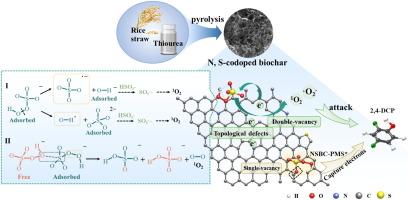
{"title":"Roles of intrinsic defects on nitrogen, sulfur-codoped biochar in peroxymonosulfate activation toward organic contaminates degradation","authors":"Shuang Zhong, Yu Tian, Chen Chen, Bin Nie, Hongyan Wang, Shengyu Zhang","doi":"10.1016/j.cej.2025.160062","DOIUrl":null,"url":null,"abstract":"The utilization of nitrogen and sulfur-codoped biochar-activated peroxymonosulfate (PMS) has emerged as a promising advanced oxidation technology for the degradation of organic pollutants. However, the dominant active sites, especially the specific defect structures governing PMS activation and their subsequent activation mechanism remain ambiguous, posing challenges to the rational design of high-performance biochar catalysts. Herein, a series of nitrogen and sulfur-codoped biochar (NSBC) with varying pyrolysis temperatures and doping levels were synthesized. An investigation into the relationship between their properties and the reaction rate constants of 2,4-dichlorophenol (2,4-DCP) degradation by activated PMS revealed that intrinsic defects, thiophene S, and graphitic N were active sites in the oxidation reaction, with intrinsic defects identified as playing a predominant role. Density functional theory (DFT) calculations combined with electrochemical measurements further revealed the crucial role of single-vacancy defective configuration in mediating a direct electron transfer pathway for 2,4-DCP degradation. Moreover, double-vacancy and topological defects facilitated the transfer of electrons to adsorbed PMS, leading to the release of <sup>1</sup>O<sub>2</sub> and subsequent degradation of 2,4-DCP. The distinctive mechanism enabled the NSBC-activated PMS system to exhibit high selectivity and effectively remove 2,4-DCP from a complex aquatic environment. The findings from this study provide valuable insights into the role of specific structural defects in PMS activation and offer theoretical support for the design of biochar catalysts with heteroatom doping strategies.","PeriodicalId":270,"journal":{"name":"Chemical Engineering Journal","volume":"40 1","pages":""},"PeriodicalIF":13.2000,"publicationDate":"2025-01-28","publicationTypes":"Journal Article","fieldsOfStudy":null,"isOpenAccess":false,"openAccessPdf":"","citationCount":"0","resultStr":null,"platform":"Semanticscholar","paperid":null,"PeriodicalName":"Chemical Engineering Journal","FirstCategoryId":"5","ListUrlMain":"https://doi.org/10.1016/j.cej.2025.160062","RegionNum":1,"RegionCategory":"工程技术","ArticlePicture":[],"TitleCN":null,"AbstractTextCN":null,"PMCID":null,"EPubDate":"","PubModel":"","JCR":"Q1","JCRName":"ENGINEERING, CHEMICAL","Score":null,"Total":0}
引用次数: 0
Abstract
The utilization of nitrogen and sulfur-codoped biochar-activated peroxymonosulfate (PMS) has emerged as a promising advanced oxidation technology for the degradation of organic pollutants. However, the dominant active sites, especially the specific defect structures governing PMS activation and their subsequent activation mechanism remain ambiguous, posing challenges to the rational design of high-performance biochar catalysts. Herein, a series of nitrogen and sulfur-codoped biochar (NSBC) with varying pyrolysis temperatures and doping levels were synthesized. An investigation into the relationship between their properties and the reaction rate constants of 2,4-dichlorophenol (2,4-DCP) degradation by activated PMS revealed that intrinsic defects, thiophene S, and graphitic N were active sites in the oxidation reaction, with intrinsic defects identified as playing a predominant role. Density functional theory (DFT) calculations combined with electrochemical measurements further revealed the crucial role of single-vacancy defective configuration in mediating a direct electron transfer pathway for 2,4-DCP degradation. Moreover, double-vacancy and topological defects facilitated the transfer of electrons to adsorbed PMS, leading to the release of 1O2 and subsequent degradation of 2,4-DCP. The distinctive mechanism enabled the NSBC-activated PMS system to exhibit high selectivity and effectively remove 2,4-DCP from a complex aquatic environment. The findings from this study provide valuable insights into the role of specific structural defects in PMS activation and offer theoretical support for the design of biochar catalysts with heteroatom doping strategies.
期刊介绍:
The Chemical Engineering Journal is an international research journal that invites contributions of original and novel fundamental research. It aims to provide an international platform for presenting original fundamental research, interpretative reviews, and discussions on new developments in chemical engineering. The journal welcomes papers that describe novel theory and its practical application, as well as those that demonstrate the transfer of techniques from other disciplines. It also welcomes reports on carefully conducted experimental work that is soundly interpreted. The main focus of the journal is on original and rigorous research results that have broad significance. The Catalysis section within the Chemical Engineering Journal focuses specifically on Experimental and Theoretical studies in the fields of heterogeneous catalysis, molecular catalysis, and biocatalysis. These studies have industrial impact on various sectors such as chemicals, energy, materials, foods, healthcare, and environmental protection.



 京公网安备 11010802042870号
京ICP备2023020795号-1
京公网安备 11010802042870号
京ICP备2023020795号-1

 分享
分享
 求助内容:
求助内容: 应助结果提醒方式:
 扫码关注我们
