{"title":"Guiding the rational design of biocompatible metal-organic frameworks for drug delivery","authors":"Dhruv Menon , David Fairen-Jimenez","doi":"10.1016/j.matt.2025.101958","DOIUrl":null,"url":null,"abstract":"<div><div>Metal-organic frameworks (MOFs) are promising for drug delivery due to their high drug-loading capacity, tunable porosity, and structural diversity. However, their clinical translation is hindered by concerns over biocompatibility. Unfortunately, experiments are resource and time intensive, while modeling approaches fail to capture the behavior of MOFs in intricate biological systems. Herein, we report a machine learning (ML)-guided computational pipeline for probing MOF biocompatibility. Using a database of over 35,000 organic molecules, our interpretable ML models predict the toxicity of MOF linkers with over 80% accuracy across different administration routes. Furthermore, we cataloged the toxicity of MOF metallic centers and screened 86,000 MOFs from the Cambridge Structural Database, identifying candidates with minimal toxicity profiles. Beyond screening, our models provide insights into chemical features of biocompatible MOFs—enabling <em>de novo</em> rational design. This framework expedites the discovery of safer MOFs for drug delivery and deepens the understanding of their underlying chemistry.</div></div>","PeriodicalId":388,"journal":{"name":"Matter","volume":"8 3","pages":"Article 101958"},"PeriodicalIF":17.5000,"publicationDate":"2025-03-05","publicationTypes":"Journal Article","fieldsOfStudy":null,"isOpenAccess":false,"openAccessPdf":"","citationCount":"0","resultStr":null,"platform":"Semanticscholar","paperid":null,"PeriodicalName":"Matter","FirstCategoryId":"88","ListUrlMain":"https://www.sciencedirect.com/science/article/pii/S2590238525000013","RegionNum":1,"RegionCategory":"材料科学","ArticlePicture":[],"TitleCN":null,"AbstractTextCN":null,"PMCID":null,"EPubDate":"2025/1/29 0:00:00","PubModel":"Epub","JCR":"Q1","JCRName":"MATERIALS SCIENCE, MULTIDISCIPLINARY","Score":null,"Total":0}
引用次数: 0
Abstract
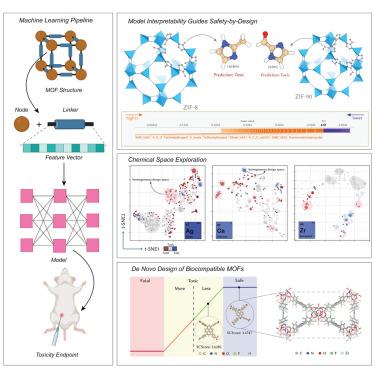
Metal-organic frameworks (MOFs) are promising for drug delivery due to their high drug-loading capacity, tunable porosity, and structural diversity. However, their clinical translation is hindered by concerns over biocompatibility. Unfortunately, experiments are resource and time intensive, while modeling approaches fail to capture the behavior of MOFs in intricate biological systems. Herein, we report a machine learning (ML)-guided computational pipeline for probing MOF biocompatibility. Using a database of over 35,000 organic molecules, our interpretable ML models predict the toxicity of MOF linkers with over 80% accuracy across different administration routes. Furthermore, we cataloged the toxicity of MOF metallic centers and screened 86,000 MOFs from the Cambridge Structural Database, identifying candidates with minimal toxicity profiles. Beyond screening, our models provide insights into chemical features of biocompatible MOFs—enabling de novo rational design. This framework expedites the discovery of safer MOFs for drug delivery and deepens the understanding of their underlying chemistry.
期刊介绍:
Matter, a monthly journal affiliated with Cell, spans the broad field of materials science from nano to macro levels,covering fundamentals to applications. Embracing groundbreaking technologies,it includes full-length research articles,reviews, perspectives,previews, opinions, personnel stories, and general editorial content.
Matter aims to be the primary resource for researchers in academia and industry, inspiring the next generation of materials scientists.




 京公网安备 11010802042870号
京ICP备2023020795号-1
京公网安备 11010802042870号
京ICP备2023020795号-1

 分享
分享
 求助内容:
求助内容: 应助结果提醒方式:
 扫码关注我们
