{"title":"High-entropy structure design of transition metal dichalcogenides for improved electromagnetic wave absorption performance†","authors":"Yefei Xu, Mian Li, Nengwen Ding and Qing Huang","doi":"10.1039/D4TA08853K","DOIUrl":null,"url":null,"abstract":"<p >Transition metal dichalcogenides (TMDs) have attracted great attention owing to their unique properties and wide range of applications. The versatile composition and tunable phase structure provide a larger potential to explore TMDs with unprecedented properties. In this work, a simple model based on the Hume-Rothery rules was proposed to predict the formation possibility of TMDs containing multiple transition metal elements. Several predicted high-entropy TMDs, <em>e.g.</em> (Ti<small><sub>0.25</sub></small>V<small><sub>0.25</sub></small>Cr<small><sub>0.25</sub></small>Nb<small><sub>0.25</sub></small>)S<small><sub>2</sub></small> and (Ti<small><sub>0.2</sub></small>V<small><sub>0.2</sub></small>Cr<small><sub>0.2</sub></small>Nb<small><sub>0.2</sub></small>Ta<small><sub>0.2</sub></small>)S<small><sub>2</sub></small>, were synthesized through a solid-phase reaction route. The high-entropy solid solution of the M-site element resulted in an atomic-scale ordered/disordered stacking structure of the TMD crystals, which enhanced the dipole polarization. The multiple M-site elements induced 1T/2H phase transition within the TMDs sheets, which enhanced the interfacial polarization. These two factors significantly enhanced the dielectric loss of the high-entropy TMDs, particularly endowing (Ti<small><sub>0.25</sub></small>V<small><sub>0.25</sub></small>Cr<small><sub>0.25</sub></small>Nb<small><sub>0.25</sub></small>)S<small><sub>2</sub></small> with exceptional electromagnetic wave absorption capabilities. The maximum reflection loss of (Ti<small><sub>0.25</sub></small>V<small><sub>0.25</sub></small>Cr<small><sub>0.25</sub></small>Nb<small><sub>0.25</sub></small>)S<small><sub>2</sub></small> reached −60.31 dB, and the effective absorption bandwidth was 2.31 GHz at the 8.2–12.4 GHz band. Thus, this study demonstrates great potential for tuning the properties and broadening the applications of TMDs through high-entropy structure design.</p>","PeriodicalId":82,"journal":{"name":"Journal of Materials Chemistry A","volume":" 11","pages":" 7852-7859"},"PeriodicalIF":9.5000,"publicationDate":"2025-01-29","publicationTypes":"Journal Article","fieldsOfStudy":null,"isOpenAccess":false,"openAccessPdf":"","citationCount":"0","resultStr":null,"platform":"Semanticscholar","paperid":null,"PeriodicalName":"Journal of Materials Chemistry A","FirstCategoryId":"88","ListUrlMain":"https://pubs.rsc.org/en/content/articlelanding/2025/ta/d4ta08853k","RegionNum":2,"RegionCategory":"材料科学","ArticlePicture":[],"TitleCN":null,"AbstractTextCN":null,"PMCID":null,"EPubDate":"","PubModel":"","JCR":"Q1","JCRName":"CHEMISTRY, PHYSICAL","Score":null,"Total":0}
引用次数: 0
Abstract
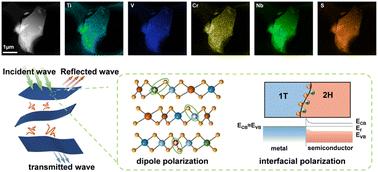
Transition metal dichalcogenides (TMDs) have attracted great attention owing to their unique properties and wide range of applications. The versatile composition and tunable phase structure provide a larger potential to explore TMDs with unprecedented properties. In this work, a simple model based on the Hume-Rothery rules was proposed to predict the formation possibility of TMDs containing multiple transition metal elements. Several predicted high-entropy TMDs, e.g. (Ti0.25V0.25Cr0.25Nb0.25)S2 and (Ti0.2V0.2Cr0.2Nb0.2Ta0.2)S2, were synthesized through a solid-phase reaction route. The high-entropy solid solution of the M-site element resulted in an atomic-scale ordered/disordered stacking structure of the TMD crystals, which enhanced the dipole polarization. The multiple M-site elements induced 1T/2H phase transition within the TMDs sheets, which enhanced the interfacial polarization. These two factors significantly enhanced the dielectric loss of the high-entropy TMDs, particularly endowing (Ti0.25V0.25Cr0.25Nb0.25)S2 with exceptional electromagnetic wave absorption capabilities. The maximum reflection loss of (Ti0.25V0.25Cr0.25Nb0.25)S2 reached −60.31 dB, and the effective absorption bandwidth was 2.31 GHz at the 8.2–12.4 GHz band. Thus, this study demonstrates great potential for tuning the properties and broadening the applications of TMDs through high-entropy structure design.
期刊介绍:
The Journal of Materials Chemistry A, B & C covers a wide range of high-quality studies in the field of materials chemistry, with each section focusing on specific applications of the materials studied. Journal of Materials Chemistry A emphasizes applications in energy and sustainability, including topics such as artificial photosynthesis, batteries, and fuel cells. Journal of Materials Chemistry B focuses on applications in biology and medicine, while Journal of Materials Chemistry C covers applications in optical, magnetic, and electronic devices. Example topic areas within the scope of Journal of Materials Chemistry A include catalysis, green/sustainable materials, sensors, and water treatment, among others.



 京公网安备 11010802042870号
京ICP备2023020795号-1
京公网安备 11010802042870号
京ICP备2023020795号-1

 分享
分享
 求助内容:
求助内容: 应助结果提醒方式:
 扫码关注我们
