Junyan Ding, Liming Zhao, Yingju Yang and Jing Liu
{"title":"Unraveling the role of a Cu dopant in formaldehyde catalytic oxidation over a La0.8Sr0.2Mn1−xCuxO3 perovskite: an experimental and theoretical study","authors":"Junyan Ding, Liming Zhao, Yingju Yang and Jing Liu","doi":"10.1039/D4TA06446A","DOIUrl":null,"url":null,"abstract":"<p >A series of La<small><sub>0.8</sub></small>Sr<small><sub>0.2</sub></small>Mn<small><sub>1−<em>x</em></sub></small>Cu<small><sub><em>x</em></sub></small>O<small><sub>3</sub></small> perovskite-type catalysts were prepared through a sol–gel method and evaluated for formaldehyde catalytic oxidation. Experimental and DFT studies were performed to reveal the role of the Cu dopant on formaldehyde oxidation over La<small><sub>0.8</sub></small>Sr<small><sub>0.2</sub></small>Mn<small><sub>1−<em>x</em></sub></small>Cu<small><sub><em>x</em></sub></small>O<small><sub>3</sub></small> catalysts and determine the optimal doping amount of Cu. The perovskite with a Cu substitution content of 0.2 exhibited the highest catalytic activity and good thermal stability for formaldehyde oxidation. The degree of Cu substitution significantly influenced the textural properties of the catalysts. The La<small><sub>0.8</sub></small>Sr<small><sub>0.2</sub></small>Mn<small><sub>0.8</sub></small>Cu<small><sub>0.2</sub></small>O<small><sub>3</sub></small> catalyst exhibited the highest specific area, pore volume, and crystalline degree, which enabled the availability of more active sites for formaldehyde adsorption. The introduction of bivalent Cu<small><sup>2+</sup></small> resulted in a charge imbalance that was compensated by the increased Mn<small><sup>4+</sup></small>/Mn<small><sup>3+</sup></small> ratio of the perovskite. Partial substitution of Mn by Cu cations enhanced the oxygen mobility of perovskites, which was ascribed to a synergy between surface Cu and Mn atoms. The La<small><sub>0.8</sub></small>Sr<small><sub>0.2</sub></small>Mn<small><sub>0.8</sub></small>Cu<small><sub>0.2</sub></small>O<small><sub>3</sub></small> catalyst presented excellent oxygen mobility and thus promoted formaldehyde catalytic oxidation. DFT calculation results indicated that the absolute value of the formaldehyde adsorption energy on the surface Cu–O site was higher than that on the Mn–O site. The Cu dopant facilitated formaldehyde adsorption and promoted the transfer of more electrons from formaldehyde to the catalyst, which was beneficial for formaldehyde activation and subsequent oxidation. Finally, combining the <em>in situ</em> FTIR measurements with DFT calculations revealed the reaction mechanism of formaldehyde oxidation on the La<small><sub>0.8</sub></small>Sr<small><sub>0.2</sub></small>Mn<small><sub>1−<em>x</em></sub></small>Cu<small><sub><em>x</em></sub></small>O<small><sub>3</sub></small> perovskite. Based on the experimental and theoretical methods, herein, the corresponding reaction cycle of formaldehyde oxidation is proposed. The reaction cycle contained seven elementary reaction steps, in which O<small><sub>2</sub></small> dissociation was the rate-limiting step with the highest energy barrier of 1.47 eV.</p>","PeriodicalId":82,"journal":{"name":"Journal of Materials Chemistry A","volume":" 10","pages":" 7371-7380"},"PeriodicalIF":9.5000,"publicationDate":"2025-01-30","publicationTypes":"Journal Article","fieldsOfStudy":null,"isOpenAccess":false,"openAccessPdf":"","citationCount":"0","resultStr":null,"platform":"Semanticscholar","paperid":null,"PeriodicalName":"Journal of Materials Chemistry A","FirstCategoryId":"88","ListUrlMain":"https://pubs.rsc.org/en/content/articlelanding/2025/ta/d4ta06446a","RegionNum":2,"RegionCategory":"材料科学","ArticlePicture":[],"TitleCN":null,"AbstractTextCN":null,"PMCID":null,"EPubDate":"","PubModel":"","JCR":"Q1","JCRName":"CHEMISTRY, PHYSICAL","Score":null,"Total":0}
引用次数: 0
Abstract
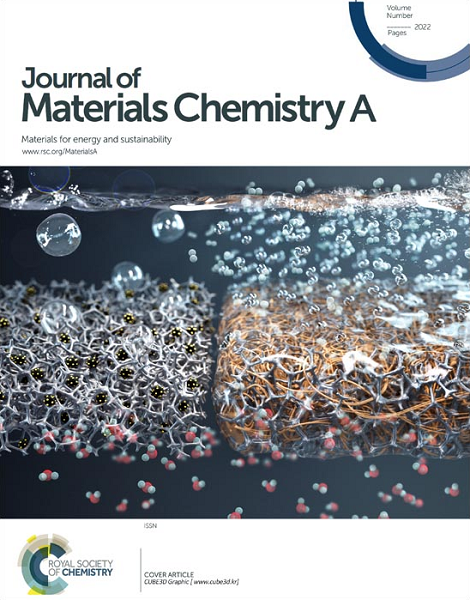
A series of La0.8Sr0.2Mn1−xCuxO3 perovskite-type catalysts were prepared through a sol–gel method and evaluated for formaldehyde catalytic oxidation. Experimental and DFT studies were performed to reveal the role of the Cu dopant on formaldehyde oxidation over La0.8Sr0.2Mn1−xCuxO3 catalysts and determine the optimal doping amount of Cu. The perovskite with a Cu substitution content of 0.2 exhibited the highest catalytic activity and good thermal stability for formaldehyde oxidation. The degree of Cu substitution significantly influenced the textural properties of the catalysts. The La0.8Sr0.2Mn0.8Cu0.2O3 catalyst exhibited the highest specific area, pore volume, and crystalline degree, which enabled the availability of more active sites for formaldehyde adsorption. The introduction of bivalent Cu2+ resulted in a charge imbalance that was compensated by the increased Mn4+/Mn3+ ratio of the perovskite. Partial substitution of Mn by Cu cations enhanced the oxygen mobility of perovskites, which was ascribed to a synergy between surface Cu and Mn atoms. The La0.8Sr0.2Mn0.8Cu0.2O3 catalyst presented excellent oxygen mobility and thus promoted formaldehyde catalytic oxidation. DFT calculation results indicated that the absolute value of the formaldehyde adsorption energy on the surface Cu–O site was higher than that on the Mn–O site. The Cu dopant facilitated formaldehyde adsorption and promoted the transfer of more electrons from formaldehyde to the catalyst, which was beneficial for formaldehyde activation and subsequent oxidation. Finally, combining the in situ FTIR measurements with DFT calculations revealed the reaction mechanism of formaldehyde oxidation on the La0.8Sr0.2Mn1−xCuxO3 perovskite. Based on the experimental and theoretical methods, herein, the corresponding reaction cycle of formaldehyde oxidation is proposed. The reaction cycle contained seven elementary reaction steps, in which O2 dissociation was the rate-limiting step with the highest energy barrier of 1.47 eV.
期刊介绍:
The Journal of Materials Chemistry A, B & C covers a wide range of high-quality studies in the field of materials chemistry, with each section focusing on specific applications of the materials studied. Journal of Materials Chemistry A emphasizes applications in energy and sustainability, including topics such as artificial photosynthesis, batteries, and fuel cells. Journal of Materials Chemistry B focuses on applications in biology and medicine, while Journal of Materials Chemistry C covers applications in optical, magnetic, and electronic devices. Example topic areas within the scope of Journal of Materials Chemistry A include catalysis, green/sustainable materials, sensors, and water treatment, among others.




 京公网安备 11010802042870号
京ICP备2023020795号-1
京公网安备 11010802042870号
京ICP备2023020795号-1

 分享
分享
 求助内容:
求助内容: 应助结果提醒方式:
 扫码关注我们
