A Very Low-Carbohydrate Program in Adults With Metabolic Dysfunction-Associated Steatotic Liver Disease and Phospholipase Domain-Containing Protein 3 Risk Genotype: Pre-Post Intervention Study.
Laura R Saslow, Jamie Krinock, Alison O'Brien, Kaitlyn Raymond, Hovig Bayandorian, Judith T Moskowitz, Jennifer Daubenmier, Antonino Oliveri, Deanna J Marriott, Dina H Griauzde, Elizabeth K Speliotes
{"title":"A Very Low-Carbohydrate Program in Adults With Metabolic Dysfunction-Associated Steatotic Liver Disease and Phospholipase Domain-Containing Protein 3 Risk Genotype: Pre-Post Intervention Study.","authors":"Laura R Saslow, Jamie Krinock, Alison O'Brien, Kaitlyn Raymond, Hovig Bayandorian, Judith T Moskowitz, Jennifer Daubenmier, Antonino Oliveri, Deanna J Marriott, Dina H Griauzde, Elizabeth K Speliotes","doi":"10.2196/60051","DOIUrl":null,"url":null,"abstract":"<p><strong>Background: </strong>Insulin resistance and the G allele of rs738409 interact to create a greater risk of metabolic dysfunction-associated steatotic liver disease.</p><p><strong>Objective: </strong>This study aims to confirm that one promising way to reduce insulin resistance is by following a very low-carbohydrate (VLC) dietary pattern.</p><p><strong>Methods: </strong>Adults with rs738409-GG or -CG with liver steatosis and elevated liver function tests, were taught an ad libitum VLC diet, positive affect and mindful eating skills, goal setting, and self-monitoring and given feedback and coaching for 4 months. We measured liver steatosis, anthropometric, serum metabolic diet adherence, and quality of life measures.</p><p><strong>Results: </strong>In this small pilot trial, of the 11 participants enrolled, 9 (82%) participants completed outcomes. All 11 participants viewed at least 1 session of the intervention, and 8 (73%) participants viewed at least half of the sessions. Among the 9 participants who provided 4-month self-report information, intervention satisfaction was high (mean 6.22, 95% CI 5.58-6.85), with 5 (56%) participants rating the intervention the top score, and 4 (44%) participants reporting they did not plan to stop following the VLC diet. Across participants with a 4-month hepatic liver fat percent measurement, the percent change in liver fat was -33.17% (95% CI -86.48 to 20.14), and in only the participants who were adherent to the eating pattern, the percent change in liver fat was -53.12% (95% CI -71.25 to -34.99). Amongst participants with a 4-month hepatic liver fat percent measurement, 6 out of 8 (75%) participants were considered responders, with a relative decline in liver fat ≥30%, and of the 9 participants with a 4-month body weight, 9 (100%) participants lost ≥5% of their body weight. There were no serious adverse events.</p><p><strong>Conclusions: </strong>Results suggest the feasibility, acceptability, and preliminary efficacy of the VLC intervention in adults with higher genetic risk for metabolic dysfunction-associated steatotic liver disease, although there is a need for further studies given the small sample size and the high risk of substantial biases in this small pilot study.</p>","PeriodicalId":14841,"journal":{"name":"JMIR Formative Research","volume":"9 ","pages":"e60051"},"PeriodicalIF":2.0000,"publicationDate":"2025-01-10","publicationTypes":"Journal Article","fieldsOfStudy":null,"isOpenAccess":false,"openAccessPdf":"https://www.ncbi.nlm.nih.gov/pmc/articles/PMC11740387/pdf/","citationCount":"0","resultStr":null,"platform":"Semanticscholar","paperid":null,"PeriodicalName":"JMIR Formative Research","FirstCategoryId":"1085","ListUrlMain":"https://doi.org/10.2196/60051","RegionNum":0,"RegionCategory":null,"ArticlePicture":[],"TitleCN":null,"AbstractTextCN":null,"PMCID":null,"EPubDate":"","PubModel":"","JCR":"Q3","JCRName":"HEALTH CARE SCIENCES & SERVICES","Score":null,"Total":0}
引用次数: 0
Abstract
Background: Insulin resistance and the G allele of rs738409 interact to create a greater risk of metabolic dysfunction-associated steatotic liver disease.
Objective: This study aims to confirm that one promising way to reduce insulin resistance is by following a very low-carbohydrate (VLC) dietary pattern.
Methods: Adults with rs738409-GG or -CG with liver steatosis and elevated liver function tests, were taught an ad libitum VLC diet, positive affect and mindful eating skills, goal setting, and self-monitoring and given feedback and coaching for 4 months. We measured liver steatosis, anthropometric, serum metabolic diet adherence, and quality of life measures.
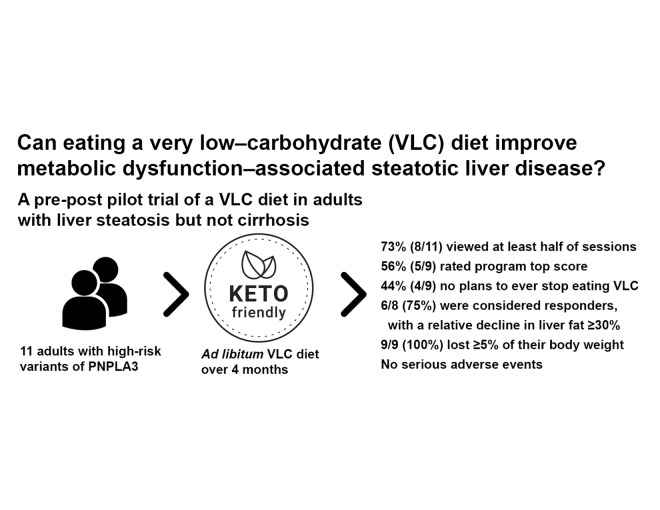
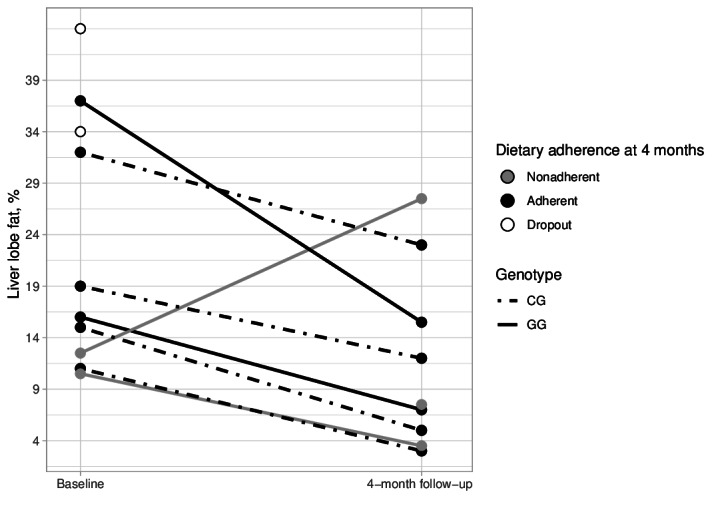
Results: In this small pilot trial, of the 11 participants enrolled, 9 (82%) participants completed outcomes. All 11 participants viewed at least 1 session of the intervention, and 8 (73%) participants viewed at least half of the sessions. Among the 9 participants who provided 4-month self-report information, intervention satisfaction was high (mean 6.22, 95% CI 5.58-6.85), with 5 (56%) participants rating the intervention the top score, and 4 (44%) participants reporting they did not plan to stop following the VLC diet. Across participants with a 4-month hepatic liver fat percent measurement, the percent change in liver fat was -33.17% (95% CI -86.48 to 20.14), and in only the participants who were adherent to the eating pattern, the percent change in liver fat was -53.12% (95% CI -71.25 to -34.99). Amongst participants with a 4-month hepatic liver fat percent measurement, 6 out of 8 (75%) participants were considered responders, with a relative decline in liver fat ≥30%, and of the 9 participants with a 4-month body weight, 9 (100%) participants lost ≥5% of their body weight. There were no serious adverse events.
Conclusions: Results suggest the feasibility, acceptability, and preliminary efficacy of the VLC intervention in adults with higher genetic risk for metabolic dysfunction-associated steatotic liver disease, although there is a need for further studies given the small sample size and the high risk of substantial biases in this small pilot study.
背景:胰岛素抵抗和rs738409的G等位基因相互作用,产生代谢功能障碍相关的脂肪变性肝病的更大风险。目的:本研究旨在证实极低碳水化合物(VLC)饮食模式是降低胰岛素抵抗的一种有希望的方法。方法:患有rs738409-GG或-CG并伴有肝脂肪变性和肝功能升高的成人,接受随机VLC饮食、积极影响和正性饮食技巧、目标设定和自我监测,并给予4个月的反馈和指导。我们测量了肝脏脂肪变性、人体测量、血清代谢饮食依从性和生活质量测量。结果:在这项小型试点试验中,11名参与者中,9名(82%)参与者完成了结局。所有11名参与者至少观看了一次干预,8名(73%)参与者至少观看了一半的干预。在提供4个月自我报告信息的9名参与者中,干预满意度高(平均值6.22,95% CI 5.58-6.85), 5名(56%)参与者认为干预得分最高,4名(44%)参与者报告他们不打算停止遵循VLC饮食。在4个月肝脂肪百分比测量的参与者中,肝脏脂肪的百分比变化为-33.17% (95% CI -86.48至20.14),仅在坚持饮食模式的参与者中,肝脏脂肪的百分比变化为-53.12% (95% CI -71.25至-34.99)。在4个月肝脂肪百分比测量的参与者中,8名参与者中有6名(75%)被认为有反应,肝脏脂肪相对下降≥30%,在4个月体重的9名参与者中,9名(100%)参与者体重减轻≥5%。无严重不良事件发生。结论:结果表明,VLC干预对代谢功能障碍相关脂肪变性疾病遗传风险较高的成人具有可行性、可接受性和初步疗效,尽管考虑到本小型试点研究的样本量小且存在较大偏倚风险,仍需要进一步研究。




 京公网安备 11010802042870号
京ICP备2023020795号-1
京公网安备 11010802042870号
京ICP备2023020795号-1

 分享
分享
 求助内容:
求助内容: 应助结果提醒方式:
 扫码关注我们
