Eugene P. Duff, Henrik Zetterberg, Amanda Heslegrave, Abbas Dehghan, Paul Elliott, Naomi Allen, Heiko Runz, Rhiannon Laban, Elena Veleva, Christopher D. Whelan, Benjamin B. Sun, Paul M. Matthews
{"title":"Plasma proteomic evidence for increased β-amyloid pathology after SARS-CoV-2 infection","authors":"Eugene P. Duff, Henrik Zetterberg, Amanda Heslegrave, Abbas Dehghan, Paul Elliott, Naomi Allen, Heiko Runz, Rhiannon Laban, Elena Veleva, Christopher D. Whelan, Benjamin B. Sun, Paul M. Matthews","doi":"10.1038/s41591-024-03426-4","DOIUrl":null,"url":null,"abstract":"Previous studies have suggested that systemic viral infections may increase risks of dementia. Whether this holds true for severe acute respiratory syndrome coronavirus 2 (SARS-CoV-2) virus infections is unknown. Determining this is important for anticipating the potential future incidence of dementia. To begin to do this, we measured plasma biomarkers linked to Alzheimer’s disease pathology in the UK Biobank before and after serology-confirmed SARS-CoV-2 infections. SARS-CoV-2 infection was associated with biomarkers associated with β-amyloid pathology: reduced plasma Aβ42:Aβ40 ratio and, in more vulnerable participants, lower plasma Aβ42 and higher plasma pTau-181. The plasma biomarker changes were greater in participants who had been hospitalized with COVID-19 or had reported hypertension previously. We showed that the changes in biomarkers were linked to brain structural imaging patterns associated with Alzheimer’s disease, lower cognitive test scores and poorer overall health evaluations. Our data from this post hoc case–control matched study thus provide observational biomarker evidence that SARS-CoV-2 infection can be associated with greater brain β-amyloid pathology in older adults. While these results do not establish causality, they suggest that SARS-CoV-2 (and possibly other systemic inflammatory diseases) may increase the risk of future Alzheimer’s disease. Blood biomarkers in a middle-aged population suggest that SARS-CoV-2 infection is associated with greater brain β-amyloid plaque accumulation.","PeriodicalId":19037,"journal":{"name":"Nature Medicine","volume":"31 3","pages":"797-806"},"PeriodicalIF":50.0000,"publicationDate":"2025-01-30","publicationTypes":"Journal Article","fieldsOfStudy":null,"isOpenAccess":false,"openAccessPdf":"https://www.nature.com/articles/s41591-024-03426-4.pdf","citationCount":"0","resultStr":null,"platform":"Semanticscholar","paperid":null,"PeriodicalName":"Nature Medicine","FirstCategoryId":"3","ListUrlMain":"https://www.nature.com/articles/s41591-024-03426-4","RegionNum":1,"RegionCategory":"医学","ArticlePicture":[],"TitleCN":null,"AbstractTextCN":null,"PMCID":null,"EPubDate":"","PubModel":"","JCR":"Q1","JCRName":"BIOCHEMISTRY & MOLECULAR BIOLOGY","Score":null,"Total":0}
引用次数: 0
Abstract
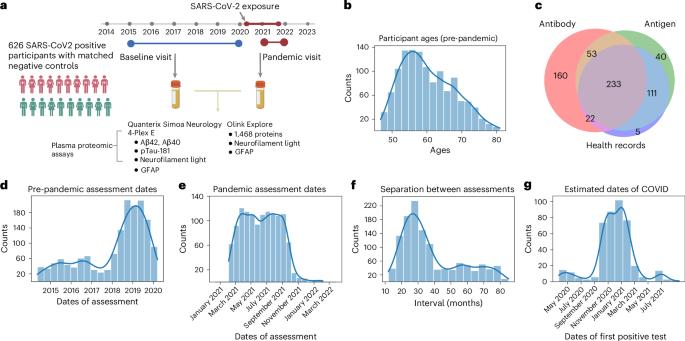
Previous studies have suggested that systemic viral infections may increase risks of dementia. Whether this holds true for severe acute respiratory syndrome coronavirus 2 (SARS-CoV-2) virus infections is unknown. Determining this is important for anticipating the potential future incidence of dementia. To begin to do this, we measured plasma biomarkers linked to Alzheimer’s disease pathology in the UK Biobank before and after serology-confirmed SARS-CoV-2 infections. SARS-CoV-2 infection was associated with biomarkers associated with β-amyloid pathology: reduced plasma Aβ42:Aβ40 ratio and, in more vulnerable participants, lower plasma Aβ42 and higher plasma pTau-181. The plasma biomarker changes were greater in participants who had been hospitalized with COVID-19 or had reported hypertension previously. We showed that the changes in biomarkers were linked to brain structural imaging patterns associated with Alzheimer’s disease, lower cognitive test scores and poorer overall health evaluations. Our data from this post hoc case–control matched study thus provide observational biomarker evidence that SARS-CoV-2 infection can be associated with greater brain β-amyloid pathology in older adults. While these results do not establish causality, they suggest that SARS-CoV-2 (and possibly other systemic inflammatory diseases) may increase the risk of future Alzheimer’s disease. Blood biomarkers in a middle-aged population suggest that SARS-CoV-2 infection is associated with greater brain β-amyloid plaque accumulation.
期刊介绍:
Nature Medicine is a monthly journal publishing original peer-reviewed research in all areas of medicine. The publication focuses on originality, timeliness, interdisciplinary interest, and the impact on improving human health. In addition to research articles, Nature Medicine also publishes commissioned content such as News, Reviews, and Perspectives. This content aims to provide context for the latest advances in translational and clinical research, reaching a wide audience of M.D. and Ph.D. readers. All editorial decisions for the journal are made by a team of full-time professional editors.
Nature Medicine consider all types of clinical research, including:
-Case-reports and small case series
-Clinical trials, whether phase 1, 2, 3 or 4
-Observational studies
-Meta-analyses
-Biomarker studies
-Public and global health studies
Nature Medicine is also committed to facilitating communication between translational and clinical researchers. As such, we consider “hybrid” studies with preclinical and translational findings reported alongside data from clinical studies.



 京公网安备 11010802042870号
京ICP备2023020795号-1
京公网安备 11010802042870号
京ICP备2023020795号-1

 分享
分享
 求助内容:
求助内容: 应助结果提醒方式:
 扫码关注我们
