Dingchang Li, Xianqiang Liu, Wenxing Gao, Wen Zhao, Shuaifei Ji, Sizhe Wang, Jinran Yang, Dingling Li, Zhengyao Chang, Yi Chen, Xu Sun, Jingcheng Zhou, Yanan Jiao, Xiaohui Du, Guanglong Dong
{"title":"An Immune Subtype Classification System Enables the Development of Strategies to Predict and Enhance Immunotherapy Responses in Colorectal Cancer","authors":"Dingchang Li, Xianqiang Liu, Wenxing Gao, Wen Zhao, Shuaifei Ji, Sizhe Wang, Jinran Yang, Dingling Li, Zhengyao Chang, Yi Chen, Xu Sun, Jingcheng Zhou, Yanan Jiao, Xiaohui Du, Guanglong Dong","doi":"10.1158/0008-5472.can-24-2464","DOIUrl":null,"url":null,"abstract":"Colorectal cancer (CRC) is the second leading cause of cancer-related mortality globally. While immunotherapeutic approaches are effective in a subset of CRC patients, the majority of CRC cases receive limited benefits from immunotherapy. This study developed an immune subtype classification system based on diverse immune cells and pathways. A model constructed through machine learning based on immune subtypes could accurately predict the sensitivity of CRC patients to immunotherapy. Validation of this model across public datasets and clinical samples confirmed its high precision and reliability. Furthermore, drug screening based on the immune subtypes identified the IGF1R inhibitor I-OMe-AG-538 (AG-538) as a potent enhancer of antitumor immunity. Mechanistic investigations revealed that AG-538 induced reactive oxygen species (ROS)-dependent DNA damage and downregulated the expression of multiple repair genes, triggering cGAS/STING-mediated type I IFN signaling within tumor cells. This signaling cascade increased tumor immunogenicity and refined the tumor immune microenvironment, thereby enhancing efficacy of immune checkpoint blockade treatment. In summary, these findings present a predictive model for immune response and highlight the potential of AG-538 combined with anti-PD1 antibodies as a chemoimmunotherapeutic strategy.","PeriodicalId":9441,"journal":{"name":"Cancer research","volume":"16 1","pages":""},"PeriodicalIF":16.6000,"publicationDate":"2025-01-29","publicationTypes":"Journal Article","fieldsOfStudy":null,"isOpenAccess":false,"openAccessPdf":"","citationCount":"0","resultStr":null,"platform":"Semanticscholar","paperid":null,"PeriodicalName":"Cancer research","FirstCategoryId":"3","ListUrlMain":"https://doi.org/10.1158/0008-5472.can-24-2464","RegionNum":1,"RegionCategory":"医学","ArticlePicture":[],"TitleCN":null,"AbstractTextCN":null,"PMCID":null,"EPubDate":"","PubModel":"","JCR":"Q1","JCRName":"ONCOLOGY","Score":null,"Total":0}
引用次数: 0
Abstract
Colorectal cancer (CRC) is the second leading cause of cancer-related mortality globally. While immunotherapeutic approaches are effective in a subset of CRC patients, the majority of CRC cases receive limited benefits from immunotherapy. This study developed an immune subtype classification system based on diverse immune cells and pathways. A model constructed through machine learning based on immune subtypes could accurately predict the sensitivity of CRC patients to immunotherapy. Validation of this model across public datasets and clinical samples confirmed its high precision and reliability. Furthermore, drug screening based on the immune subtypes identified the IGF1R inhibitor I-OMe-AG-538 (AG-538) as a potent enhancer of antitumor immunity. Mechanistic investigations revealed that AG-538 induced reactive oxygen species (ROS)-dependent DNA damage and downregulated the expression of multiple repair genes, triggering cGAS/STING-mediated type I IFN signaling within tumor cells. This signaling cascade increased tumor immunogenicity and refined the tumor immune microenvironment, thereby enhancing efficacy of immune checkpoint blockade treatment. In summary, these findings present a predictive model for immune response and highlight the potential of AG-538 combined with anti-PD1 antibodies as a chemoimmunotherapeutic strategy.
期刊介绍:
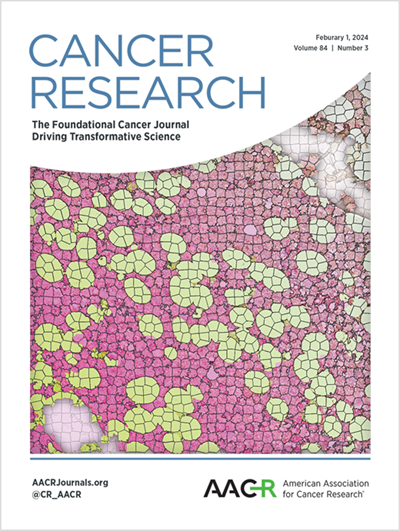
Cancer Research, published by the American Association for Cancer Research (AACR), is a journal that focuses on impactful original studies, reviews, and opinion pieces relevant to the broad cancer research community. Manuscripts that present conceptual or technological advances leading to insights into cancer biology are particularly sought after. The journal also places emphasis on convergence science, which involves bridging multiple distinct areas of cancer research.
With primary subsections including Cancer Biology, Cancer Immunology, Cancer Metabolism and Molecular Mechanisms, Translational Cancer Biology, Cancer Landscapes, and Convergence Science, Cancer Research has a comprehensive scope. It is published twice a month and has one volume per year, with a print ISSN of 0008-5472 and an online ISSN of 1538-7445.
Cancer Research is abstracted and/or indexed in various databases and platforms, including BIOSIS Previews (R) Database, MEDLINE, Current Contents/Life Sciences, Current Contents/Clinical Medicine, Science Citation Index, Scopus, and Web of Science.



 京公网安备 11010802042870号
京ICP备2023020795号-1
京公网安备 11010802042870号
京ICP备2023020795号-1

 分享
分享
 求助内容:
求助内容: 应助结果提醒方式:
 扫码关注我们
