Yan Huang, Kensuke Igarashi, Laiyan Liu, Daisuke Mayumi, Tomomi Ujiie, Lin Fu, Min Yang, Yahai Lu, Lei Cheng, Souichiro Kato, Masaru K. Nobu
{"title":"Methanol transfer supports metabolic syntrophy between bacteria and archaea","authors":"Yan Huang, Kensuke Igarashi, Laiyan Liu, Daisuke Mayumi, Tomomi Ujiie, Lin Fu, Min Yang, Yahai Lu, Lei Cheng, Souichiro Kato, Masaru K. Nobu","doi":"10.1038/s41586-024-08491-w","DOIUrl":null,"url":null,"abstract":"In subsurface methanogenic ecosystems, the ubiquity of methylated-compound-using archaea—methylotrophic methanogens1–4—implies that methylated compounds have an important role in the ecology and carbon cycling of such habitats. However, the origin of these chemicals remains unclear5,6 as there are no known energy metabolisms that generate methylated compounds de novo as a major product. Here we identified an energy metabolism in the subsurface-derived thermophilic anaerobe Zhaonella formicivorans7 that catalyses the conversion of formate to methanol, thereby producing methanol without requiring methylated compounds as an input. Cultivation experiments showed that formate-driven methanologenesis is inhibited by the accumulation of methanol. However, this limitation can be overcome through methanol consumption by a methylotrophic partner methanogen, Methermicoccus shengliensis. This symbiosis represents a fourth mode of mutualistic cross-feeding driven by thermodynamic necessity (syntrophy), previously thought to rely on transfer of hydrogen, formate or electrons8–10. The unusual metabolism and syntrophy provide insights into the enigmatic presence of methylated compounds in subsurface methanogenic ecosystems and demonstrate how organisms survive at the thermodynamic limit through metabolic symbiosis. Zhaonella formicivorans produces methanol, for a novel syntrophic interaction, without requiring methylated compounds as an input.","PeriodicalId":18787,"journal":{"name":"Nature","volume":"639 8053","pages":"190-195"},"PeriodicalIF":48.5000,"publicationDate":"2025-01-29","publicationTypes":"Journal Article","fieldsOfStudy":null,"isOpenAccess":false,"openAccessPdf":"","citationCount":"0","resultStr":null,"platform":"Semanticscholar","paperid":null,"PeriodicalName":"Nature","FirstCategoryId":"103","ListUrlMain":"https://www.nature.com/articles/s41586-024-08491-w","RegionNum":1,"RegionCategory":"综合性期刊","ArticlePicture":[],"TitleCN":null,"AbstractTextCN":null,"PMCID":null,"EPubDate":"","PubModel":"","JCR":"Q1","JCRName":"MULTIDISCIPLINARY SCIENCES","Score":null,"Total":0}
引用次数: 0
Abstract
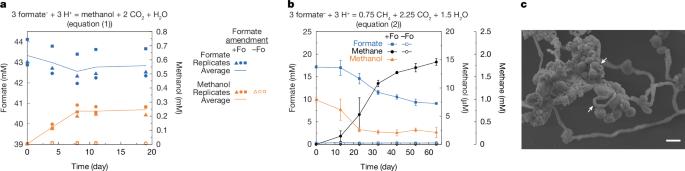
In subsurface methanogenic ecosystems, the ubiquity of methylated-compound-using archaea—methylotrophic methanogens1–4—implies that methylated compounds have an important role in the ecology and carbon cycling of such habitats. However, the origin of these chemicals remains unclear5,6 as there are no known energy metabolisms that generate methylated compounds de novo as a major product. Here we identified an energy metabolism in the subsurface-derived thermophilic anaerobe Zhaonella formicivorans7 that catalyses the conversion of formate to methanol, thereby producing methanol without requiring methylated compounds as an input. Cultivation experiments showed that formate-driven methanologenesis is inhibited by the accumulation of methanol. However, this limitation can be overcome through methanol consumption by a methylotrophic partner methanogen, Methermicoccus shengliensis. This symbiosis represents a fourth mode of mutualistic cross-feeding driven by thermodynamic necessity (syntrophy), previously thought to rely on transfer of hydrogen, formate or electrons8–10. The unusual metabolism and syntrophy provide insights into the enigmatic presence of methylated compounds in subsurface methanogenic ecosystems and demonstrate how organisms survive at the thermodynamic limit through metabolic symbiosis. Zhaonella formicivorans produces methanol, for a novel syntrophic interaction, without requiring methylated compounds as an input.
期刊介绍:
Nature is a prestigious international journal that publishes peer-reviewed research in various scientific and technological fields. The selection of articles is based on criteria such as originality, importance, interdisciplinary relevance, timeliness, accessibility, elegance, and surprising conclusions. In addition to showcasing significant scientific advances, Nature delivers rapid, authoritative, insightful news, and interpretation of current and upcoming trends impacting science, scientists, and the broader public. The journal serves a dual purpose: firstly, to promptly share noteworthy scientific advances and foster discussions among scientists, and secondly, to ensure the swift dissemination of scientific results globally, emphasizing their significance for knowledge, culture, and daily life.



 京公网安备 11010802042870号
京ICP备2023020795号-1
京公网安备 11010802042870号
京ICP备2023020795号-1

 分享
分享
 求助内容:
求助内容: 应助结果提醒方式:
 扫码关注我们
