Zhuolin Shi, Yuwen Wang, Rong Zhang, Hanshu Li, Rui Cai, Jinguo Wu, Xin Wang, Hechuan Li, Xuezhao Li and Cheng He
{"title":"Confining Cu(i) ions within an Ir(iii)-based twin-cavity cage for photo-triggered dioxygen activation toward C(sp3)–H oxidation†","authors":"Zhuolin Shi, Yuwen Wang, Rong Zhang, Hanshu Li, Rui Cai, Jinguo Wu, Xin Wang, Hechuan Li, Xuezhao Li and Cheng He","doi":"10.1039/D5QI00091B","DOIUrl":null,"url":null,"abstract":"<p >Efficient activation of dioxygen (O<small><sub>2</sub></small>) under mild and environmentally friendly conditions remains a challenging yet crucial area of research in chemistry. In this study, we present a simple yet effective approach for O<small><sub>2</sub></small> activation under 450 nm light irradiation by rationally modulating the coordination environment of Cu(<small>I</small>) ions and incorporating a photoactive Ir(<small>III</small>) module into a supramolecular system, leading to efficient C(sp<small><sup>3</sup></small>)−H photo-oxidation of <em>N</em>-aryl tetrahydroisoquinolines. The hexaformyl end-capped <em>fac</em>-Ir(ppy)<small><sub>3</sub></small> module (<strong>1</strong>), the Ir(<small>III</small>)-based twin-cavity cage (<strong>2</strong>), and the supramolecular <strong>Cu<small><sub>2</sub></small>@2</strong> entity—where two Cu(<small>I</small>) ions are coordinated within cage <strong>2</strong>—were comprehensively characterized using NMR, HR-MS, and X-ray crystallography. The confined cavities of <strong>2</strong> effectively trap Cu(<small>I</small>) ions, protecting them from oxidation by O<small><sub>2</sub></small>. Mechanistic studies reveal that photoinduced singlet oxygen (<small><sup>1</sup></small>O<small><sub>2</sub></small>), generated by the <em>fac</em>-Ir(ppy)<small><sub>3</sub></small> module, activates Cu(<small>I</small>) to generate superoxide radical (O<small><sub>2</sub></small>˙<small><sup>−</sup></small>) species. Importantly, the Cu(<small>I</small>) redox-active state is regenerated through electron transfer from the photoexcited *Ir(<small>III</small>) state to the resulting Cu(<small>II</small>) ions. This study introduces a gradual and controlled energy/electron delivery mechanism from Ir(<small>III</small>) module to O<small><sub>2</sub></small> and the Cu centres, offering an advanced supramolecular strategy for photo-induced O<small><sub>2</sub></small> activation in oxidation reactions.</p>","PeriodicalId":79,"journal":{"name":"Inorganic Chemistry Frontiers","volume":" 6","pages":" 2515-2523"},"PeriodicalIF":6.2000,"publicationDate":"2025-01-30","publicationTypes":"Journal Article","fieldsOfStudy":null,"isOpenAccess":false,"openAccessPdf":"","citationCount":"0","resultStr":null,"platform":"Semanticscholar","paperid":null,"PeriodicalName":"Inorganic Chemistry Frontiers","FirstCategoryId":"92","ListUrlMain":"https://pubs.rsc.org/en/content/articlelanding/2025/qi/d5qi00091b","RegionNum":1,"RegionCategory":"化学","ArticlePicture":[],"TitleCN":null,"AbstractTextCN":null,"PMCID":null,"EPubDate":"","PubModel":"","JCR":"Q1","JCRName":"CHEMISTRY, INORGANIC & NUCLEAR","Score":null,"Total":0}
引用次数: 0
Abstract
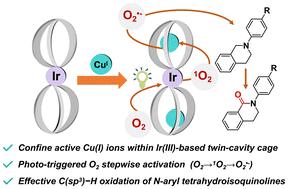
Efficient activation of dioxygen (O2) under mild and environmentally friendly conditions remains a challenging yet crucial area of research in chemistry. In this study, we present a simple yet effective approach for O2 activation under 450 nm light irradiation by rationally modulating the coordination environment of Cu(I) ions and incorporating a photoactive Ir(III) module into a supramolecular system, leading to efficient C(sp3)−H photo-oxidation of N-aryl tetrahydroisoquinolines. The hexaformyl end-capped fac-Ir(ppy)3 module (1), the Ir(III)-based twin-cavity cage (2), and the supramolecular Cu2@2 entity—where two Cu(I) ions are coordinated within cage 2—were comprehensively characterized using NMR, HR-MS, and X-ray crystallography. The confined cavities of 2 effectively trap Cu(I) ions, protecting them from oxidation by O2. Mechanistic studies reveal that photoinduced singlet oxygen (1O2), generated by the fac-Ir(ppy)3 module, activates Cu(I) to generate superoxide radical (O2˙−) species. Importantly, the Cu(I) redox-active state is regenerated through electron transfer from the photoexcited *Ir(III) state to the resulting Cu(II) ions. This study introduces a gradual and controlled energy/electron delivery mechanism from Ir(III) module to O2 and the Cu centres, offering an advanced supramolecular strategy for photo-induced O2 activation in oxidation reactions.




 京公网安备 11010802042870号
京ICP备2023020795号-1
京公网安备 11010802042870号
京ICP备2023020795号-1

 分享
分享
 求助内容:
求助内容: 应助结果提醒方式:
 扫码关注我们
